 Add to Chrome
 Add to Firefox
 Add to Edge
See More, Think Deeper: Query-Expanded Visual Evidence and Answer-Clue Guided Reflection for Long Video Understanding
Jun 08, 2026
Recent advances in Video Large Language Models (Video-LLMs) have enabled performance on long-video understanding tasks. However, existing methods still face two key limitations: evidence acquisition often relies on a single search intent, and answer generation lacks an effective visual feedback mechanism. To address these limitations, we propose \textbf{CoVER}, a Comprehensive Visual Evidence and Reflection framework for long-video understanding. CoVER enables Video-LLMs to \textbf{See More} by dynamically gathering query-expanded visual evidence, and \textbf{Think Deeper} by verifying draft answers with effective answer-specific visual feedback. Together, these mechanisms shift long-video understanding from answer-centric generation to evidence-centric and visually verifiable reasoning. Experimental results show that CoVER-7B substantially outperforms models with the same parameter scale and even surpasses state-of-the-art closed-source models on certain metrics.

SceneSelect: Selective Learning for Trajectory Scene Classification and Expert Scheduling
Apr 27, 2026Accurate trajectory prediction is fundamentally challenging due to high scene heterogeneity - the severe variance in motion velocity, spatial density, and interaction patterns across different real-world environments. However, most existing approaches typically train a single unified model, expecting a fixed-capacity architecture to generalize universally across all possible scenarios. This conventional model-centric paradigm is fundamentally flawed when confronting such extreme heterogeneity, inevitably leading to a severe generalization gap, degraded accuracy, and massive computational waste. To overcome this bottleneck, rather than refining restricted model-centric architectures, we propose selective learning, a novel scene-centric paradigm. It explicitly analyzes the characteristics of the underlying scene to dynamically route inputs to the most appropriate expert models. As a concrete implementation of this paradigm, we introduce SceneSelect. Specifically, SceneSelect utilizes unsupervised clustering on interpretable geometric and kinematic features to discover a latent scene taxonomy. A highly decoupled classification module is then trained to assign real-time inputs to these scene categories, and a highly extensible, plug-and-play scheduling policy automatically dispatches the trajectory sequence to the optimal expert predictor. Crucially, this decoupled design ensures excellent generalization capabilities, allowing seamless integration with different off-the-shelf models and robust adaptation across new datasets without requiring computationally expensive joint retraining. Extensive experiments on three public benchmarks (ETH-UCY, SDD, and NBA) demonstrate that our method consistently outperforms strong single-model and ensemble baselines, achieving an average improvement of 10.5%, showcasing the effectiveness of scene-aware selective learning.
LAMM-ViT: AI Face Detection via Layer-Aware Modulation of Region-Guided Attention
May 12, 2025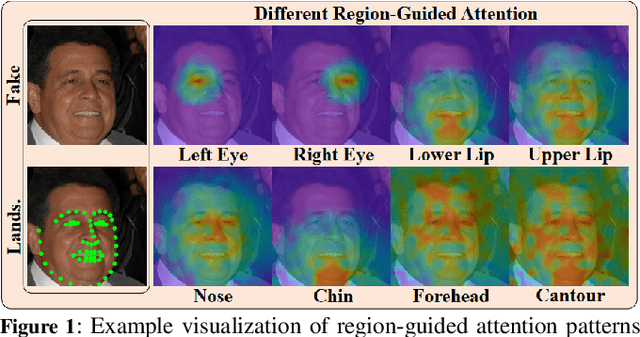
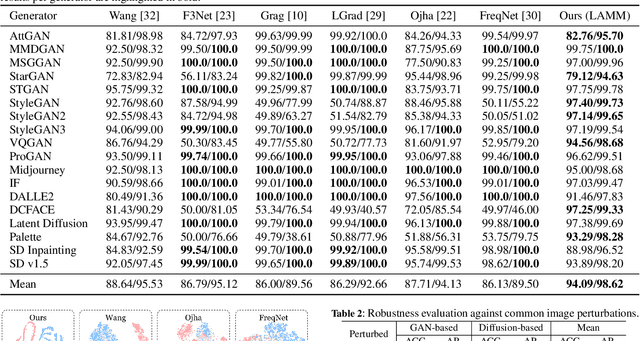
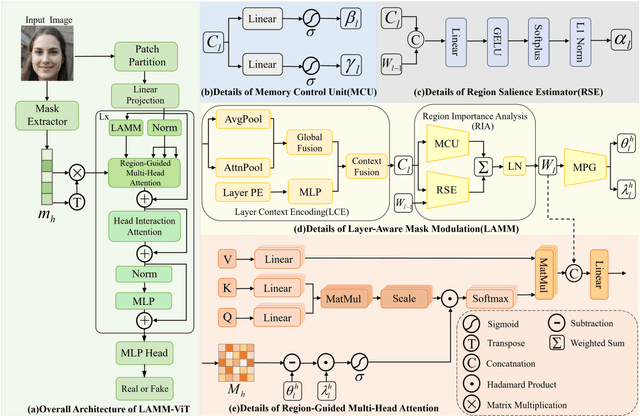
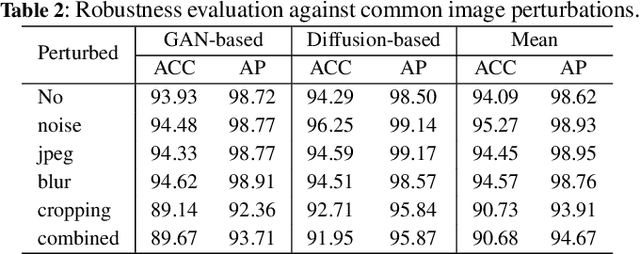
Detecting AI-synthetic faces presents a critical challenge: it is hard to capture consistent structural relationships between facial regions across diverse generation techniques. Current methods, which focus on specific artifacts rather than fundamental inconsistencies, often fail when confronted with novel generative models. To address this limitation, we introduce Layer-aware Mask Modulation Vision Transformer (LAMM-ViT), a Vision Transformer designed for robust facial forgery detection. This model integrates distinct Region-Guided Multi-Head Attention (RG-MHA) and Layer-aware Mask Modulation (LAMM) components within each layer. RG-MHA utilizes facial landmarks to create regional attention masks, guiding the model to scrutinize architectural inconsistencies across different facial areas. Crucially, the separate LAMM module dynamically generates layer-specific parameters, including mask weights and gating values, based on network context. These parameters then modulate the behavior of RG-MHA, enabling adaptive adjustment of regional focus across network depths. This architecture facilitates the capture of subtle, hierarchical forgery cues ubiquitous among diverse generation techniques, such as GANs and Diffusion Models. In cross-model generalization tests, LAMM-ViT demonstrates superior performance, achieving 94.09% mean ACC (a +5.45% improvement over SoTA) and 98.62% mean AP (a +3.09% improvement). These results demonstrate LAMM-ViT's exceptional ability to generalize and its potential for reliable deployment against evolving synthetic media threats.