 Add to Chrome
 Add to Firefox
 Add to Edge
Open-Set Visual Text Forensics via Sparse-Constraint Rectified Flow
Aug 03, 2026
Rapidly evolving Generative AI enables sophisticated visual text manipulations that increasingly evade current forensic detectors. Existing discriminative models often overfit specific forgery patterns, limiting their generalization to unseen, open-set attacks. To address this challenge, we propose a generative detector that localizes tampering by estimating the local restoration cost required to align a query image with authentic visual-text statistics, rather than by learning forgery-specific decision boundaries. Specifically, we introduce Sparse-Constraint Rectified Flow (SC-RF), a detector-oriented adaptation of Flow Matching for spatially sparse anomaly localization. We further mitigate data scarcity via self-supervised Artifact Injection and preserve high-frequency forensic traces using a pixel-space Forensic-DiT. Extensive experiments on three benchmarks show that our method achieves state-of-the-art performance, surpassing the runner-up by 3.2 and 4.8 percentage points in F1 and IoU, respectively. In particular, the proposed detector demonstrates strong zero-shot performance on challenging unseen text editing patterns. We further provide an auxiliary stress-test analysis showing that local harmonization produced by our model can weaken the statistical cues relied upon by existing detectors, offering a complementary vulnerability-analysis perspective.

A Sketch+Text Composed Image Retrieval Dataset for Thangka
Feb 09, 2026Composed Image Retrieval (CIR) enables image retrieval by combining multiple query modalities, but existing benchmarks predominantly focus on general-domain imagery and rely on reference images with short textual modifications. As a result, they provide limited support for retrieval scenarios that require fine-grained semantic reasoning, structured visual understanding, and domain-specific knowledge. In this work, we introduce CIRThan, a sketch+text Composed Image Retrieval dataset for Thangka imagery, a culturally grounded and knowledge-specific visual domain characterized by complex structures, dense symbolic elements, and domain-dependent semantic conventions. CIRThan contains 2,287 high-quality Thangka images, each paired with a human-drawn sketch and hierarchical textual descriptions at three semantic levels, enabling composed queries that jointly express structural intent and multi-level semantic specification. We provide standardized data splits, comprehensive dataset analysis, and benchmark evaluations of representative supervised and zero-shot CIR methods. Experimental results reveal that existing CIR approaches, largely developed for general-domain imagery, struggle to effectively align sketch-based abstractions and hierarchical textual semantics with fine-grained Thangka images, particularly without in-domain supervision. We believe CIRThan offers a valuable benchmark for advancing sketch+text CIR, hierarchical semantic modeling, and multimodal retrieval in cultural heritage and other knowledge-specific visual domains. The dataset is publicly available at https://github.com/jinyuxu-whut/CIRThan.
LAMM-ViT: AI Face Detection via Layer-Aware Modulation of Region-Guided Attention
May 12, 2025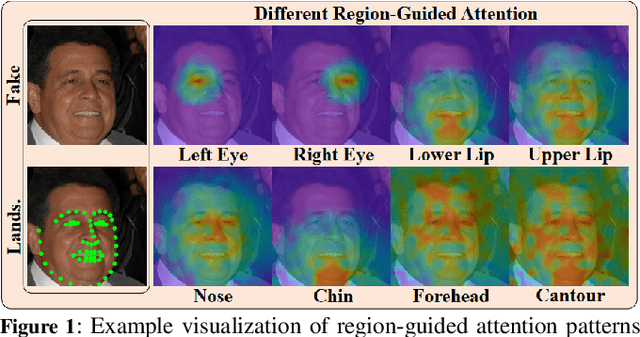
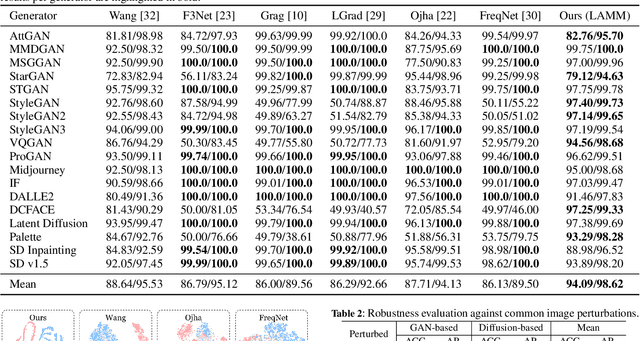
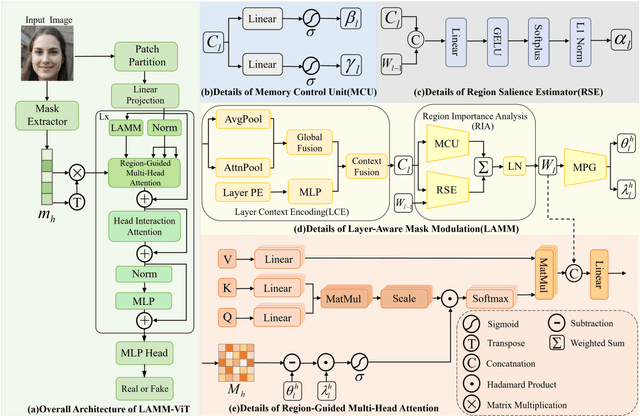
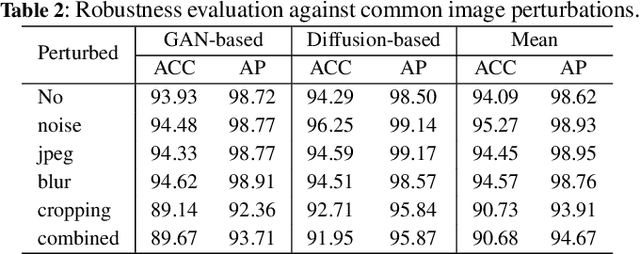
Detecting AI-synthetic faces presents a critical challenge: it is hard to capture consistent structural relationships between facial regions across diverse generation techniques. Current methods, which focus on specific artifacts rather than fundamental inconsistencies, often fail when confronted with novel generative models. To address this limitation, we introduce Layer-aware Mask Modulation Vision Transformer (LAMM-ViT), a Vision Transformer designed for robust facial forgery detection. This model integrates distinct Region-Guided Multi-Head Attention (RG-MHA) and Layer-aware Mask Modulation (LAMM) components within each layer. RG-MHA utilizes facial landmarks to create regional attention masks, guiding the model to scrutinize architectural inconsistencies across different facial areas. Crucially, the separate LAMM module dynamically generates layer-specific parameters, including mask weights and gating values, based on network context. These parameters then modulate the behavior of RG-MHA, enabling adaptive adjustment of regional focus across network depths. This architecture facilitates the capture of subtle, hierarchical forgery cues ubiquitous among diverse generation techniques, such as GANs and Diffusion Models. In cross-model generalization tests, LAMM-ViT demonstrates superior performance, achieving 94.09% mean ACC (a +5.45% improvement over SoTA) and 98.62% mean AP (a +3.09% improvement). These results demonstrate LAMM-ViT's exceptional ability to generalize and its potential for reliable deployment against evolving synthetic media threats.