 Add to Chrome
 Add to Firefox
 Add to Edge
The Label Complexity of Class-Conditional Coverage under Distribution Shift
Jul 20, 2026
Standard evaluation of many recognition systems contains distribution shift by construction, since benchmarks place disjoint conditions in the training and test splits. Under such a shift, split conformal prediction keeps marginal coverage near the nominal level while per-class coverage fails silently: on a real cross-subject skeleton benchmark, marginal coverage stays near ninety percent, the worst action class is covered about seventy percent of the time, and ten of the sixty classes fall below eighty percent coverage. We characterize the cost of restoring per-class validity. First, an impossibility: once the shift acts jointly on the covariates and the labels, the target class-conditional score law is unidentified from source labels and an unlabeled target sample, so no label-free method attains per-class coverage that is at once valid and efficient. Second, we make the cost precise: per-class validity alone needs only a handful of target labels per class, while the label count necessary and sufficient for validity together with per-class efficiency grows as the inverse square of the efficiency tolerance and the logarithm of the number of classes, with matching upper and lower bounds. Third, within the evaluated prediction-powered inference family, even the most favorable use of the classifier's own pseudo-labels on an unbounded unlabeled target pool improves efficiency by at most a small constant factor where coverage collapses. Skeleton action recognition is our real-data case study. A per-class calibration using source labels alone recovers a substantial share of the per-class gap while the shift preserves marginal coverage, and stops helping exactly when marginal coverage itself breaks. Three real shifts of increasing severity trace this boundary, and the same collapse and recovery appears on a natural-image corruption benchmark, beyond any single modality.

Decomposing Runtime, Kernel, and Quantization Speedups via a Matched FP16 Intermediate: A Hardware-Conditioned Case Study on Four NVIDIA RTX A5000 GPUs
Jul 13, 2026Reported serving speedups from quantized kernels typically bundle the weight format, the kernel, and the inference runtime into one number. We present an attribution study on four NVIDIA RTX A5000 GPUs, 24 GiB each, on a single host with NVLink-bridged pairs. A matched intermediate stack that keeps the faster runtime without the quantized kernel splits the full speedup into a runtime part and a kernel and quantization part. Under matched greedy decoding the full stack reaches $2.58\times$ end to end, with the runtime change accounting for about two thirds of that gain on a logarithmic scale; across three similar model families the kernel and quantization part moves by at most 1.5%. Sharding one instance across all four cards falls well below doubling: a profiler trace attributes about 80% of the per token shortfall to coordination, and an NVLink versus PCIe control on the same hardware shows similar realized bandwidth on both links, pointing away from link bandwidth as the cause. Whether to run one sharded instance or several independent ones depends on the workload and the model, with the ranking reversing on the larger model: the smaller model splits between sharding and multiple instances by workload, while the larger model favors two paired instances on every workload. Quantization extends sustainable concurrent users roughly four times past a reproducible half precision memory cliff. Differences in sampling mode and prompt pool between the two stacks are documented as threats to validity.
Cognitive Learning of Statistical Primary Patterns via Bayesian Network
Feb 09, 2015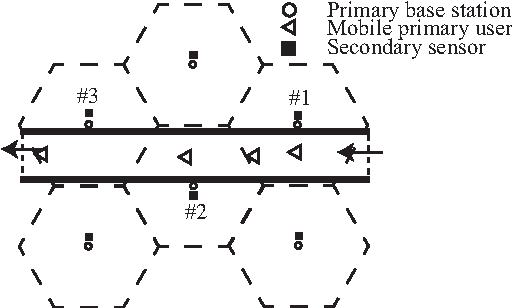
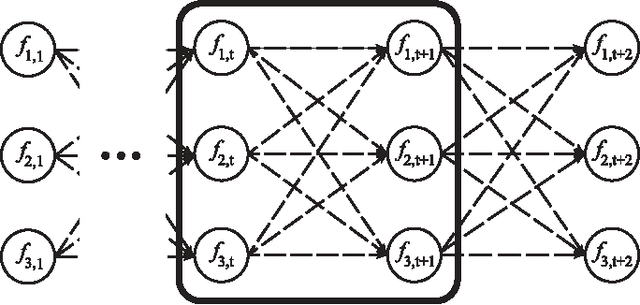
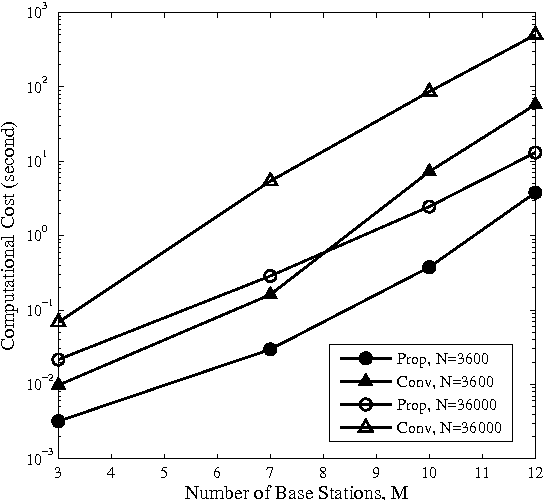
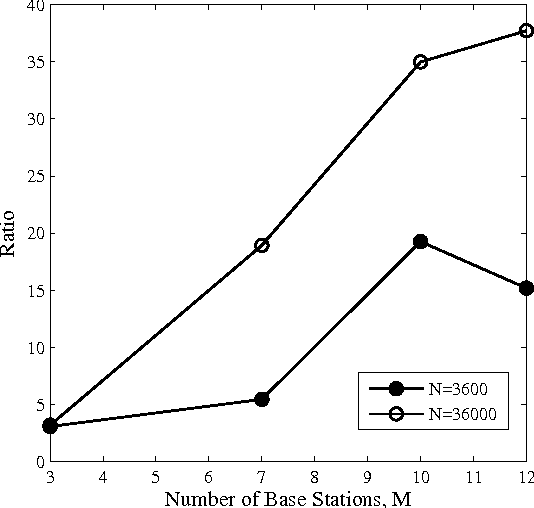
In cognitive radio (CR) technology, the trend of sensing is no longer to only detect the presence of active primary users. A large number of applications demand for more comprehensive knowledge on primary user behaviors in spatial, temporal, and frequency domains. To satisfy such requirements, we study the statistical relationship among primary users by introducing a Bayesian network (BN) based framework. How to learn such a BN structure is a long standing issue, not fully understood even in the statistical learning community. Besides, another key problem in this learning scenario is that the CR has to identify how many variables are in the BN, which is usually considered as prior knowledge in statistical learning applications. To solve such two issues simultaneously, this paper proposes a BN structure learning scheme consisting of an efficient structure learning algorithm and a blind variable identification scheme. The proposed approach incurs significantly lower computational complexity compared with previous ones, and is capable of determining the structure without assuming much prior knowledge about variables. With this result, cognitive users could efficiently understand the statistical pattern of primary networks, such that more efficient cognitive protocols could be designed across different network layers.