 Add to Chrome
 Add to Firefox
 Add to Edge
Adversarial Patch Generation for Visual-Infrared Dense Prediction Tasks via Joint Position-Color Optimization
Feb 27, 2026
Multimodal adversarial attacks for dense prediction remain largely underexplored. In particular, visual-infrared (VI) perception systems introduce unique challenges due to heterogeneous spectral characteristics and modality-specific intensity distributions. Existing adversarial patch methods are primarily designed for single-modal inputs and fail to account for crossspectral inconsistencies, leading to reduced attack effectiveness and poor stealthiness when applied to VI dense prediction models. To address these challenges, we propose a joint position-color optimization framework (AP-PCO) for generating adversarial patches in visual-infrared settings. The proposed method optimizes patch placement and color composition simultaneously using a fitness function derived from model outputs, enabling a single patch to perturb both visible and infrared modalities. To further bridge spectral discrepancies, we introduce a crossmodal color adaptation strategy that constrains patch appearance according to infrared grayscale characteristics while maintaining strong perturbations in the visible domain, thereby reducing cross-spectral saliency. The optimization procedure operates without requiring internal model information, supporting flexible black-box attacks. Extensive experiments on visual-infrared dense prediction tasks demonstrate that the proposed AP-PCO achieves consistently strong attack performance across multiple architectures, providing a practical benchmark for robustness evaluation in VI perception systems.

FusionCounting: Robust visible-infrared image fusion guided by crowd counting via multi-task learning
Aug 28, 2025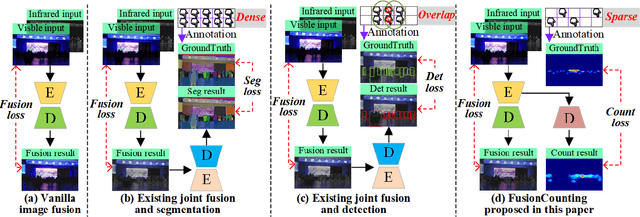

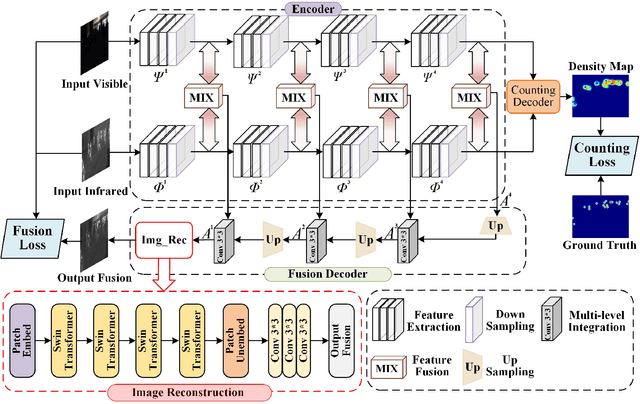
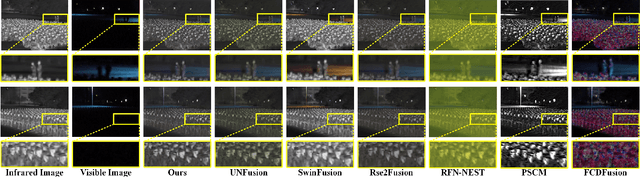
Most visible and infrared image fusion (VIF) methods focus primarily on optimizing fused image quality. Recent studies have begun incorporating downstream tasks, such as semantic segmentation and object detection, to provide semantic guidance for VIF. However, semantic segmentation requires extensive annotations, while object detection, despite reducing annotation efforts compared with segmentation, faces challenges in highly crowded scenes due to overlapping bounding boxes and occlusion. Moreover, although RGB-T crowd counting has gained increasing attention in recent years, no studies have integrated VIF and crowd counting into a unified framework. To address these challenges, we propose FusionCounting, a novel multi-task learning framework that integrates crowd counting into the VIF process. Crowd counting provides a direct quantitative measure of population density with minimal annotation, making it particularly suitable for dense scenes. Our framework leverages both input images and population density information in a mutually beneficial multi-task design. To accelerate convergence and balance tasks contributions, we introduce a dynamic loss function weighting strategy. Furthermore, we incorporate adversarial training to enhance the robustness of both VIF and crowd counting, improving the model's stability and resilience to adversarial attacks. Experimental results on public datasets demonstrate that FusionCounting not only enhances image fusion quality but also achieves superior crowd counting performance.