 Add to Chrome
 Add to Firefox
 Add to Edge
Hierarchical Latent Reasoning for LLM-based Recommendation
Jul 30, 2026
Large Language Models (LLMs) have shown strong potential for recommendation by leveraging their semantic understanding and contextual modeling capabilities. Recent studies further introduce reasoning mechanisms to improve user preference modeling. However, explicit natural-language reasoning incurs substantial inference overhead, whereas existing latent reasoning methods mainly focus on generating or verifying intermediate states, leaving their layer-wise preference roles and contributions insufficiently characterized. We propose HiLaR, a Hierarchical Latent Reasoning framework with layer-aware reinforcement optimization for LLM-based recommendation. HiLaR constructs temporal-guided hierarchical user preference representations, aligns them with multiple LLM latent reasoning states, and organizes the reasoning process from broad preferences to fine-grained current intents. To further optimize the reasoning trajectory, HiLaR combines final recommendation feedback with layer-aware process rewards derived from the marginal target-likelihood gain of each state. Experiments on four Amazon benchmark datasets show that HiLaR generally outperforms strong sequential, generative, and LLM-based recommendation baselines. Ablation and sensitivity analyses further verify the contribution of hierarchical representation learning, latent alignment, and process-level optimization. Our code is available in https://github.com/hupeiyu21/HiLaR.

Retrieval-Augmented Multimodal Model for Fake News Detection
Apr 20, 2026In recent years, multimodal multidomain fake news detection has garnered increasing attention. Nevertheless, this direction presents two significant challenges: (1) Failure to Capture Cross-Instance Narrative Consistency: existing models usually evaluate each news in isolation, fail to capture cross-instance narrative consistency, and thus struggle to address the spread of cluster based fake news driven by social media; (2) Lack of Domain Specific Knowledge for Reasoning: conventional models, which rely solely on knowledge encoded in their parameters during training, struggle to generalize to new or data-scarce domains (e.g., emerging events or niche topics). To tackle these challenges, we introduce Retrieval-Augmented Multimodal Model for Fake News Detection (RAMM). First, RAMM employs a Multimodal Large Language Model (MLLM) as its backbone to capture cross-modal semantic information from news samples. Second, RAMM incorporates an Abstract Narrative Alignment Module. This component adaptively extracts abstract narrative consistency from diverse instances across distinct domains, aggregates relevant knowledge, and thereby enables the modeling of high-level narrative information. Finally, RAMM introduces a Semantic Representation Alignment Module, which aligns the model's decision-making paradigm with that of humans - specifically, it shifts the model's reasoning process from direct inference on multimodal features to an instance-based analogical reasoning process. Extensive experimental results on three public datasets validate the efficacy of our proposed approach. Our code is available at the following link: https://github.com/li-yiheng/RAMM
Multi-Modal Multi-Behavior Sequential Recommendation with Conditional Diffusion-Based Feature Denoising
Aug 07, 2025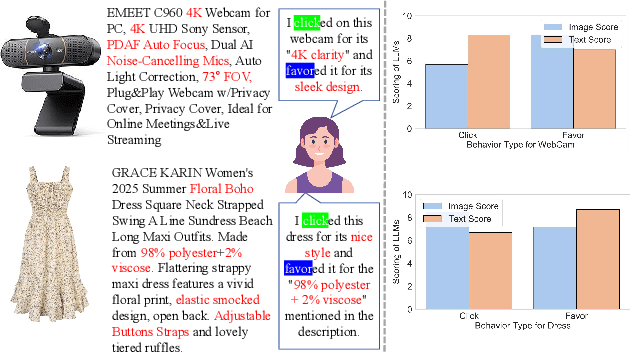

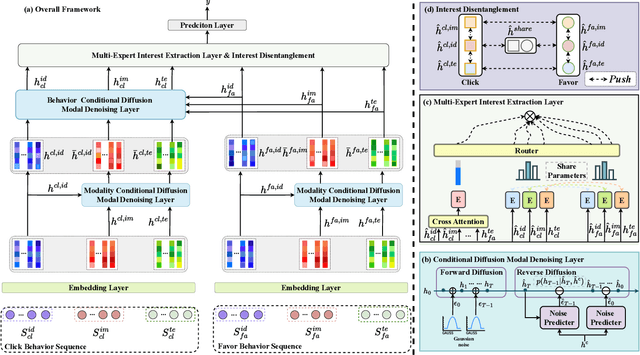
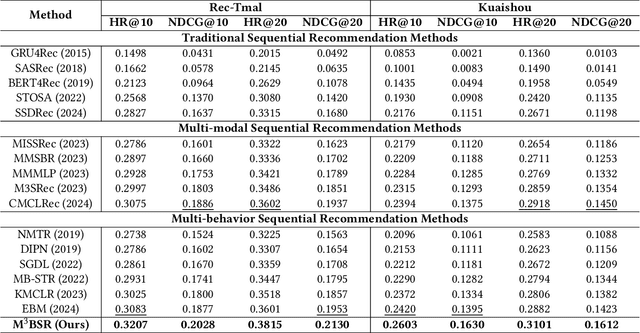
The sequential recommendation system utilizes historical user interactions to predict preferences. Effectively integrating diverse user behavior patterns with rich multimodal information of items to enhance the accuracy of sequential recommendations is an emerging and challenging research direction. This paper focuses on the problem of multi-modal multi-behavior sequential recommendation, aiming to address the following challenges: (1) the lack of effective characterization of modal preferences across different behaviors, as user attention to different item modalities varies depending on the behavior; (2) the difficulty of effectively mitigating implicit noise in user behavior, such as unintended actions like accidental clicks; (3) the inability to handle modality noise in multi-modal representations, which further impacts the accurate modeling of user preferences. To tackle these issues, we propose a novel Multi-Modal Multi-Behavior Sequential Recommendation model (M$^3$BSR). This model first removes noise in multi-modal representations using a Conditional Diffusion Modality Denoising Layer. Subsequently, it utilizes deep behavioral information to guide the denoising of shallow behavioral data, thereby alleviating the impact of noise in implicit feedback through Conditional Diffusion Behavior Denoising. Finally, by introducing a Multi-Expert Interest Extraction Layer, M$^3$BSR explicitly models the common and specific interests across behaviors and modalities to enhance recommendation performance. Experimental results indicate that M$^3$BSR significantly outperforms existing state-of-the-art methods on benchmark datasets.
* SIGIR 2025