 Add to Chrome
 Add to Firefox
 Add to Edge
GAMR: Geometric-Aware Manifold Regularization with Virtual Outlier Synthesis for Learning with Noisy Labels
May 20, 2026
Deep neural networks (DNNs) experience significant performance degradation when processing noisy labels, primarily due to overfitting on mislabeled data. Current mainstream approaches attempt to mitigate this issue by passively filtering clean samples during training. However, simple sample filtering within feature spaces degraded by noise struggles to distinguish between challenging samples and noisy samples, creating a bottleneck for model performance. We highlight for the first time the fundamental importance of actively reshaping feature space geometry for learning from noisy data. We propose a novel Geometry-aware Manifold Regularization Paradigm whose core idea is to explicitly construct energy barriers between data manifolds by actively synthesizing virtual outlier samples. By imposing geometric constraints that promote intra-class compactness and inter-class separation, this approach enhances the discriminability between hard and noisy samples, leading to the learning of more robust representations. Our regularization mechanism exhibits high universality, with effectiveness independent of any prior assumptions about noise patterns. It can be integrated as a standalone mechanism into existing sample selection frameworks, providing stronger robustness against diverse noisy environments. Experiments demonstrate that our paradigm achieves performance surpassing current state-of-the-art (SOTA) methods on multiple benchmarks, including CIFAR-10, with particularly pronounced advantages under more challenging asymmetric noise conditions. Furthermore, this paradigm significantly enhances the model's capability in Out-of-Distribution (OOD) detection, ensuring superior reliability and safety for deployment in open-world scenarios.

Neural Network based Deep Transfer Learning for Cross-domain Dependency Parsing
Aug 08, 2019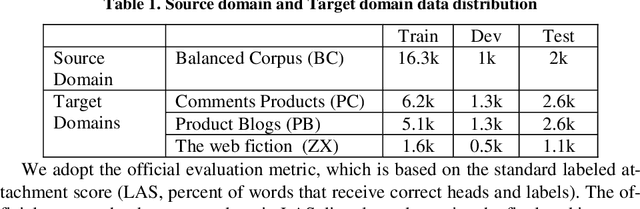
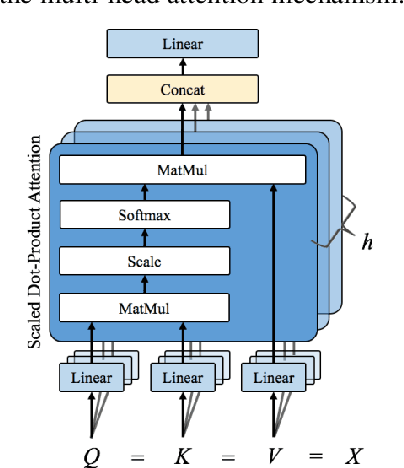
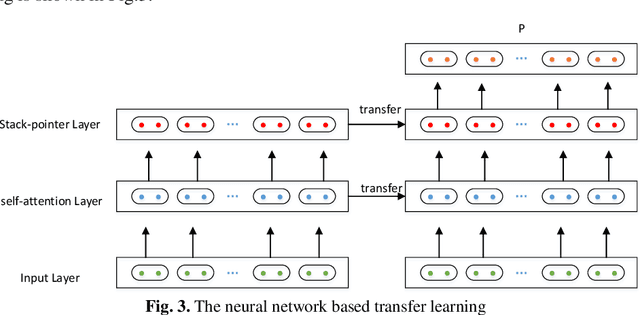
In this paper, we describe the details of the neural dependency parser sub-mitted by our team to the NLPCC 2019 Shared Task of Semi-supervised do-main adaptation subtask on Cross-domain Dependency Parsing. Our system is based on the stack-pointer networks(STACKPTR). Considering the im-portance of context, we utilize self-attention mechanism for the representa-tion vectors to capture the meaning of words. In addition, to adapt three dif-ferent domains, we utilize neural network based deep transfer learning which transfers the pre-trained partial network in the source domain to be a part of deep neural network in the three target domains (product comments, product blogs and web fiction) respectively. Results on the three target domains demonstrate that our model performs competitively.