 Add to Chrome
 Add to Firefox
 Add to Edge
Verication-driven closed-loop multi-agent large language modelframework for code-compliant structural design
Aug 08, 2026
Multi-agent large language model(LLM)systems are applied to structural design,yet most use one-shot generation and cannot verify their output,leaving themill-suited to safety-critical tasks.Rather than trusting LLM self-correction,thisframework injects feedback from an external physics-based verier into a closedrepair loop.The framework couples a three-layernite-element verication systemwith a dual-node loop.Node 1 turns code violations into hard repair constraints,Node 2 turns a four-dimensional quality score into safety-rst soft constraints,and a retrieval-augmented code base makes every violation traceable to a clause.Overve structure types and 44 cases,code compliance rises from 56.8%to 98.6%and the composite score from 63.8 to 71.4(p<0.000001),using about 5.8%lessmaterial.Removing either node degrades performance,and compliance does notchange detectably across the two backbone LLMs tested,indicating that it ishere attributed to the external verier rather than the model.The framework,the 44-case benchmark and all experiment scripts are released as open source forreplicability.

An Item Recommendation Approach by Fusing Images based on Neural Networks
Jul 04, 2019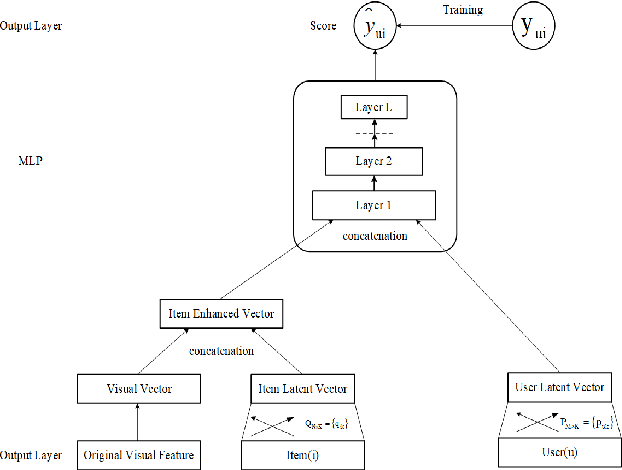
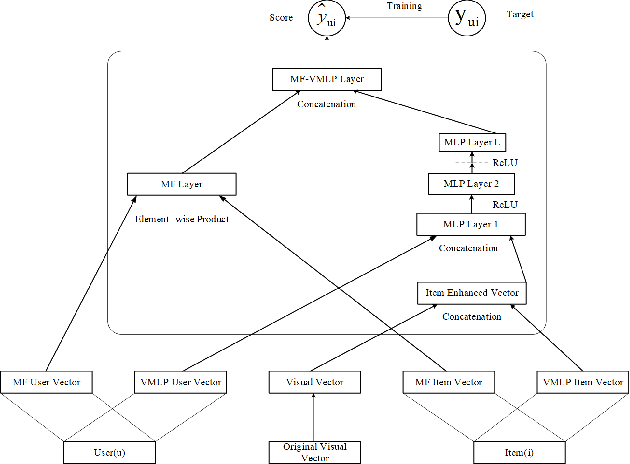
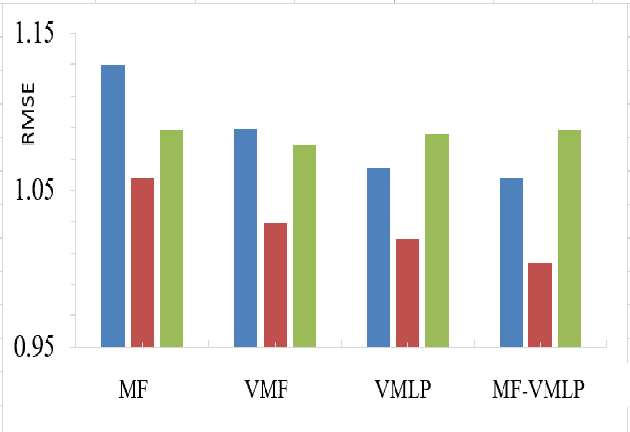
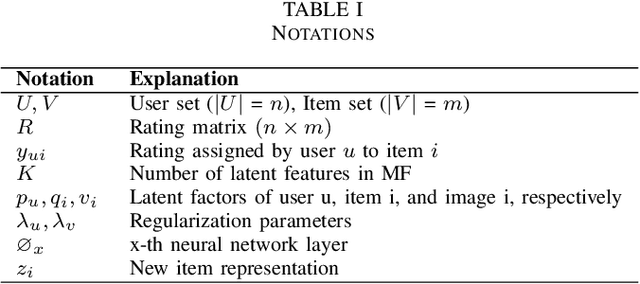
There are rich formats of information in the network, such as rating, text, image, and so on, which represent different aspects of user preferences. In the field of recommendation, how to use those data effectively has become a difficult subject. With the rapid development of neural network, researching on multi-modal method for recommendation has become one of the major directions. In the existing recommender systems, numerical rating, item description and review are main information to be considered by researchers. However, the characteristics of the item may affect the user's preferences, which are rarely used for recommendation models. In this work, we propose a novel model to incorporate visual factors into predictors of people's preferences, namely MF-VMLP, based on the recent developments of neural collaborative filtering (NCF). Firstly, we get visual presentation via a pre-trained convolutional neural network (CNN) model. To obtain the nonlinearities interaction of latent vectors and visual vectors, we propose to leverage a multi-layer perceptron (MLP) to learn. Moreover, the combination of MF and MLP has achieved collaborative filtering recommendation between users and items. Our experiments conduct Amazon's public dataset for experimental validation and root-mean-square error (RMSE) as evaluation metrics. To some extent, experimental result on a real-world data set demonstrates that our model can boost the recommendation performance.