 Add to Chrome
 Add to Firefox
 Add to Edge
Learning Whole-Body Human-Humanoid Interaction from Human-Human Demonstrations
Jan 14, 2026
Enabling humanoid robots to physically interact with humans is a critical frontier, but progress is hindered by the scarcity of high-quality Human-Humanoid Interaction (HHoI) data. While leveraging abundant Human-Human Interaction (HHI) data presents a scalable alternative, we first demonstrate that standard retargeting fails by breaking the essential contacts. We address this with PAIR (Physics-Aware Interaction Retargeting), a contact-centric, two-stage pipeline that preserves contact semantics across morphology differences to generate physically consistent HHoI data. This high-quality data, however, exposes a second failure: conventional imitation learning policies merely mimic trajectories and lack interactive understanding. We therefore introduce D-STAR (Decoupled Spatio-Temporal Action Reasoner), a hierarchical policy that disentangles when to act from where to act. In D-STAR, Phase Attention (when) and a Multi-Scale Spatial module (where) are fused by the diffusion head to produce synchronized whole-body behaviors beyond mimicry. By decoupling these reasoning streams, our model learns robust temporal phases without being distracted by spatial noise, leading to responsive, synchronized collaboration. We validate our framework through extensive and rigorous simulations, demonstrating significant performance gains over baseline approaches and a complete, effective pipeline for learning complex whole-body interactions from HHI data.

Modeling Multiple Normal Action Representations for Error Detection in Procedural Tasks
Apr 02, 2025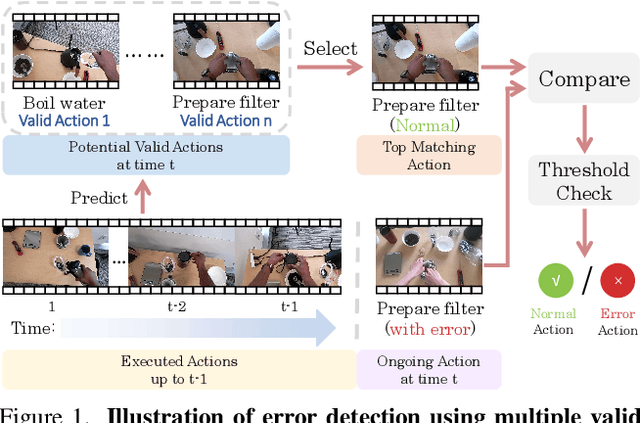
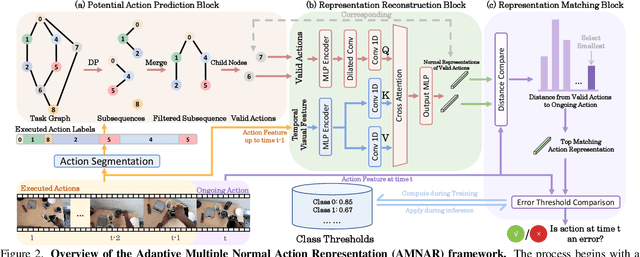
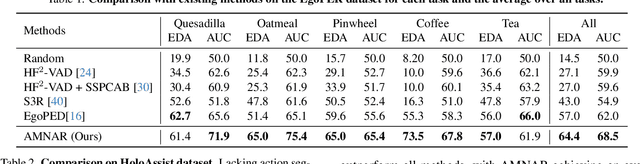
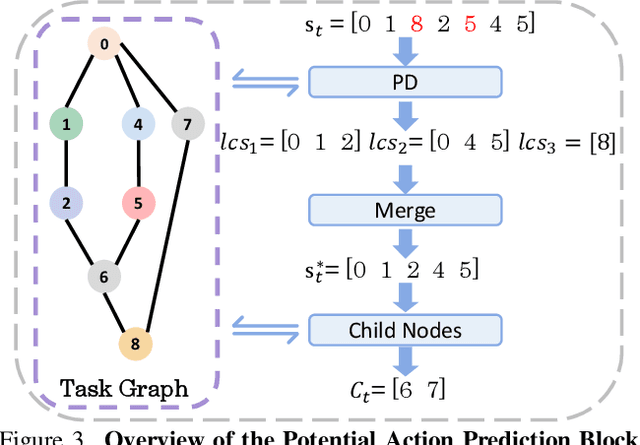
Error detection in procedural activities is essential for consistent and correct outcomes in AR-assisted and robotic systems. Existing methods often focus on temporal ordering errors or rely on static prototypes to represent normal actions. However, these approaches typically overlook the common scenario where multiple, distinct actions are valid following a given sequence of executed actions. This leads to two issues: (1) the model cannot effectively detect errors using static prototypes when the inference environment or action execution distribution differs from training; and (2) the model may also use the wrong prototypes to detect errors if the ongoing action label is not the same as the predicted one. To address this problem, we propose an Adaptive Multiple Normal Action Representation (AMNAR) framework. AMNAR predicts all valid next actions and reconstructs their corresponding normal action representations, which are compared against the ongoing action to detect errors. Extensive experiments demonstrate that AMNAR achieves state-of-the-art performance, highlighting the effectiveness of AMNAR and the importance of modeling multiple valid next actions in error detection. The code is available at https://github.com/iSEE-Laboratory/AMNAR.
EgoExo-Fitness: Towards Egocentric and Exocentric Full-Body Action Understanding
Jun 13, 2024We present EgoExo-Fitness, a new full-body action understanding dataset, featuring fitness sequence videos recorded from synchronized egocentric and fixed exocentric (third-person) cameras. Compared with existing full-body action understanding datasets, EgoExo-Fitness not only contains videos from first-person perspectives, but also provides rich annotations. Specifically, two-level temporal boundaries are provided to localize single action videos along with sub-steps of each action. More importantly, EgoExo-Fitness introduces innovative annotations for interpretable action judgement--including technical keypoint verification, natural language comments on action execution, and action quality scores. Combining all of these, EgoExo-Fitness provides new resources to study egocentric and exocentric full-body action understanding across dimensions of "what", "when", and "how well". To facilitate research on egocentric and exocentric full-body action understanding, we construct benchmarks on a suite of tasks (i.e., action classification, action localization, cross-view sequence verification, cross-view skill determination, and a newly proposed task of guidance-based execution verification), together with detailed analysis. Code and data will be available at https://github.com/iSEE-Laboratory/EgoExo-Fitness/tree/main.