 Add to Chrome
 Add to Firefox
 Add to Edge
CaReTS: A Multi-Task Framework Unifying Classification and Regression for Time Series Forecasting
Nov 12, 2025
Recent advances in deep forecasting models have achieved remarkable performance, yet most approaches still struggle to provide both accurate predictions and interpretable insights into temporal dynamics. This paper proposes CaReTS, a novel multi-task learning framework that combines classification and regression tasks for multi-step time series forecasting problems. The framework adopts a dual-stream architecture, where a classification branch learns the stepwise trend into the future, while a regression branch estimates the corresponding deviations from the latest observation of the target variable. The dual-stream design provides more interpretable predictions by disentangling macro-level trends from micro-level deviations in the target variable. To enable effective learning in output prediction, deviation estimation, and trend classification, we design a multi-task loss with uncertainty-aware weighting to adaptively balance the contribution of each task. Furthermore, four variants (CaReTS1--4) are instantiated under this framework to incorporate mainstream temporal modelling encoders, including convolutional neural networks (CNNs), long short-term memory networks (LSTMs), and Transformers. Experiments on real-world datasets demonstrate that CaReTS outperforms state-of-the-art (SOTA) algorithms in forecasting accuracy, while achieving higher trend classification performance.

A New Self-organizing Interval Type-2 Fuzzy Neural Network for Multi-Step Time Series Prediction
Jul 10, 2024This paper proposes a new self-organizing interval type-2 fuzzy neural network with multiple outputs (SOIT2FNN-MO) for multi-step time series prediction. Differing from the traditional six-layer IT2FNN, a nine-layer network is developed to improve prediction accuracy, uncertainty handling and model interpretability. First, a new co-antecedent layer and a modified consequent layer are devised to improve the interpretability of the fuzzy model for multi-step predictions. Second, a new transformation layer is designed to address the potential issues in the vanished rule firing strength caused by highdimensional inputs. Third, a new link layer is proposed to build temporal connections between multi-step predictions. Furthermore, a two-stage self-organizing mechanism is developed to automatically generate the fuzzy rules, in which the first stage is used to create the rule base from empty and perform the initial optimization, while the second stage is to fine-tune all network parameters. Finally, various simulations are carried out on chaotic and microgrid time series prediction problems, demonstrating the superiority of our approach in terms of prediction accuracy, uncertainty handling and model interpretability.
Enhancing Fake News Detection in Social Media via Label Propagation on Cross-modal Tweet Graph
Jun 14, 2024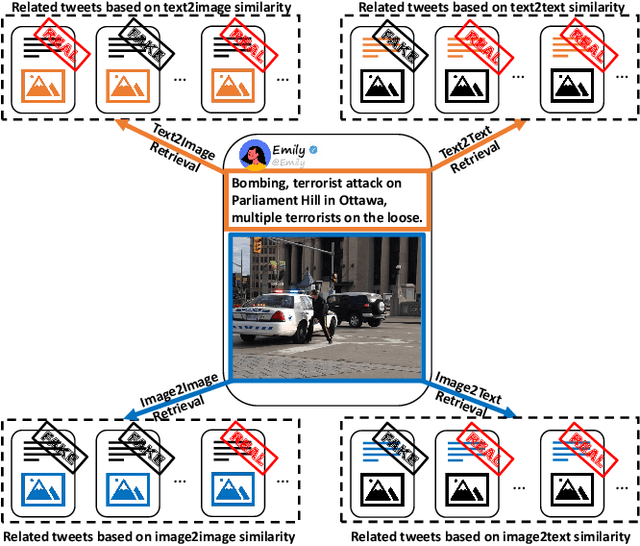
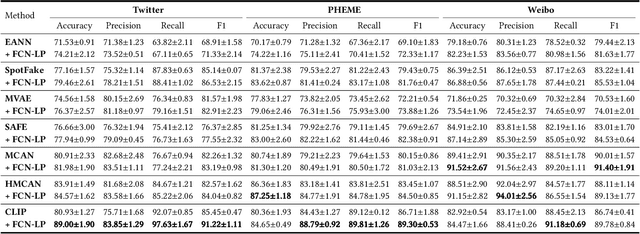
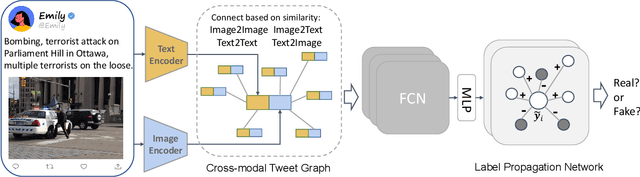

Fake news detection in social media has become increasingly important due to the rapid proliferation of personal media channels and the consequential dissemination of misleading information. Existing methods, which primarily rely on multimodal features and graph-based techniques, have shown promising performance in detecting fake news. However, they still face a limitation, i.e., sparsity in graph connections, which hinders capturing possible interactions among tweets. This challenge has motivated us to explore a novel method that densifies the graph's connectivity to capture denser interaction better. Our method constructs a cross-modal tweet graph using CLIP, which encodes images and text into a unified space, allowing us to extract potential connections based on similarities in text and images. We then design a Feature Contextualization Network with Label Propagation (FCN-LP) to model the interaction among tweets as well as positive or negative correlations between predicted labels of connected tweets. The propagated labels from the graph are weighted and aggregated for the final detection. To enhance the model's generalization ability to unseen events, we introduce a domain generalization loss that ensures consistent features between tweets on seen and unseen events. We use three publicly available fake news datasets, Twitter, PHEME, and Weibo, for evaluation. Our method consistently improves the performance over the state-of-the-art methods on all benchmark datasets and effectively demonstrates its aptitude for generalizing fake news detection in social media.