 Add to Chrome
 Add to Firefox
 Add to Edge
Geometry-Aligned Differential Privacy for Location-Safe Federated Radio Map Construction
Dec 09, 2025
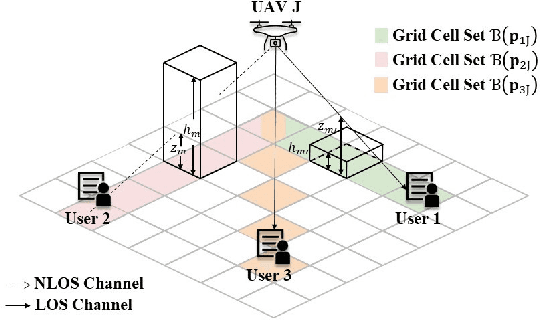
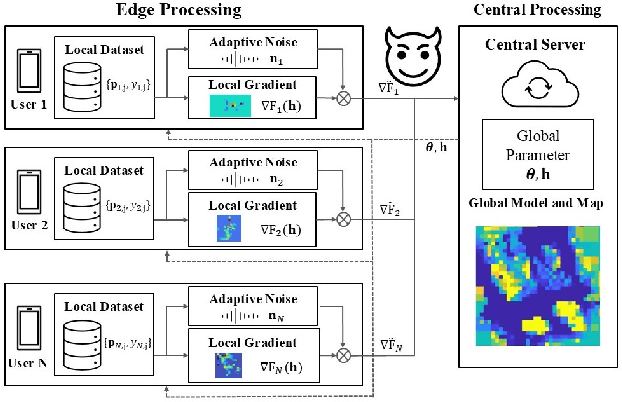
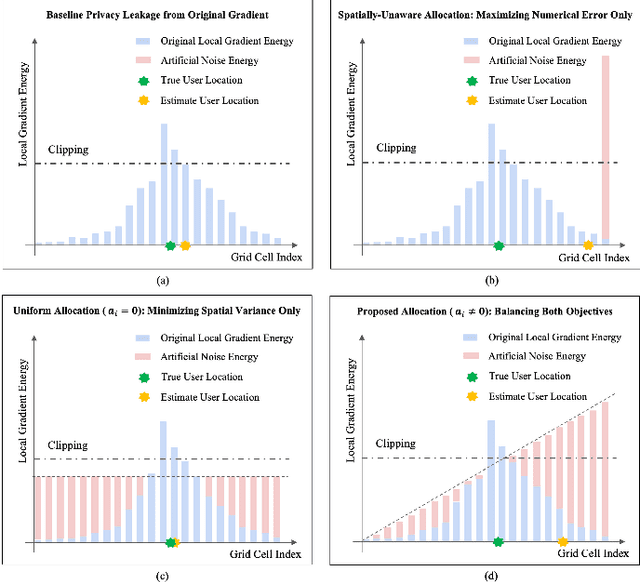
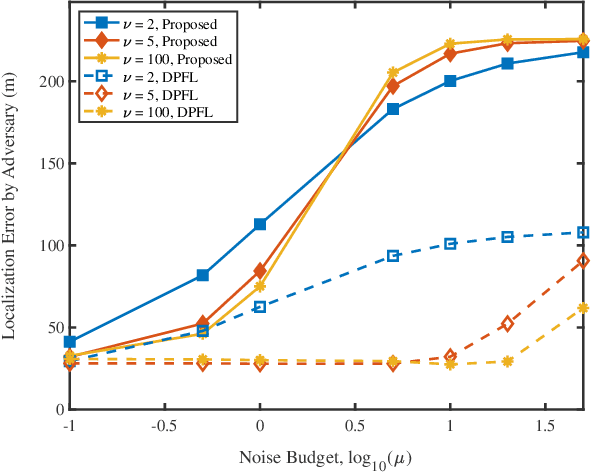
Radio maps that describe spatial variations in wireless signal strength are widely used to optimize networks and support aerial platforms. Their construction requires location-labeled signal measurements from distributed users, raising fundamental concerns about location privacy. Even when raw data are kept local, the shared model updates can reveal user locations through their spatial structure, while naive noise injection either fails to hide this leakage or degrades model accuracy. This work analyzes how location leakage arises from gradients in a virtual-environment radio map model and proposes a geometry-aligned differential privacy mechanism with heterogeneous noise tailored to both confuse localization and cover gradient spatial patterns. The approach is theoretically supported with a convergence guarantee linking privacy strength to learning accuracy. Numerical experiments show the approach increases attacker localization error from 30 m to over 180 m, with only 0.2 dB increase in radio map construction error compared to a uniform-noise baseline.

Diffraction and Scattering Aware Radio Map and Environment Reconstruction using Geometry Model-Assisted Deep Learning
Mar 01, 2024Machine learning (ML) facilitates rapid channel modeling for 5G and beyond wireless communication systems. Many existing ML techniques utilize a city map to construct the radio map; however, an updated city map may not always be available. This paper proposes to employ the received signal strength (RSS) data to jointly construct the radio map and the virtual environment by exploiting the geometry structure of the environment. In contrast to many existing ML approaches that lack of an environment model, we develop a virtual obstacle model and characterize the geometry relation between the propagation paths and the virtual obstacles. A multi-screen knife-edge model is adopted to extract the key diffraction features, and these features are fed into a neural network (NN) for diffraction representation. To describe the scattering, as oppose to most existing methods that directly input an entire city map, our model focuses on the geometry structure from the local area surrounding the TX-RX pair and the spatial invariance of such local geometry structure is exploited. Numerical experiments demonstrate that, in addition to reconstructing a 3D virtual environment, the proposed model outperforms the state-of-the-art methods in radio map construction with 10%-18% accuracy improvements. It can also reduce 20% data and 50% training epochs when transferred to a new environment.