 Add to Chrome
 Add to Firefox
 Add to Edge
Robust Semantic Transmission for Low-Altitude UAVs: Predictive Channel-Aware Scheduling and Generative Reconstruction
Feb 11, 2026
Unmanned aerial vehicle (UAV) downlink transmission facilitates critical time-sensitive visual applications but is fundamentally constrained by bandwidth scarcity and dynamic channel impairments. The rapid fluctuation of the air-to-ground (A2G) link creates a regime where reliable transmission slots are intermittent and future channel quality can only be predicted with uncertainty. Conventional deep joint source-channel coding (DeepJSCC) methods transmit coupled feature streams, causing global reconstruction failure when specific time slots experience deep fading. Decoupling semantic content into a deterministic structure component and a stochastic texture component enables differentiated error protection strategies aligned with channel reliability. A predictive transmission framework is developed that utilizes a split-stream variational codec and a channel-aware scheduler to prioritize the delivery of structural layout over reliable slots. Experimental evaluations indicate that this approach achieves a 5.6 dB gain in peak signal-to-noise (SNR) ratio over single-stream baselines and maintains structural fidelity under significant prediction mismatch.

Geometry-Aligned Differential Privacy for Location-Safe Federated Radio Map Construction
Dec 09, 2025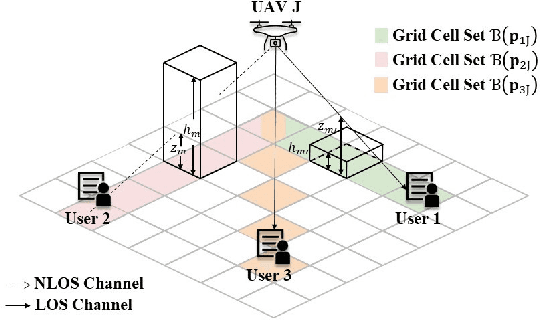
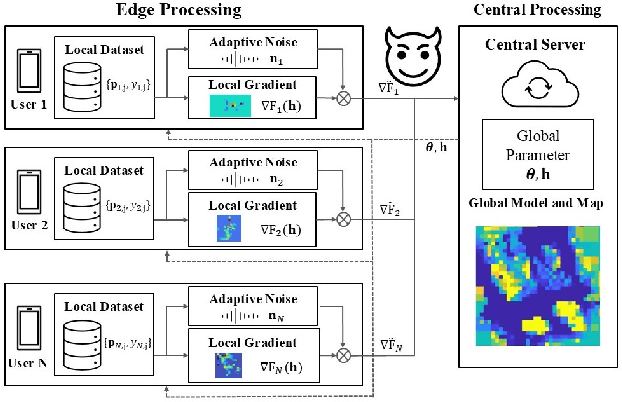
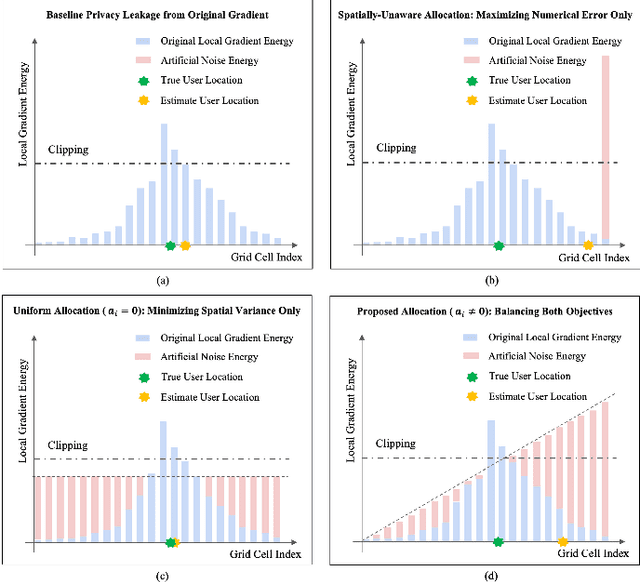
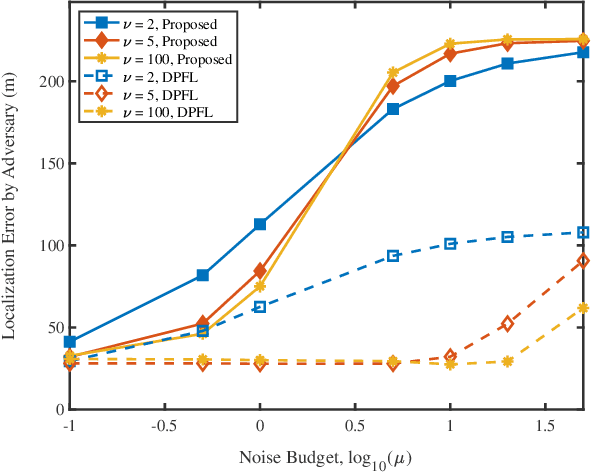
Radio maps that describe spatial variations in wireless signal strength are widely used to optimize networks and support aerial platforms. Their construction requires location-labeled signal measurements from distributed users, raising fundamental concerns about location privacy. Even when raw data are kept local, the shared model updates can reveal user locations through their spatial structure, while naive noise injection either fails to hide this leakage or degrades model accuracy. This work analyzes how location leakage arises from gradients in a virtual-environment radio map model and proposes a geometry-aligned differential privacy mechanism with heterogeneous noise tailored to both confuse localization and cover gradient spatial patterns. The approach is theoretically supported with a convergence guarantee linking privacy strength to learning accuracy. Numerical experiments show the approach increases attacker localization error from 30 m to over 180 m, with only 0.2 dB increase in radio map construction error compared to a uniform-noise baseline.