 Add to Chrome
 Add to Firefox
 Add to Edge
Radar-Inertial Odometry with Online Spatio-Temporal Calibration via Continuous-Time IMU Modeling
Mar 20, 2026
Radar-Inertial Odometry (RIO) has emerged as a robust alternative to vision- and LiDAR-based odometry in challenging conditions such as low light, fog, featureless environments, or in adverse weather. However, many existing RIO approaches assume known radar-IMU extrinsic calibration or rely on sufficient motion excitation for online extrinsic estimation, while temporal misalignment between sensors is often neglected or treated independently. In this work, we present a RIO framework that performs joint online spatial and temporal calibration within a factor-graph optimization formulation, based on continuous-time modeling of inertial measurements using uniform cubic B-splines. The proposed continuous-time representation of acceleration and angular velocity accurately captures the asynchronous nature of radar-IMU measurements, enabling reliable convergence of both the temporal offset and extrinsic calibration parameters, without relying on scan matching, target tracking, or environment-specific assumptions.

Impact of Temporal Delay on Radar-Inertial Odometry
Mar 04, 2025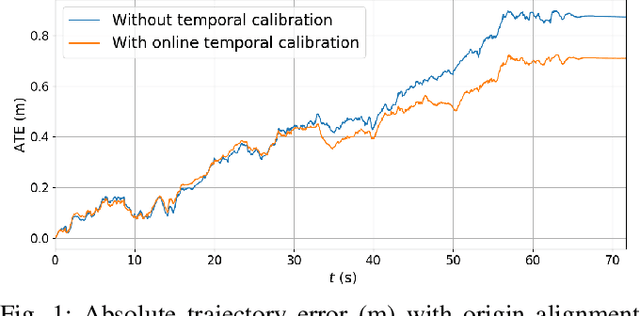
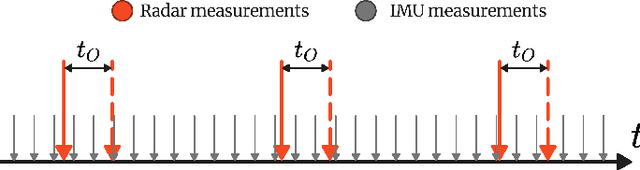
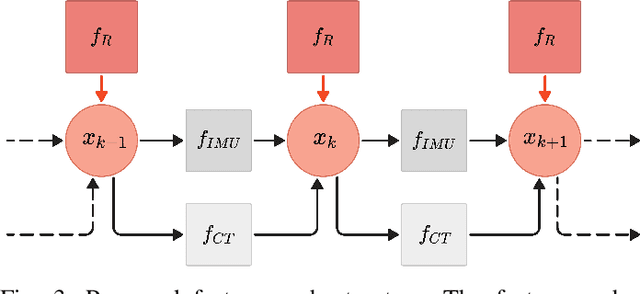
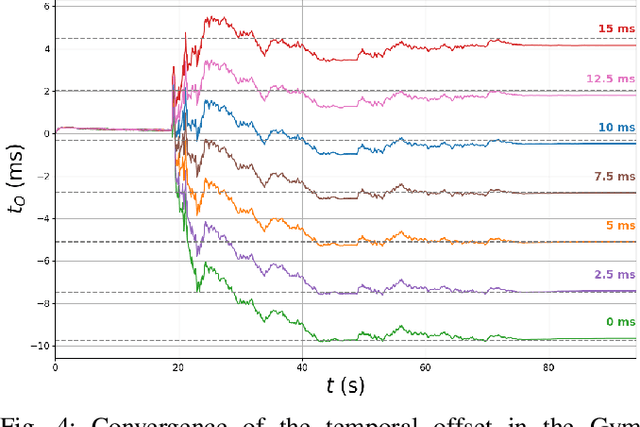
Accurate ego-motion estimation is a critical component of any autonomous system. Conventional ego-motion sensors, such as cameras and LiDARs, may be compromised in adverse environmental conditions, such as fog, heavy rain, or dust. Automotive radars, known for their robustness to such conditions, present themselves as complementary sensors or a promising alternative within the ego-motion estimation frameworks. In this paper we propose a novel Radar-Inertial Odometry (RIO) system that integrates an automotive radar and an inertial measurement unit. The key contribution is the integration of online temporal delay calibration within the factor graph optimization framework that compensates for potential time offsets between radar and IMU measurements. To validate the proposed approach we have conducted thorough experimental analysis on real-world radar and IMU data. The results show that, even without scan matching or target tracking, integration of online temporal calibration significantly reduces localization error compared to systems that disregard time synchronization, thus highlighting the important role of, often neglected, accurate temporal alignment in radar-based sensor fusion systems for autonomous navigation.
RAVE: A Framework for Radar Ego-Velocity Estimation
Jun 27, 2024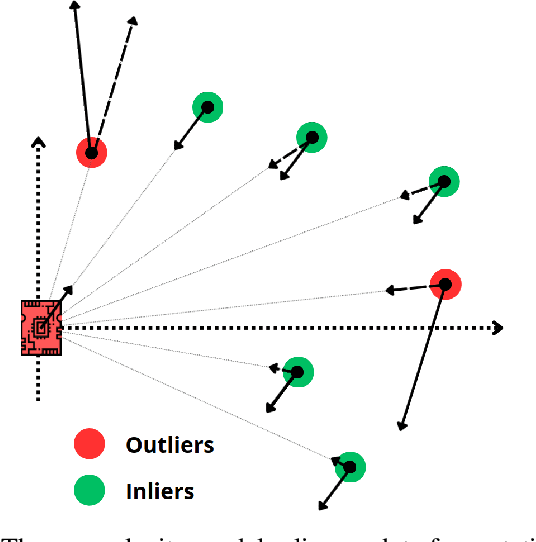

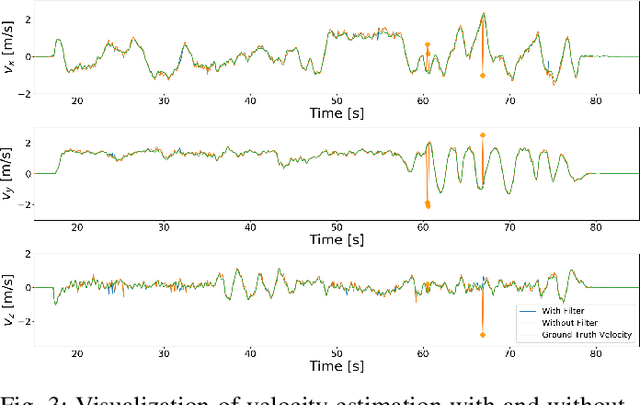
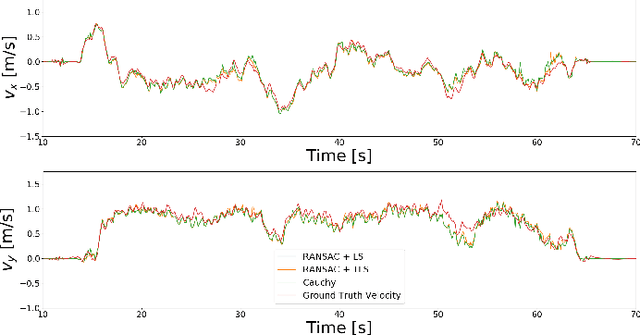
State estimation is an essential component of autonomous systems, usually relying on sensor fusion that integrates data from cameras, LiDARs and IMUs. Recently, radars have shown the potential to improve the accuracy and robustness of state estimation and perception, especially in challenging environmental conditions such as adverse weather and low-light scenarios. In this paper, we present a framework for ego-velocity estimation, which we call RAVE, that relies on 3D automotive radar data and encompasses zero velocity detection, outlier rejection, and velocity estimation. In addition, we propose a simple filtering method to discard infeasible ego-velocity estimates. We also conduct a systematic analysis of how different existing outlier rejection techniques and optimization loss functions impact estimation accuracy. Our evaluation on three open-source datasets demonstrates the effectiveness of the proposed filter and a significant positive impact of RAVE on the odometry accuracy. Furthermore, we release an open-source implementation of the proposed framework for radar ego-velocity estimation accompanied with a ROS interface.