 Add to Chrome
 Add to Firefox
 Add to Edge
Machine Learning on Heterogeneous, Edge, and Quantum Hardware for Particle Physics (ML-HEQUPP)
Feb 24, 2026
The next generation of particle physics experiments will face a new era of challenges in data acquisition, due to unprecedented data rates and volumes along with extreme environments and operational constraints. Harnessing this data for scientific discovery demands real-time inference and decision-making, intelligent data reduction, and efficient processing architectures beyond current capabilities. Crucial to the success of this experimental paradigm are several emerging technologies, such as artificial intelligence and machine learning (AI/ML) and silicon microelectronics, and the advent of quantum algorithms and processing. Their intersection includes areas of research such as low-power and low-latency devices for edge computing, heterogeneous accelerator systems, reconfigurable hardware, novel codesign and synthesis strategies, readout for cryogenic or high-radiation environments, and analog computing. This white paper presents a community-driven vision to identify and prioritize research and development opportunities in hardware-based ML systems and corresponding physics applications, contributing towards a successful transition to the new data frontier of fundamental science.

Comparative Analysis of FPGA and GPU Performance for Machine Learning-Based Track Reconstruction at LHCb
Feb 05, 2025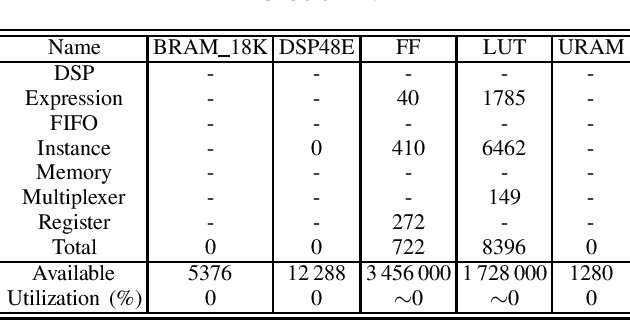
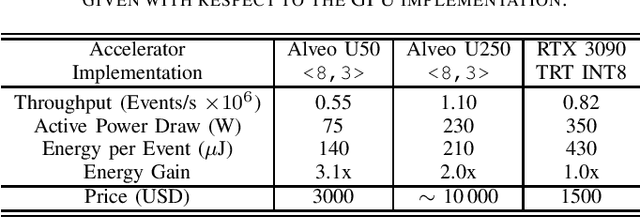
In high-energy physics, the increasing luminosity and detector granularity at the Large Hadron Collider are driving the need for more efficient data processing solutions. Machine Learning has emerged as a promising tool for reconstructing charged particle tracks, due to its potentially linear computational scaling with detector hits. The recent implementation of a graph neural network-based track reconstruction pipeline in the first level trigger of the LHCb experiment on GPUs serves as a platform for comparative studies between computational architectures in the context of high-energy physics. This paper presents a novel comparison of the throughput of ML model inference between FPGAs and GPUs, focusing on the first step of the track reconstruction pipeline$\unicode{x2013}$an implementation of a multilayer perceptron. Using HLS4ML for FPGA deployment, we benchmark its performance against the GPU implementation and demonstrate the potential of FPGAs for high-throughput, low-latency inference without the need for an expertise in FPGA development and while consuming significantly less power.