 Add to Chrome
 Add to Firefox
 Add to Edge
Multimodal Digital Biomarker for Asthma: Complementary Roles of Vocal, Clinical and Demographic Factors
Jul 09, 2026
Asthma affects over 260 million people worldwide, yet diagnosis remains dependent on spirometry and specialist assessment, limiting accessibility in primary care and low-resource settings. Vocal biomarkers offer a promising non-invasive alternative, but prior studies have largely focused on acoustic features without integrating clinical context. We present a multimodal Mixture-of-Experts framework for asthma detection that adaptively combines acoustic embeddings from sustained vowel phonation and reading passage tasks with structured clinical and demographic data. The model was evaluated on a matched cohort of 1,218 asthma cases and healthy controls from the Colive Voice study. The multimodal model achieved an AUROC of 0.85 and Brier score of 0.17, outperforming unimodal and bimodal approaches. Adaptive gating analysis revealed increased reliance on audio features in participants with greater respiratory symptom burden, whereas clinical features contributed more strongly in less symptomatic individuals. These findings support scalable and explainable asthma screening using smartphone-collected voice recordings.

RodEpil: A Video Dataset of Laboratory Rodents for Seizure Detection and Benchmark Evaluation
Nov 14, 2025We introduce a curated video dataset of laboratory rodents for automatic detection of convulsive events. The dataset contains short (10~s) top-down and side-view video clips of individual rodents, labeled at clip level as normal activity or seizure. It includes 10,101 negative samples and 2,952 positive samples collected from 19 subjects. We describe the data curation, annotation protocol and preprocessing pipeline, and report baseline experiments using a transformer-based video classifier (TimeSformer). Experiments employ five-fold cross-validation with strict subject-wise partitioning to prevent data leakage (no subject appears in more than one fold). Results show that the TimeSformer architecture enables discrimination between seizure and normal activity with an average F1-score of 97%. The dataset and baseline code are publicly released to support reproducible research on non-invasive, video-based monitoring in preclinical epilepsy research. RodEpil Dataset access - DOI: 10.5281/zenodo.17601357
CardioPHON: Quality assessment and self-supervised pretraining for screening of cardiac function based on phonocardiogram recordings
Nov 06, 2025Remote monitoring of cardiovascular diseases plays an essential role in early detection of abnormal cardiac function, enabling timely intervention, improved preventive care, and personalized patient treatment. Abnormalities in the heart sounds can be detected automatically via computer-assisted decision support systems, and used as the first-line screening tool for detection of cardiovascular problems, or for monitoring the effects of treatments and interventions. We propose in this paper CardioPHON, an integrated heart sound quality assessment and classification tool that can be used for screening of abnormal cardiac function from phonocardiogram recordings. The model is pretrained in a self-supervised fashion on a collection of six small- and mid-sized heart sound datasets, enables automatic removal of low quality recordings to ensure that subtle sounds of heart abnormalities are not misdiagnosed, and provides a state-of-the-art performance for the heart sound classification task. The multimodal model that combines audio and socio-demographic features demonstrated superior performance, achieving the best ranking on the official leaderboard of the 2022 George B. Moody PhysioNet heart sound challenge, whereas the unimodal model, that is based only on phonocardiogram recordings, holds the first position among the unimodal approaches (a total rank 4), surpassing the models utilizing multiple modalities. CardioPHON is the first publicly released pretrained model in the domain of heart sound recordings, facilitating the development of data-efficient artificial intelligence models that can generalize to various downstream tasks in cardiovascular diagnostics.
Glioma subtype classification from histopathological images using in-domain and out-of-domain transfer learning: An experimental study
Sep 29, 2023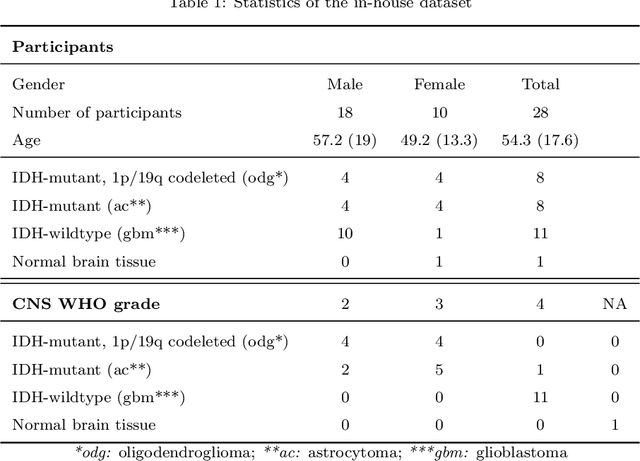
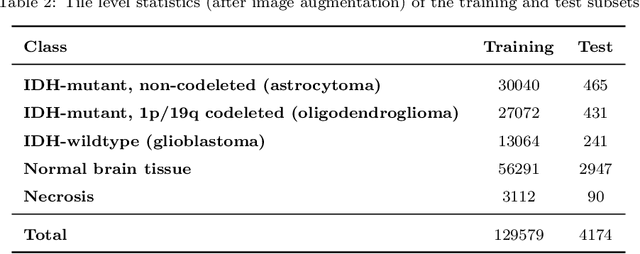
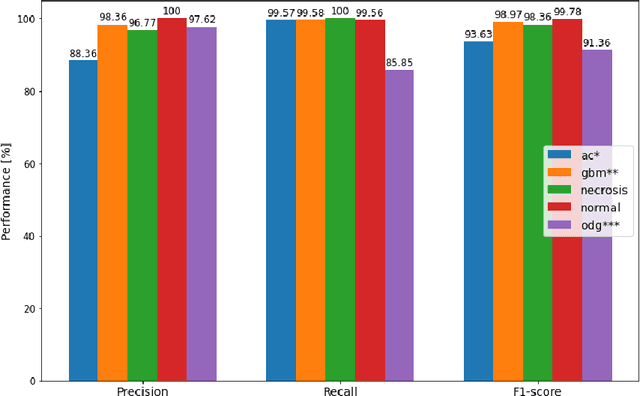
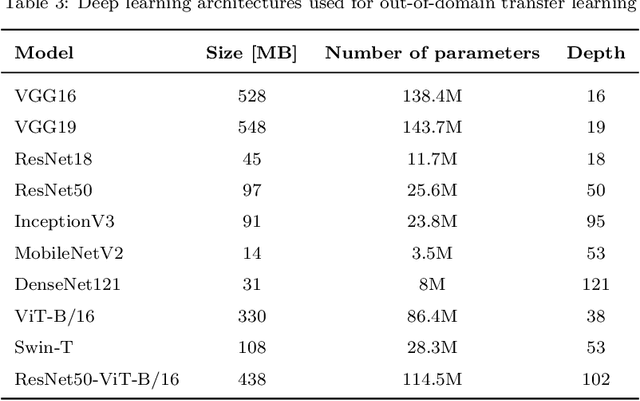
We provide in this paper a comprehensive comparison of various transfer learning strategies and deep learning architectures for computer-aided classification of adult-type diffuse gliomas. We evaluate the generalizability of out-of-domain ImageNet representations for a target domain of histopathological images, and study the impact of in-domain adaptation using self-supervised and multi-task learning approaches for pretraining the models using the medium-to-large scale datasets of histopathological images. A semi-supervised learning approach is furthermore proposed, where the fine-tuned models are utilized to predict the labels of unannotated regions of the whole slide images (WSI). The models are subsequently retrained using the ground-truth labels and weak labels determined in the previous step, providing superior performance in comparison to standard in-domain transfer learning with balanced accuracy of 96.91% and F1-score 97.07%, and minimizing the pathologist's efforts for annotation. Finally, we provide a visualization tool working at WSI level which generates heatmaps that highlight tumor areas; thus, providing insights to pathologists concerning the most informative parts of the WSI.
State of the Art of Audio- and Video-Based Solutions for AAL
Jul 05, 2022The report illustrates the state of the art of the most successful AAL applications and functions based on audio and video data, namely (i) lifelogging and self-monitoring, (ii) remote monitoring of vital signs, (iii) emotional state recognition, (iv) food intake monitoring, activity and behaviour recognition, (v) activity and personal assistance, (vi) gesture recognition, (vii) fall detection and prevention, (viii) mobility assessment and frailty recognition, and (ix) cognitive and motor rehabilitation. For these application scenarios, the report illustrates the state of play in terms of scientific advances, available products and research project. The open challenges are also highlighted.