 Add to Chrome
 Add to Firefox
 Add to Edge
Long-Term Optimization for Large-Scale Generative Retrieval with Off-Policy REINFORCE
Jul 02, 2026
Generative retrieval has become a popular paradigm for large-scale recommendation. However, it is typically trained with supervised next-item prediction objectives that do not directly optimize long-term user satisfaction. In this work, we formulate recommendation as a session-level sequential decision-making problem and introduce an autoregressive approach for training generative retrievers with off-policy REINFORCE on pre-collected data. Unlike the one-step off-policy correction used in prior work, we propose a multi-step approximation of importance weights enabled by the autoregressive formulation. To support offline evaluation, we train a user feedback model that simulates user responses to generated recommendations. This lets us adapt doubly robust off-policy evaluation for sequential decision-making to recommendation, a setting that has received limited attention. We further introduce a feedback-model-based test-time scaling procedure that simulates future responses and selects recommendations with the highest predicted long-term returns. Experiments on the public large-scale Yambda-5B dataset show that our RL agent improves offline estimates of cumulative session reward over next-item and next-positive prediction baselines, while largely preserving retrieval quality. Moreover, allocating more inference-time compute to simulating future responses improves model-based long-term return estimates without updating the policy.

Mitigating Collaborative Semantic ID Staleness in Generative Retrieval
Apr 14, 2026Generative retrieval with Semantic IDs (SIDs) assigns each item a discrete identifier and treats retrieval as a sequence generation problem rather than a nearest-neighbor search. While content-only SIDs are stable, they do not take into account user-item interaction patterns, so recent systems construct interaction-informed SIDs. However, as interaction patterns drift over time, these identifiers become stale, i.e., their collaborative semantics no longer match recent logs. Prior work typically assumes a fixed SID vocabulary during fine-tuning, or treats SID refresh as a full rebuild that requires retraining. However, SID staleness under temporal drift is rarely analyzed explicitly. To bridge this gap, we study SID staleness under strict chronological evaluation and propose a lightweight, model-agnostic SID alignment update. Given refreshed SIDs derived from recent logs, we align them to the existing SID vocabulary so the retriever checkpoint remains compatible, enabling standard warm-start fine-tuning without a full rebuild-and-retrain pipeline. Across three public benchmarks, our update consistently improves Recall@K and nDCG@K at high cutoffs over naive fine-tuning with stale SIDs and reduces retriever-training compute by approximately 8-9 times compared to full retraining.
Blending Sequential Embeddings, Graphs, and Engineered Features: 4th Place Solution in RecSys Challenge 2025
Aug 09, 2025This paper describes the 4th-place solution by team ambitious for the RecSys Challenge 2025, organized by Synerise and ACM RecSys, which focused on universal behavioral modeling. The challenge objective was to generate user embeddings effective across six diverse downstream tasks. Our solution integrates (1) a sequential encoder to capture the temporal evolution of user interests, (2) a graph neural network to enhance generalization, (3) a deep cross network to model high-order feature interactions, and (4) performance-critical feature engineering.
End-to-End Graph-Sequential Representation Learning for Accurate Recommendations
Mar 15, 2024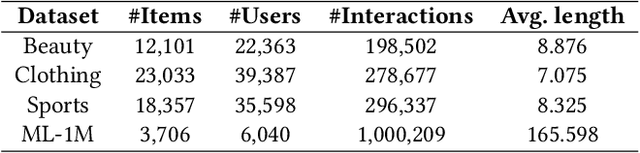
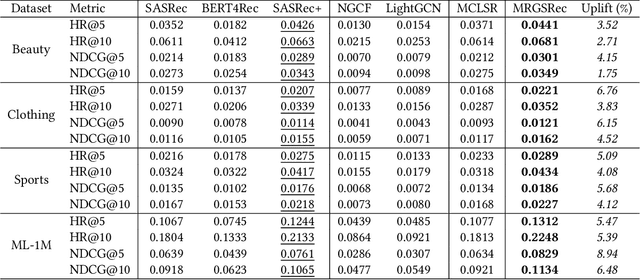
Recent recommender system advancements have focused on developing sequence-based and graph-based approaches. Both approaches proved useful in modeling intricate relationships within behavioral data, leading to promising outcomes in personalized ranking and next-item recommendation tasks while maintaining good scalability. However, they capture very different signals from data. While the former approach represents users directly through ordered interactions with recent items, the latter aims to capture indirect dependencies across the interactions graph. This paper presents a novel multi-representational learning framework exploiting these two paradigms' synergies. Our empirical evaluation on several datasets demonstrates that mutual training of sequential and graph components with the proposed framework significantly improves recommendations performance.