 Add to Chrome
 Add to Firefox
 Add to Edge
Long-Term Optimization for Large-Scale Generative Retrieval with Off-Policy REINFORCE
Jul 02, 2026
Generative retrieval has become a popular paradigm for large-scale recommendation. However, it is typically trained with supervised next-item prediction objectives that do not directly optimize long-term user satisfaction. In this work, we formulate recommendation as a session-level sequential decision-making problem and introduce an autoregressive approach for training generative retrievers with off-policy REINFORCE on pre-collected data. Unlike the one-step off-policy correction used in prior work, we propose a multi-step approximation of importance weights enabled by the autoregressive formulation. To support offline evaluation, we train a user feedback model that simulates user responses to generated recommendations. This lets us adapt doubly robust off-policy evaluation for sequential decision-making to recommendation, a setting that has received limited attention. We further introduce a feedback-model-based test-time scaling procedure that simulates future responses and selects recommendations with the highest predicted long-term returns. Experiments on the public large-scale Yambda-5B dataset show that our RL agent improves offline estimates of cumulative session reward over next-item and next-positive prediction baselines, while largely preserving retrieval quality. Moreover, allocating more inference-time compute to simulating future responses improves model-based long-term return estimates without updating the policy.

Variable-Length Semantic IDs for Recommender Systems
Feb 18, 2026Generative models are increasingly used in recommender systems, both for modeling user behavior as event sequences and for integrating large language models into recommendation pipelines. A key challenge in this setting is the extremely large cardinality of item spaces, which makes training generative models difficult and introduces a vocabulary gap between natural language and item identifiers. Semantic identifiers (semantic IDs), which represent items as sequences of low-cardinality tokens, have recently emerged as an effective solution to this problem. However, existing approaches generate semantic identifiers of fixed length, assigning the same description length to all items. This is inefficient, misaligned with natural language, and ignores the highly skewed frequency structure of real-world catalogs, where popular items and rare long-tail items exhibit fundamentally different information requirements. In parallel, the emergent communication literature studies how agents develop discrete communication protocols, often producing variable-length messages in which frequent concepts receive shorter descriptions. Despite the conceptual similarity, these ideas have not been systematically adopted in recommender systems. In this work, we bridge recommender systems and emergent communication by introducing variable-length semantic identifiers for recommendation. We propose a discrete variational autoencoder with Gumbel-Softmax reparameterization that learns item representations of adaptive length under a principled probabilistic framework, avoiding the instability of REINFORCE-based training and the fixed-length constraints of prior semantic ID methods.
Blending Sequential Embeddings, Graphs, and Engineered Features: 4th Place Solution in RecSys Challenge 2025
Aug 09, 2025This paper describes the 4th-place solution by team ambitious for the RecSys Challenge 2025, organized by Synerise and ACM RecSys, which focused on universal behavioral modeling. The challenge objective was to generate user embeddings effective across six diverse downstream tasks. Our solution integrates (1) a sequential encoder to capture the temporal evolution of user interests, (2) a graph neural network to enhance generalization, (3) a deep cross network to model high-order feature interactions, and (4) performance-critical feature engineering.
Personalized Transformer-based Ranking for e-Commerce at Yandex
Oct 09, 2023
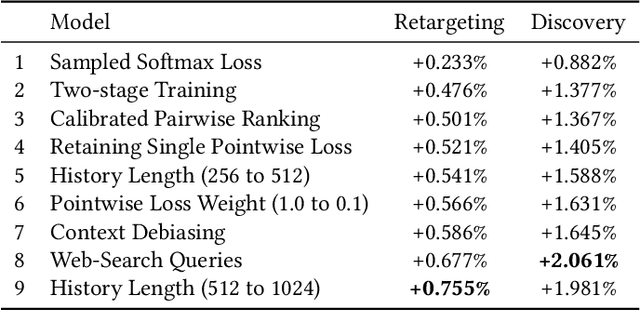
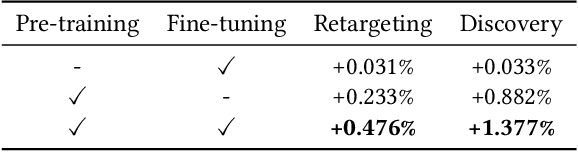
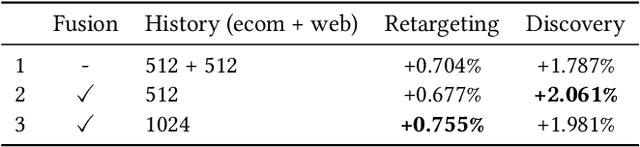
Personalizing user experience with high-quality recommendations based on user activity is vital for e-commerce platforms. This is particularly important in scenarios where the user's intent is not explicit, such as on the homepage. Recently, personalized embedding-based systems have significantly improved the quality of recommendations and search in the e-commerce domain. However, most of these works focus on enhancing the retrieval stage. In this paper, we demonstrate that features produced by retrieval-focused deep learning models are sub-optimal for ranking stage in e-commerce recommendations. To address this issue, we propose a two-stage training process that fine-tunes two-tower models to achieve optimal ranking performance. We provide a detailed description of our transformer-based two-tower model architecture, which is specifically designed for personalization in e-commerce. Additionally, we introduce a novel technique for debiasing context in offline models and report significant improvements in ranking performance when using web-search queries for e-commerce recommendations. Our model has been successfully deployed at Yandex, serves millions of users daily, and has delivered strong performance in online A/B testing.