 Add to Chrome
 Add to Firefox
 Add to Edge
Efficiently Linking Real Scenes with Synthetic Data Generation for AI-based Cognitive Robotics and Computer Vision Applications
Jun 18, 2026
AI vision models are a driving factor for the potential use case scenarios of cognitive robotics within in the industry and household applications. A large array of methods from semantic environment analysis towards 6D and grasping pose estimation have been proposed based on the latest AI achievements. However, such advancements require further strong and efficient methods w.r.t. training data and AI-architectures, which are capable in synergy to tackle current challenges, precision limits, and scalability beyond domain gaps. In this paper, we discuss these current limits and trends in the related state-of-the-art which are challenging those. Further we discuss our current work in progress on bridging the domain gap between simulations and real world applications by linking those in the training data generation.

Visual Quality Score Assessment of Large White Goods in Remanufacture with Multi-View Deformable-DETR
Jun 12, 2026Remanufacturing large white goods is essential for a circular economy, yet visual quality assessment remains a manual bottleneck for training and pricing. Conventional detection methods require extensive annotation and struggle with small defects in high-resolution multi-view data. We present a multi-view framework based on Deformable-DETR for automated quality scoring that aggregates information across redundant views to extract fine-grained features. To enhance robustness with limited labels, we employ self-supervised pretraining followed by supervised fine-tuning on expert-annotated scores. Additionally, a linear projection over frozen feature maps identifies regions of interest to explain model decisions. Evaluated on an industrial multi-view dataset, our approach delivers precise quality assessments while reducing reliance on manual annotation and per-part customization, enabling scalable and transparent inspection for remanufacturing lines.
Feeling Machines: Ethics, Culture, and the Rise of Emotional AI
Jun 14, 2025This paper explores the growing presence of emotionally responsive artificial intelligence through a critical and interdisciplinary lens. Bringing together the voices of early-career researchers from multiple fields, it explores how AI systems that simulate or interpret human emotions are reshaping our interactions in areas such as education, healthcare, mental health, caregiving, and digital life. The analysis is structured around four central themes: the ethical implications of emotional AI, the cultural dynamics of human-machine interaction, the risks and opportunities for vulnerable populations, and the emerging regulatory, design, and technical considerations. The authors highlight the potential of affective AI to support mental well-being, enhance learning, and reduce loneliness, as well as the risks of emotional manipulation, over-reliance, misrepresentation, and cultural bias. Key challenges include simulating empathy without genuine understanding, encoding dominant sociocultural norms into AI systems, and insufficient safeguards for individuals in sensitive or high-risk contexts. Special attention is given to children, elderly users, and individuals with mental health challenges, who may interact with AI in emotionally significant ways. However, there remains a lack of cognitive or legal protections which are necessary to navigate such engagements safely. The report concludes with ten recommendations, including the need for transparency, certification frameworks, region-specific fine-tuning, human oversight, and longitudinal research. A curated supplementary section provides practical tools, models, and datasets to support further work in this domain.
On the Application of Egocentric Computer Vision to Industrial Scenarios
Jun 11, 2024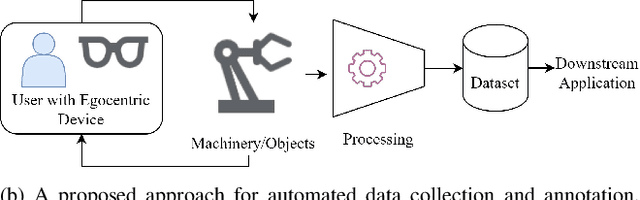

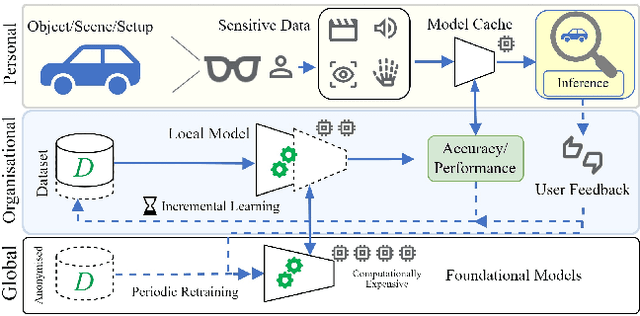
Egocentric vision aims to capture and analyse the world from the first-person perspective. We explore the possibilities for egocentric wearable devices to improve and enhance industrial use cases w.r.t. data collection, annotation, labelling and downstream applications. This would contribute to easier data collection and allow users to provide additional context. We envision that this approach could serve as a supplement to the traditional industrial Machine Vision workflow. Code, Dataset and related resources will be available at: https://github.com/Vivek9Chavan/EgoVis24