 Add to Chrome
 Add to Firefox
 Add to Edge
WANDR: A Benchmark for Wide and Deep Research
Aug 14, 2026
WANDR (Wide ANd Deep Research) is a benchmark of 500 realistic, challenging data-collection tasks for research agents. Each task requires a system to discover a large set of entities that satisfy specified criteria (breadth), investigate each entity through multiple coordinated web searches (depth), and return independently verifiable records with supporting sources and excerpts. Tasks are represented as qualification key hierarchies that specify the entities, relationships, evidence, and required count at each level; a hierarchy with n companies, m employees per company, and k sources per employee requires n x m x k records. This structure supports diverse workflows such as market mapping, due diligence, literature review, product comparison, and talent sourcing, with targets ranging from dozens to thousands of records. WANDR replaces static gold answer sets with task-specific judges that refetch cited pages and verify each record against its evidence, allowing evaluation of current and changing facts. Record verdicts are aggregated into soft and hard precision, recall, and F1 scores that distinguish factual quality, coverage, and hierarchical completeness. The tasks are derived from de-identified product-usage logs and produced through a semi-automated pipeline with automated checks, empirical audits, and human review where needed. We evaluate six production research systems and find that the benchmark is far from saturated: at high effort, the strongest system reaches only 0.363 soft F1 and 0.133 hard F1. Performance degrades as target volume and hierarchy depth increase, with incomplete discovery, missing enrichment, and incomplete evidence construction remaining major bottlenecks. The benchmark and evaluation harness are available at https://github.com/perplexityai/wandr.

U-MATH: A University-Level Benchmark for Evaluating Mathematical Skills in LLMs
Dec 04, 2024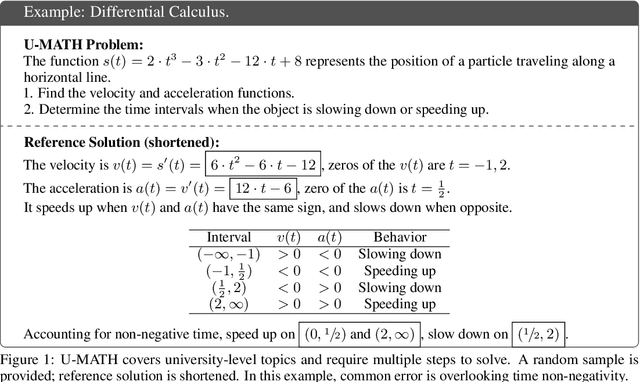
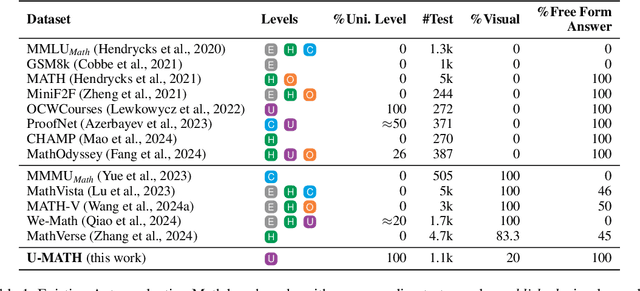
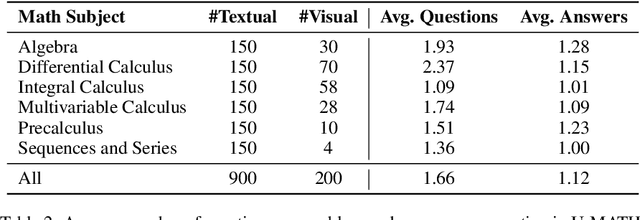
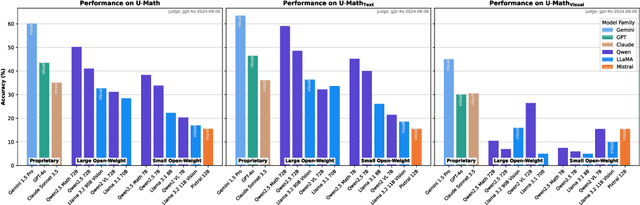
The current evaluation of mathematical skills in LLMs is limited, as existing benchmarks are either relatively small, primarily focus on elementary and high-school problems, or lack diversity in topics. Additionally, the inclusion of visual elements in tasks remains largely under-explored. To address these gaps, we introduce U-MATH, a novel benchmark of 1,100 unpublished open-ended university-level problems sourced from teaching materials. It is balanced across six core subjects, with 20% of multimodal problems. Given the open-ended nature of U-MATH problems, we employ an LLM to judge the correctness of generated solutions. To this end, we release $\mu$-MATH, a dataset to evaluate the LLMs' capabilities in judging solutions. The evaluation of general domain, math-specific, and multimodal LLMs highlights the challenges presented by U-MATH. Our findings reveal that LLMs achieve a maximum accuracy of only 63% on text-based tasks, with even lower 45% on visual problems. The solution assessment proves challenging for LLMs, with the best LLM judge having an F1-score of 80% on $\mu$-MATH.