 Add to Chrome
 Add to Firefox
 Add to Edge
Sign in the Air to Unlock: An Interface for authentication in Virtual and Augmented Reality Powered by Point-Voxel Cross-Attention Network
Jul 01, 2026
Significant advancement of immersive technologies such as Virtual and Augmented Reality (VR/AR) and their integration into diverse aspects of modern life need authentication interfaces that are secure, intuitive, and compatible with embodied interaction. Traditional methods such as passwords, PINs, and device-based logins, break immersion and rely on external hardware. Recent 3D-specific behavioral approaches, such as hand-gesture, eye-tracking, and electroencephalography (EEG)-based methods, offer promising alternatives but often require specialized sensors or constrain natural movement, limiting usability in dynamic environments. We present Sign in the Air to Unlock, an in-air signature interface that enables users to authenticate by signing naturally in 3D space which is a familiar, personal, and reproducible gesture. To realize this interface, we design a point-voxel Cross-Attention Network (PV-Net) that jointly models local motion dynamics and global spatial structure from 3D trajectories. The model is evaluated on two datasets: the public DeepAirSig dataset (1,800 signatures from 40 users) and ImmAirsig, a new dataset collected using Meta Quest 2 in immersive VR (880 samples from 22 users). PV-Net achieves an Equal Error Rate of 2.5% on DeepAirSig and 76% classification accuracy on ImmAirSig. These findings highlight the potential of 3D behavioral interfaces for seamless, user-centric authentication that merges security with natural interaction in immersive environments.

Treadmill Assisted Gait Spoofing (TAGS): An Emerging Threat to wearable Sensor-based Gait Authentication
Dec 17, 2020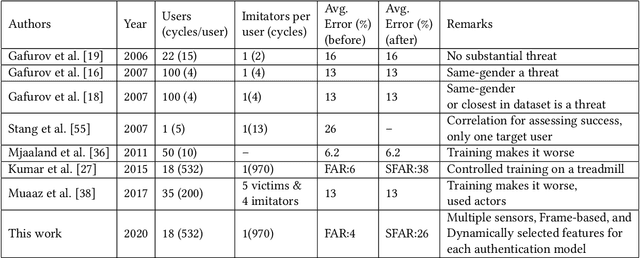
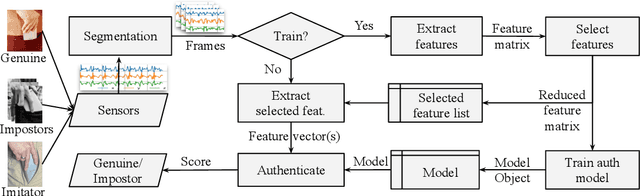
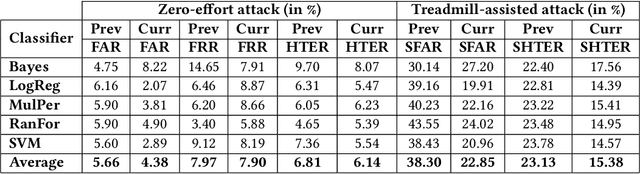
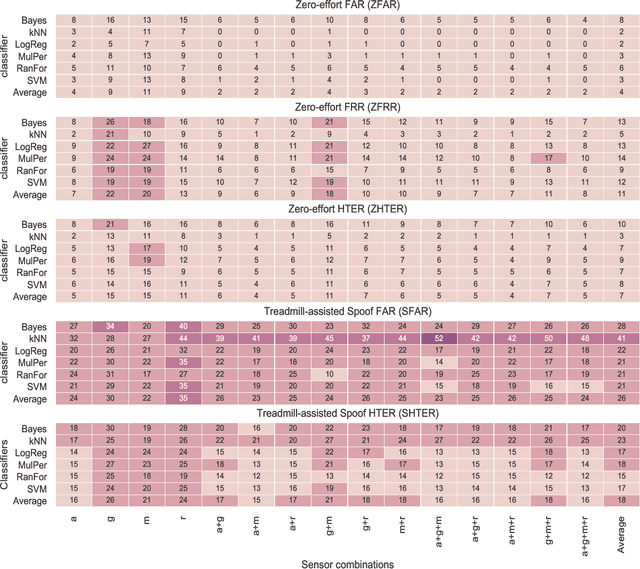
In this work, we examine the impact of Treadmill Assisted Gait Spoofing (TAGS) on Wearable Sensor-based Gait Authentication (WSGait). We consider more realistic implementation and deployment scenarios than the previous study, which focused only on the accelerometer sensor and a fixed set of features. Specifically, we consider the situations in which the implementation of WSGait could be using one or more sensors embedded into modern smartphones. Besides, it could be using different sets of features or different classification algorithms, or both. Despite the use of a variety of sensors, feature sets (ranked by mutual information), and six different classification algorithms, TAGS was able to increase the average False Accept Rate (FAR) from 4% to 26%. Such a considerable increase in the average FAR, especially under the stringent implementation and deployment scenarios considered in this study, calls for a further investigation into the design of evaluations of WSGait before its deployment for public use.
Authenticating users through their arm movement patterns
Mar 07, 2016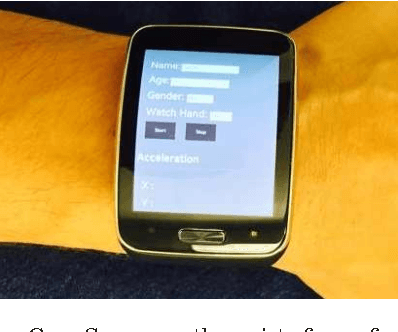
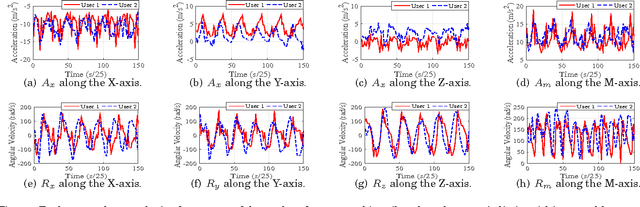
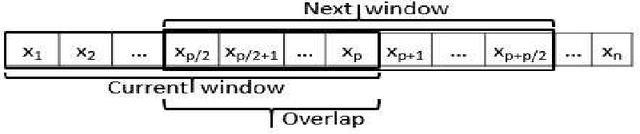
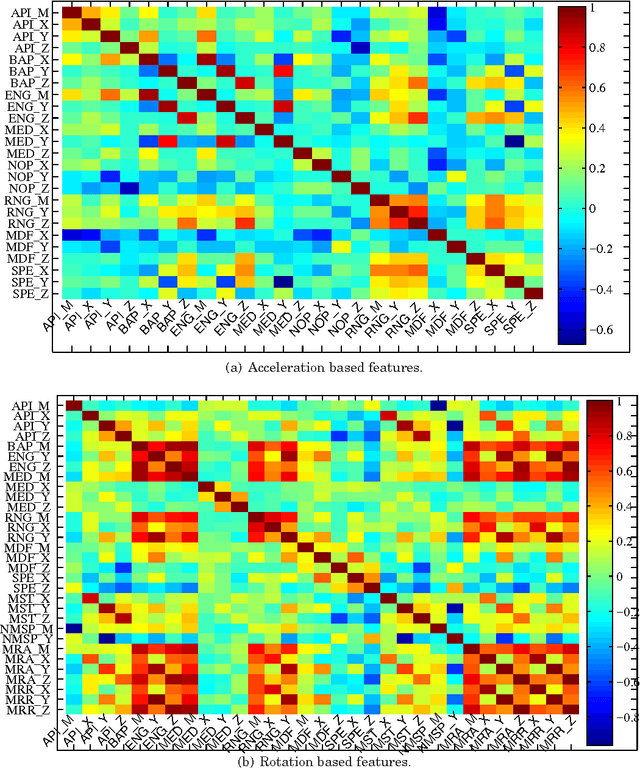
In this paper, we propose four continuous authentication designs by using the characteristics of arm movements while individuals walk. The first design uses acceleration of arms captured by a smartwatch's accelerometer sensor, the second design uses the rotation of arms captured by a smartwatch's gyroscope sensor, third uses the fusion of both acceleration and rotation at the feature-level and fourth uses the fusion at score-level. Each of these designs is implemented by using four classifiers, namely, k nearest neighbors (k-NN) with Euclidean distance, Logistic Regression, Multilayer Perceptrons, and Random Forest resulting in a total of sixteen authentication mechanisms. These authentication mechanisms are tested under three different environments, namely an intra-session, inter-session on a dataset of 40 users and an inter-phase on a dataset of 12 users. The sessions of data collection were separated by at least ten minutes, whereas the phases of data collection were separated by at least three months. Under the intra-session environment, all of the twelve authentication mechanisms achieve a mean dynamic false accept rate (DFAR) of 0% and dynamic false reject rate (DFRR) of 0%. For the inter-session environment, feature level fusion-based design with classifier k-NN achieves the best error rates that are a mean DFAR of 2.2% and DFRR of 4.2%. The DFAR and DFRR increased from 5.68% and 4.23% to 15.03% and 14.62% respectively when feature level fusion-based design with classifier k-NN was tested under the inter-phase environment on a dataset of 12 users.