 Add to Chrome
 Add to Firefox
 Add to Edge
Reviving ConvNeXt for Efficient Convolutional Diffusion Models
Mar 10, 2026
Recent diffusion models increasingly favor Transformer backbones, motivated by the remarkable scalability of fully attentional architectures. Yet the locality bias, parameter efficiency, and hardware friendliness--the attributes that established ConvNets as the efficient vision backbone--have seen limited exploration in modern generative modeling. Here we introduce the fully convolutional diffusion model (FCDM), a model having a backbone similar to ConvNeXt, but designed for conditional diffusion modeling. We find that using only 50% of the FLOPs of DiT-XL/2, FCDM-XL achieves competitive performance with 7$\times$ and 7.5$\times$ fewer training steps at 256$\times$256 and 512$\times$512 resolutions, respectively. Remarkably, FCDM-XL can be trained on a 4-GPU system, highlighting the exceptional training efficiency of our architecture. Our results demonstrate that modern convolutional designs provide a competitive and highly efficient alternative for scaling diffusion models, reviving ConvNeXt as a simple yet powerful building block for efficient generative modeling.

Spatially Adaptive Cloth Regression with Implicit Neural Representations
Nov 27, 2023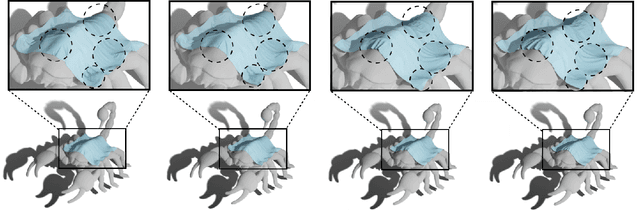
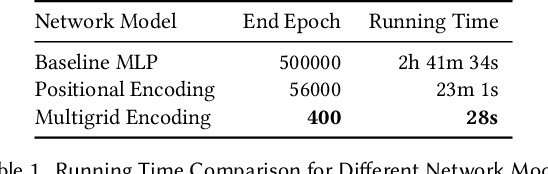
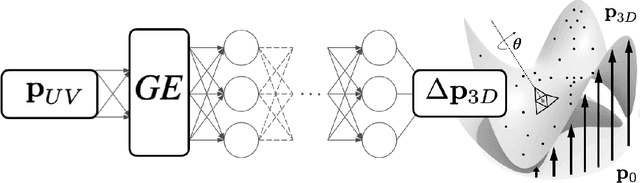
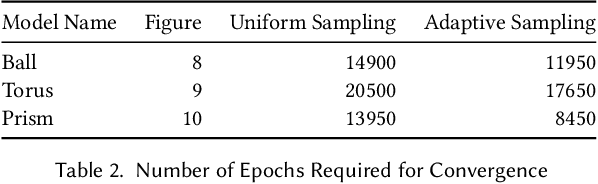
The accurate representation of fine-detailed cloth wrinkles poses significant challenges in computer graphics. The inherently non-uniform structure of cloth wrinkles mandates the employment of intricate discretization strategies, which are frequently characterized by high computational demands and complex methodologies. Addressing this, the research introduced in this paper elucidates a novel anisotropic cloth regression technique that capitalizes on the potential of implicit neural representations of surfaces. Our first core contribution is an innovative mesh-free sampling approach, crafted to reduce the reliance on traditional mesh structures, thereby offering greater flexibility and accuracy in capturing fine cloth details. Our second contribution is a novel adversarial training scheme, which is designed meticulously to strike a harmonious balance between the sampling and simulation objectives. The adversarial approach ensures that the wrinkles are represented with high fidelity, while also maintaining computational efficiency. Our results showcase through various cloth-object interaction scenarios that our method, given the same memory constraints, consistently surpasses traditional discrete representations, particularly when modelling highly-detailed localized wrinkles.