 Add to Chrome
 Add to Firefox
 Add to Edge
$\texttt{YC-Bench}$: Benchmarking AI Agents for Long-Term Planning and Consistent Execution
Apr 01, 2026
As LLM agents tackle increasingly complex tasks, a critical question is whether they can maintain strategic coherence over long horizons: planning under uncertainty, learning from delayed feedback, and adapting when early mistakes compound. We introduce $\texttt{YC-Bench}$, a benchmark that evaluates these capabilities by tasking an agent with running a simulated startup over a one-year horizon spanning hundreds of turns. The agent must manage employees, select task contracts, and maintain profitability in a partially observable environment where adversarial clients and growing payroll create compounding consequences for poor decisions. We evaluate 12 models, both proprietary and open source, across 3 seeds each. Only three models consistently surpass the starting capital of \$200K, with Claude Opus 4.6 achieving the highest average final funds at \$1.27 M, followed by GLM-5 at \$1.21 M at 11$\times$ lower inference cost. Scratchpad usage, the sole mechanism for persisting information across context truncation, is the strongest predictor of success, and adversarial client detection is the primary failure mode, accounting for $47\%$ of bankruptcies. Our analysis reveals that frontier models still fail through distinct failure modes such as over-parallelization, demonstrating the capability gaps for long-horizon performance. $\texttt{YC-Bench}$ is open-source, reproducible, and configurable.

The Unreasonable Effectiveness of Scaling Agents for Computer Use
Oct 02, 2025Computer-use agents (CUAs) hold promise for automating everyday digital tasks, but their unreliability and high variance hinder their application to long-horizon, complex tasks. We introduce Behavior Best-of-N (bBoN), a method that scales over agents by generating multiple rollouts and selecting among them using behavior narratives that describe the agents' rollouts. It enables both wide exploration and principled trajectory selection, substantially improving robustness and success rates. On OSWorld, our bBoN scaling method establishes a new state of the art (SoTA) at 69.9%, significantly outperforming prior methods and approaching human-level performance at 72%, with comprehensive ablations validating key design choices. We further demonstrate strong generalization results to different operating systems on WindowsAgentArena and AndroidWorld. Crucially, our results highlight the unreasonable effectiveness of scaling CUAs, when you do it right: effective scaling requires structured trajectory understanding and selection, and bBoN provides a practical framework to achieve this.
Agent S2: A Compositional Generalist-Specialist Framework for Computer Use Agents
Apr 01, 2025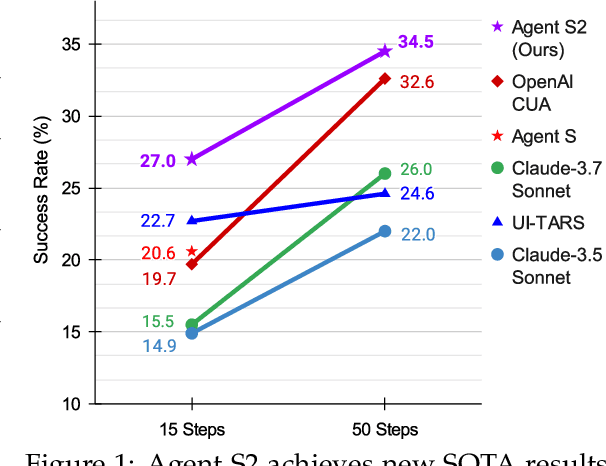
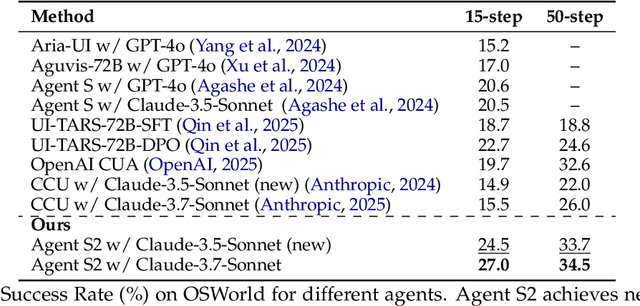
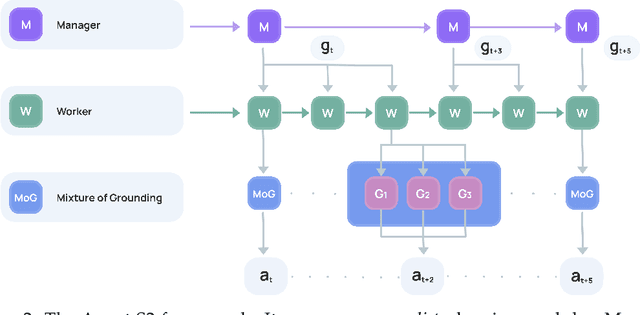

Computer use agents automate digital tasks by directly interacting with graphical user interfaces (GUIs) on computers and mobile devices, offering significant potential to enhance human productivity by completing an open-ended space of user queries. However, current agents face significant challenges: imprecise grounding of GUI elements, difficulties with long-horizon task planning, and performance bottlenecks from relying on single generalist models for diverse cognitive tasks. To this end, we introduce Agent S2, a novel compositional framework that delegates cognitive responsibilities across various generalist and specialist models. We propose a novel Mixture-of-Grounding technique to achieve precise GUI localization and introduce Proactive Hierarchical Planning, dynamically refining action plans at multiple temporal scales in response to evolving observations. Evaluations demonstrate that Agent S2 establishes new state-of-the-art (SOTA) performance on three prominent computer use benchmarks. Specifically, Agent S2 achieves 18.9% and 32.7% relative improvements over leading baseline agents such as Claude Computer Use and UI-TARS on the OSWorld 15-step and 50-step evaluation. Moreover, Agent S2 generalizes effectively to other operating systems and applications, surpassing previous best methods by 52.8% on WindowsAgentArena and by 16.52% on AndroidWorld relatively. Code available at https://github.com/simular-ai/Agent-S.