 Add to Chrome
 Add to Firefox
 Add to Edge
CN101 - A Digital Thermodynamic Computer for Generative AI
Aug 01, 2026
Thermodynamic computing is an emerging hardware paradigm, in which stochastic physical dynamics serve as the direct computational primitive. The recent explosion of generative AI has only sharpened the search for alternative approaches to compute, and, as we show in this work, thermodynamic computing turns out to be well suited to this space. An important class of methods realises a function as the stationary expectation of an ergodic stochastic process: the answer is encoded in the time-averaged statistics of an equilibrating trajectory. To date, this equilibration-style class has been formulated exclusively through Langevin dynamics, restricting its implementations to analogue substrates and the engineering challenges those bring. In this work, we propose a substrate-independent formalisation of the equilibration-style formulation, in which the only object of design is the dynamical generator L* of an arbitrary ergodic process. The formalisation makes three hardware-level properties of the formulation explicit: the precision of a result is a knob set by how long the dynamics are run, sample averages decompose across independent trajectories, and dependent stages of a computation operate concurrently rather than serially, a property we call sequential parallelism. We instantiate the formalisation by fabricating a prototype digital thermodynamic computing chip, named CN101, that implements the formulation through discrete accumulator dynamics on standard CMOS using stochastic computing principles. We characterise CN101's success across conventional generative AI workloads in the form of VAEs and flow matching, applied to both image generation and scientific problems. Together, the formalisation and its digital instantiation show that the equilibration-style formulation is substrate-independent, and that its computational properties can be exploited on standard digital hardware.

How does the teacher rate? Observations from the NeuroPiano dataset
Oct 04, 2024This paper provides a detailed analysis of the NeuroPiano dataset, which comprise 104 audio recordings of student piano performances accompanied with 2255 textual feedback and ratings given by professional pianists. We offer a statistical overview of the dataset, focusing on the standardization of annotations and inter-annotator agreement across 12 evaluative questions concerning performance quality. We also explore the predictive relationship between audio features and teacher ratings via machine learning, as well as annotations provided for text analysis of the responses.
LLaQo: Towards a Query-Based Coach in Expressive Music Performance Assessment
Sep 16, 2024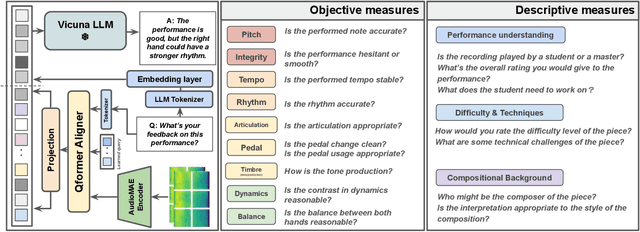


Research in music understanding has extensively explored composition-level attributes such as key, genre, and instrumentation through advanced representations, leading to cross-modal applications using large language models. However, aspects of musical performance such as stylistic expression and technique remain underexplored, along with the potential of using large language models to enhance educational outcomes with customized feedback. To bridge this gap, we introduce LLaQo, a Large Language Query-based music coach that leverages audio language modeling to provide detailed and formative assessments of music performances. We also introduce instruction-tuned query-response datasets that cover a variety of performance dimensions from pitch accuracy to articulation, as well as contextual performance understanding (such as difficulty and performance techniques). Utilizing AudioMAE encoder and Vicuna-7b LLM backend, our model achieved state-of-the-art (SOTA) results in predicting teachers' performance ratings, as well as in identifying piece difficulty and playing techniques. Textual responses from LLaQo was moreover rated significantly higher compared to other baseline models in a user study using audio-text matching. Our proposed model can thus provide informative answers to open-ended questions related to musical performance from audio data.
Matrix Tile Analysis
Jun 27, 2012

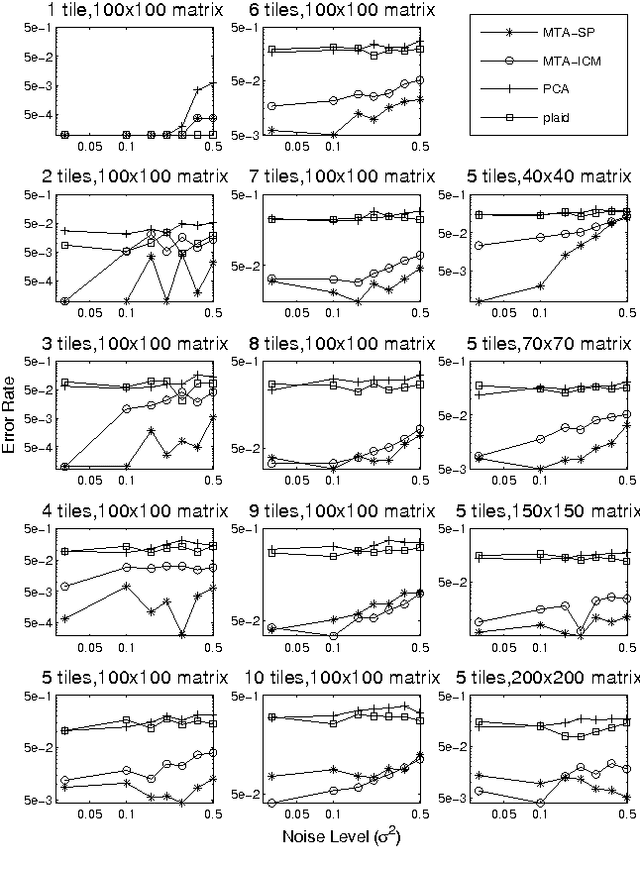

Many tasks require finding groups of elements in a matrix of numbers, symbols or class likelihoods. One approach is to use efficient bi- or tri-linear factorization techniques including PCA, ICA, sparse matrix factorization and plaid analysis. These techniques are not appropriate when addition and multiplication of matrix elements are not sensibly defined. More directly, methods like bi-clustering can be used to classify matrix elements, but these methods make the overly-restrictive assumption that the class of each element is a function of a row class and a column class. We introduce a general computational problem, `matrix tile analysis' (MTA), which consists of decomposing a matrix into a set of non-overlapping tiles, each of which is defined by a subset of usually nonadjacent rows and columns. MTA does not require an algebra for combining tiles, but must search over discrete combinations of tile assignments. Exact MTA is a computationally intractable integer programming problem, but we describe an approximate iterative technique and a computationally efficient sum-product relaxation of the integer program. We compare the effectiveness of these methods to PCA and plaid on hundreds of randomly generated tasks. Using double-gene-knockout data, we show that MTA finds groups of interacting yeast genes that have biologically-related functions.