 Add to Chrome
 Add to Firefox
 Add to Edge
Building Better Deception Probes Using Targeted Instruction Pairs
Feb 01, 2026
Linear probes are a promising approach for monitoring AI systems for deceptive behaviour. Previous work has shown that a linear classifier trained on a contrastive instruction pair and a simple dataset can achieve good performance. However, these probes exhibit notable failures even in straightforward scenarios, including spurious correlations and false positives on non-deceptive responses. In this paper, we identify the importance of the instruction pair used during training. Furthermore, we show that targeting specific deceptive behaviors through a human-interpretable taxonomy of deception leads to improved results on evaluation datasets. Our findings reveal that instruction pairs capture deceptive intent rather than content-specific patterns, explaining why prompt choice dominates probe performance (70.6% of variance). Given the heterogeneity of deception types across datasets, we conclude that organizations should design specialized probes targeting their specific threat models rather than seeking a universal deception detector.

Mechanistic Decomposition of Sentence Representations
Jun 04, 2025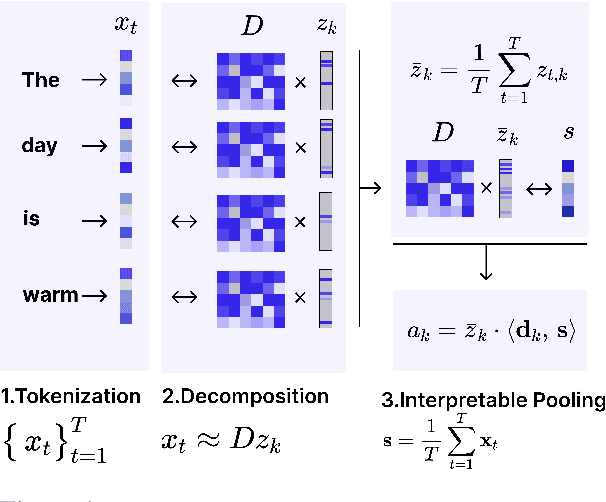
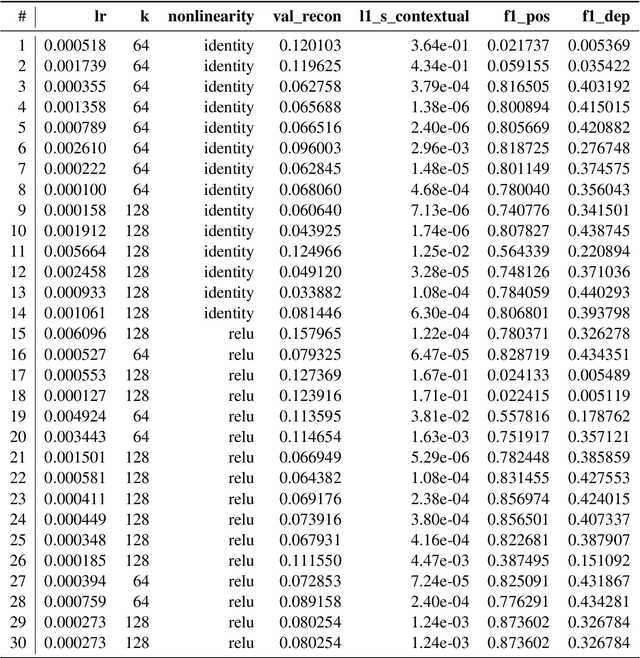
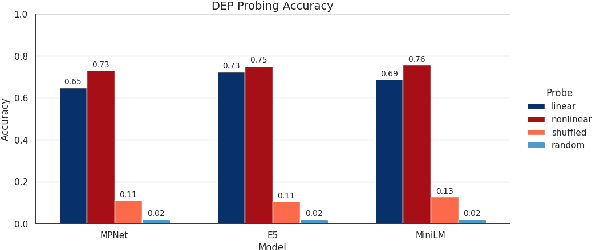
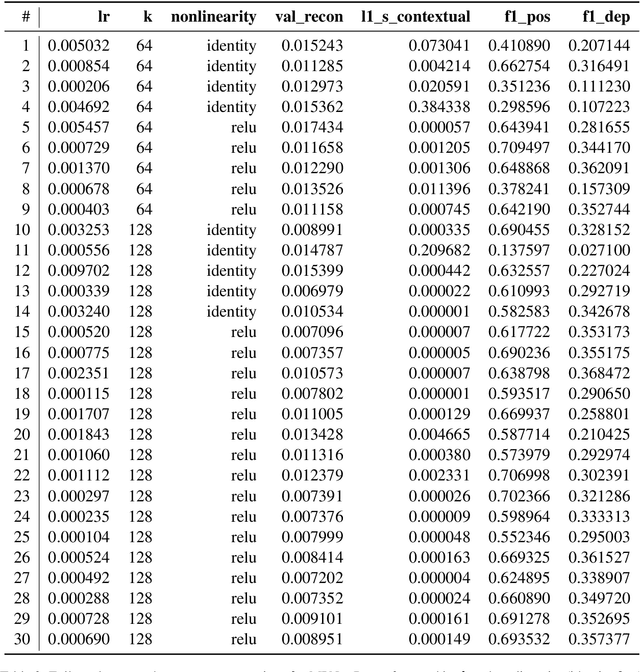
Sentence embeddings are central to modern NLP and AI systems, yet little is known about their internal structure. While we can compare these embeddings using measures such as cosine similarity, the contributing features are not human-interpretable, and the content of an embedding seems untraceable, as it is masked by complex neural transformations and a final pooling operation that combines individual token embeddings. To alleviate this issue, we propose a new method to mechanistically decompose sentence embeddings into interpretable components, by using dictionary learning on token-level representations. We analyze how pooling compresses these features into sentence representations, and assess the latent features that reside in a sentence embedding. This bridges token-level mechanistic interpretability with sentence-level analysis, making for more transparent and controllable representations. In our studies, we obtain several interesting insights into the inner workings of sentence embedding spaces, for instance, that many semantic and syntactic aspects are linearly encoded in the embeddings.