 Add to Chrome
 Add to Firefox
 Add to Edge
Model-Based Systems Engineering Framework for SysML-Driven Design of Autonomous UAVs
Aug 10, 2026
Autonomous Unmanned Aerial Vehicles (UAVs) are complex cyber-physical systems that require the coordinated integration of flight control, navigation, perception, communication, power management, and mission-level decision-making under safety, timing, and reliability constraints. However, many autonomous UAV development workflows still rely on document-centric requirements, separated architectural descriptions, and software implementation artifacts, which can lead to ambiguity, interface inconsistencies, and weak traceability during early design. This paper presents a Model-Based Systems Engineering (MBSE) design framework for the SysML-driven development of autonomous UAVs. The proposed framework uses the Systems Modeling Language (SysML) as a formal design backbone to structure UAV development across four connected layers: stakeholder requirements, functional decomposition, logical architecture, and physical/software allocation. SysML requirement diagrams, activity diagrams, block definition diagrams, internal block diagrams, state machine diagrams, and parametric diagrams are used to capture the functional, structural, behavioral, interface, and performance aspects of the UAV system. The logical architecture is then systematically mapped to a Robot Operating System 2 (ROS 2) software architecture by relating SysML blocks to ROS 2 nodes, flow ports and connectors to topics, request-response interactions to services, and goal-oriented behaviors to actions. The framework is illustrated at the design level using representative autonomous UAV mission scenarios, including autonomous take-off, waypoint navigation, hover stabilization, obstacle avoidance, return-to-home, and emergency handling. The resulting model supports requirement allocation, interface definition, subsystem responsibility assignment, and verification planning before simulation or physical deployment.

Design and Evaluation of an AI-Enabled Cloud-Edge Architecture for Connected Precision Agriculture Farms
Aug 04, 2026Plant diseases cause significant yield losses worldwide, with tomato crops particularly susceptible to early blight, late blight, and leaf mold. Manual monitoring is practical only for small-scale farms and becomes unmanageable at larger scales. To tackle this limitation, an artificial intelligence (AI) enabled cloud-edge architecture is proposed for autonomous crop monitoring. This proposed architecture integrates Internet of Things (IoT) sensors, unmanned aerial vehicles (UAVs), deep learning, Azure IoT Hub-based cloud analytics, and multi-platform (mobile app, web app, and embedded edge device platform) interfaces to enable real-time detection of tomato diseases. For training and validation, we used publicly available datasets, such as PlantVillage and Kaggle. A TensorFlow model trained on a collected dataset is deployed across mobile, web, and edge-device platforms. Experimental results show detection effectiveness around 92-95%, with consistent performance over diverse environments and device platforms. The proposed system improves disease detection effectiveness, lowers dependence on manual inspection, and enables prompt interventions, thereby supporting sustainable, connected precision agriculture farms.
Extracting Procedural Knowledge from Technical Documents
Oct 20, 2020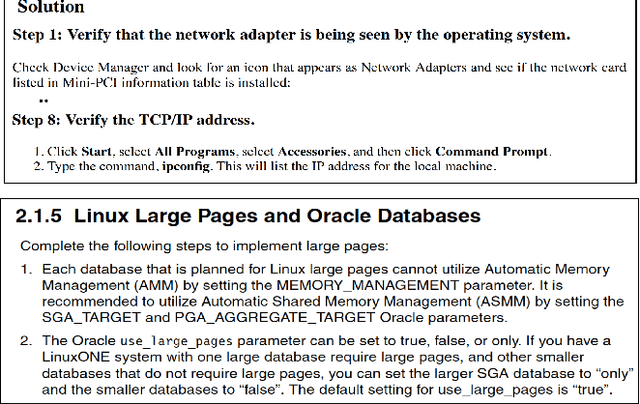
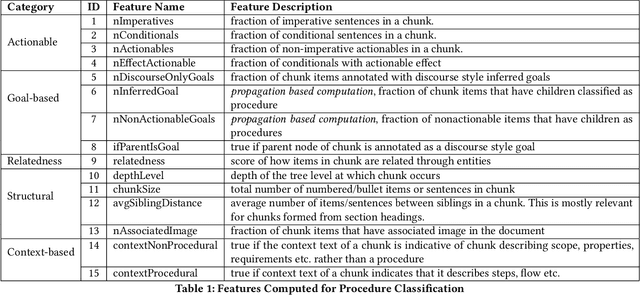
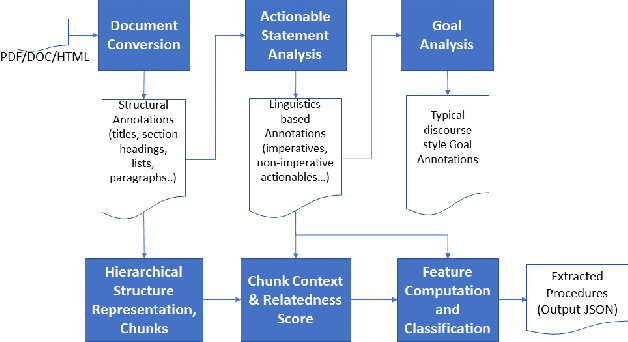
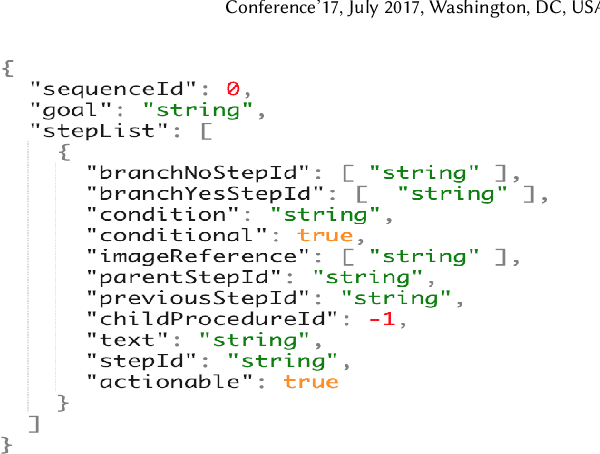
Procedures are an important knowledge component of documents that can be leveraged by cognitive assistants for automation, question-answering or driving a conversation. It is a challenging problem to parse big dense documents like product manuals, user guides to automatically understand which parts are talking about procedures and subsequently extract them. Most of the existing research has focused on extracting flows in given procedures or understanding the procedures in order to answer conceptual questions. Identifying and extracting multiple procedures automatically from documents of diverse formats remains a relatively less addressed problem. In this work, we cover some of this ground by -- 1) Providing insights on how structural and linguistic properties of documents can be grouped to define types of procedures, 2) Analyzing documents to extract the relevant linguistic and structural properties, and 3) Formulating procedure identification as a classification problem that leverages the features of the document derived from the above analysis. We first implemented and deployed unsupervised techniques which were used in different use cases. Based on the evaluation in different use cases, we figured out the weaknesses of the unsupervised approach. We then designed an improved version which was supervised. We demonstrate that our technique is effective in identifying procedures from big and complex documents alike by achieving accuracy of 89%.