 Add to Chrome
 Add to Firefox
 Add to Edge
Multi-Agent Planning with Spatio-Temporal and Topological Constraints using STL-GO
Jul 29, 2026
Multi-agent planning problems arise in a variety of engineering applications, such as multi-robot wildfire fighting and unmanned aerial inspection in factories. A particular challenge is the existence of spatio-temporal (i.e., when and/or where an agent should do what) and topological constraints (i.e., how agents should interact), as typically formalized via the notion of graphs. Over the last years, various frameworks have been proposed that can capture such constraints via spatio-temporal logics. We focus here on spatio-temporal logic with graph operators (STL-GO), a recent formalism that supports reasoning about multiple agents and their topologies, such as sensing, communication, and task topologies. In this paper, we consider the problem of planning multi-agent paths that satisfy constraints written in STL-GO. This problem is particularly challenging due to the need of encoding multiple, potentially time-varying graphs via the graph operators inherent to STL-GO. We present two encodings of this problem, one based on mixed-integer programming (MIP) and another based on satisfiability modulo theory (SMT), with soundness guarantees. We provide a unified interface for specifying agent constraints, their graph topologies, and the STL-GO specification, enabling seamless use of both methods and facilitating direct comparison between them. We evaluate both encodings on a multi-UAV search-and-rescue benchmark, ablating over team size and graph complexity, highlighting the expressiveness of the proposed encodings under dynamic multi- graph interactions.

ARROCH Augmented Reality for Robots Collaborating with a Human
Sep 21, 2021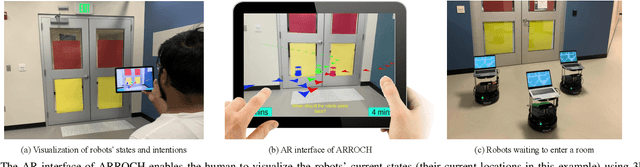
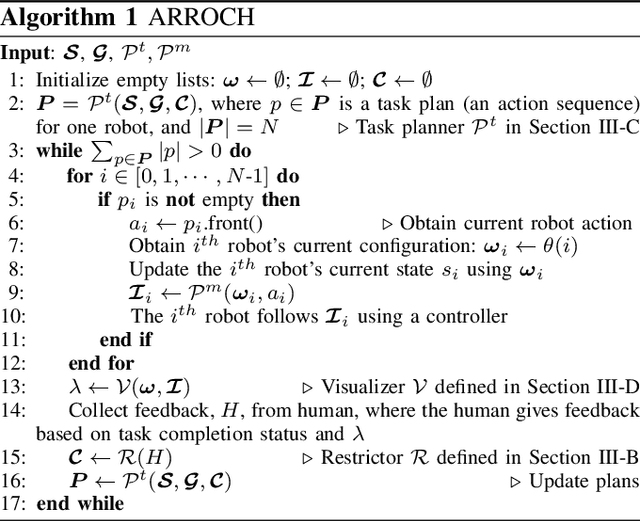

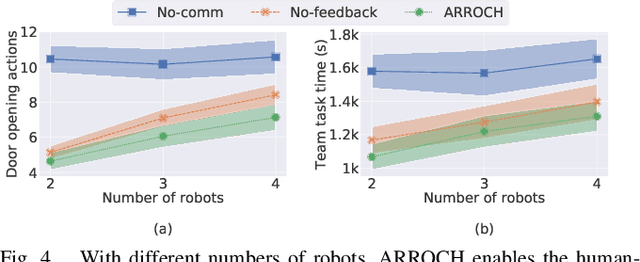
Human-robot collaboration frequently requires extensive communication, e.g., using natural language and gestures. Augmented reality (AR) has provided an alternative way of bridging the communication gap between robots and people. However, most current AR-based human-robot communication methods are unidirectional, focusing on how the human adapts to robot behaviors, and are limited to single-robot domains. In this paper, we develop AR for Robots Collaborating with a Human (ARROCH), a novel algorithm and system that supports bidirectional, multi-turn, human-multi-robot communication in indoor multi-room environments. The human can see through obstacles to observe the robots' current states and intentions, and provide feedback, while the robots' behaviors are then adjusted toward human-multi-robot teamwork. Experiments have been conducted with real robots and human participants using collaborative delivery tasks. Results show that ARROCH outperformed a standard non-AR approach in both user experience and teamwork efficiency. In addition, we have developed a novel simulation environment using Unity (for AR and human simulation) and Gazebo (for robot simulation). Results in simulation demonstrate ARROCH's superiority over AR-based baselines in human-robot collaboration.