 Add to Chrome
 Add to Firefox
 Add to Edge
Compressing LLMs with MoP: Mixture of Pruners
Feb 05, 2026
The high computational demands of Large Language Models (LLMs) motivate methods that reduce parameter count and accelerate inference. In response, model pruning emerges as an effective strategy, yet current methods typically focus on a single dimension-depth or width. We introduce MoP (Mixture of Pruners), an iterative framework that unifies these dimensions. At each iteration, MoP generates two branches-pruning in depth versus pruning in width-and selects a candidate to advance the path. On LLaMA-2 and LLaMA-3, MoP advances the frontier of structured pruning, exceeding the accuracy of competing methods across a broad set of compression regimes. It also consistently outperforms depth-only and width-only pruning. Furthermore, MoP translates structural pruning into real speedup, reducing end-to-end latency by 39% at 40% compression. Finally, extending MoP to the vision-language model LLaVA-1.5, we notably improve computational efficiency and demonstrate that text-only recovery fine-tuning can restore performance even on visual tasks.

Efficient LLMs with AMP: Attention Heads and MLP Pruning
Apr 29, 2025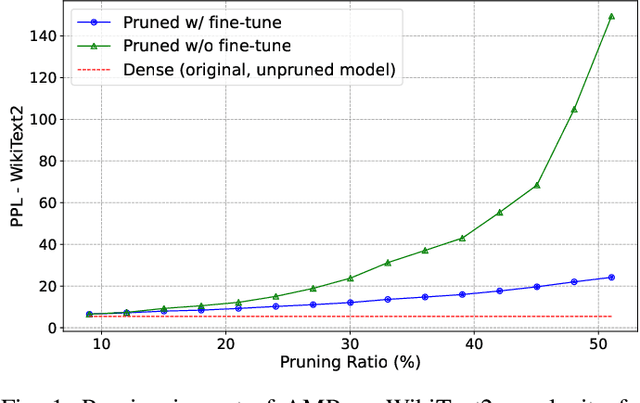
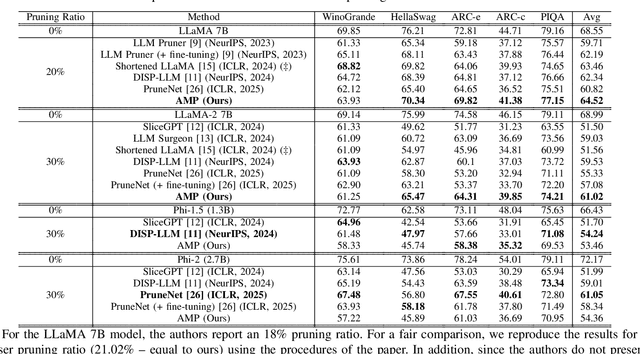
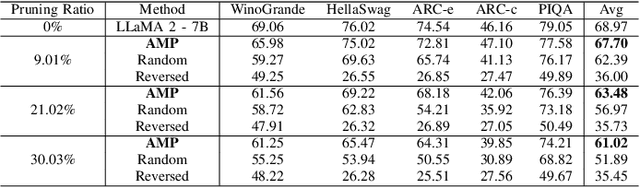

Deep learning drives a new wave in computing systems and triggers the automation of increasingly complex problems. In particular, Large Language Models (LLMs) have significantly advanced cognitive tasks, often matching or even surpassing human-level performance. However, their extensive parameters result in high computational costs and slow inference, posing challenges for deployment in resource-limited settings. Among the strategies to overcome the aforementioned challenges, pruning emerges as a successful mechanism since it reduces model size while maintaining predictive ability. In this paper, we introduce AMP: Attention Heads and MLP Pruning, a novel structured pruning method that efficiently compresses LLMs by removing less critical structures within Multi-Head Attention (MHA) and Multilayer Perceptron (MLP). By projecting the input data onto weights, AMP assesses structural importance and overcomes the limitations of existing techniques, which often fall short in flexibility or efficiency. In particular, AMP surpasses the current state-of-the-art on commonsense reasoning tasks by up to 1.49 percentage points, achieving a 30% pruning ratio with minimal impact on zero-shot task performance. Moreover, AMP also improves inference speeds, making it well-suited for deployment in resource-constrained environments. We confirm the flexibility of AMP on different families of LLMs, including LLaMA and Phi.