 Add to Chrome
 Add to Firefox
 Add to Edge
SynthAVE: Scalable Synthetic Labeling for E-Commerce with LLM-Arena Validation
Jul 08, 2026
Fine-tuning large language models (LLMs) for e-commerce attribute extraction requires labeled data representative across thousands of product types, attributes, and multiple languages. This combinatorial scale translates to millions of annotations, rendering human labeling prohibitively costly. While recent work has demonstrated synthetic label generation using LLMs, deploying such approaches at industrial scale requires integrated quality control mechanisms. We present SynthAVE, a large-scale human-validated benchmark for attribute value extraction spanning 12,726 products across 229 product types, 792 attributes, and 4 languages (Spanish, French, Italian, German). To validate synthetic labels at scale, we introduce a multi-LLM arena framework where samples are independently evaluated by 21 judge configurations (7 model families $\times$ 3 prompts), with final labels determined via majority voting. The majority vote ensemble agrees with human experts at Cohen's $κ= 0.92$ (95.2% agreement), while individual judges show substantial inter-model agreement (Fleiss' $κ= 0.76$). This demonstrates that diverse models with varying individual judgments aggregate into highly reliable predictions, enabling cost-effective validation at scale while maintaining quality parity with human review.

Transfer Learning for Fine-grained Classification Using Semi-supervised Learning and Visual Transformers
May 17, 2023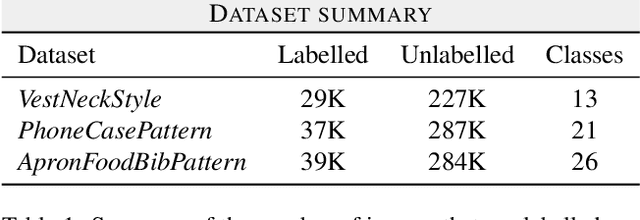
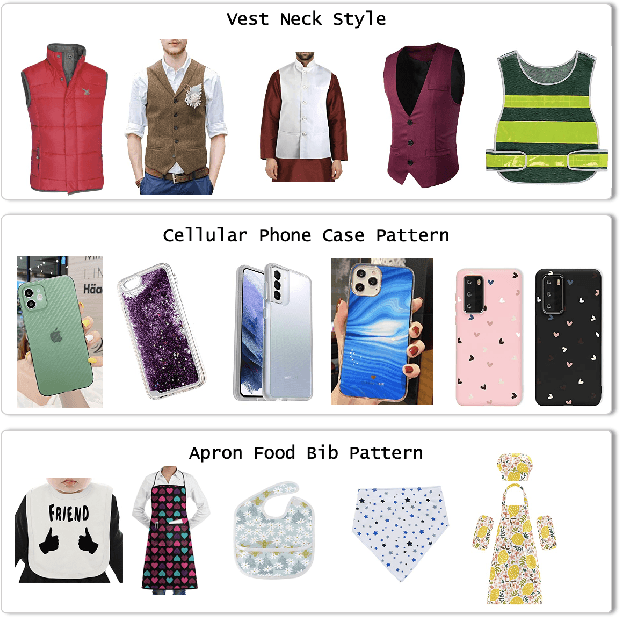
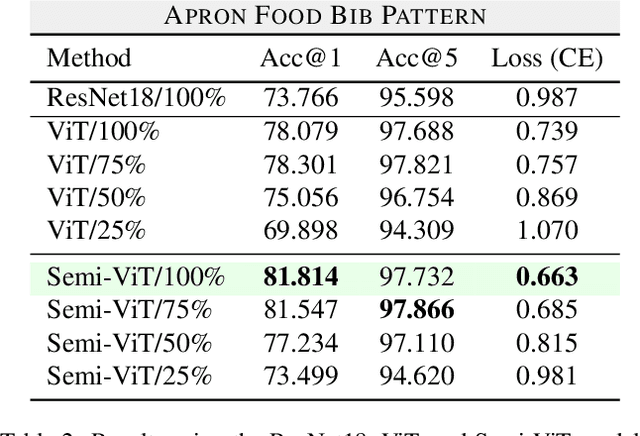
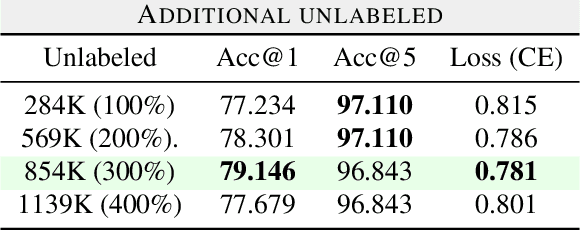
Fine-grained classification is a challenging task that involves identifying subtle differences between objects within the same category. This task is particularly challenging in scenarios where data is scarce. Visual transformers (ViT) have recently emerged as a powerful tool for image classification, due to their ability to learn highly expressive representations of visual data using self-attention mechanisms. In this work, we explore Semi-ViT, a ViT model fine tuned using semi-supervised learning techniques, suitable for situations where we have lack of annotated data. This is particularly common in e-commerce, where images are readily available but labels are noisy, nonexistent, or expensive to obtain. Our results demonstrate that Semi-ViT outperforms traditional convolutional neural networks (CNN) and ViTs, even when fine-tuned with limited annotated data. These findings indicate that Semi-ViTs hold significant promise for applications that require precise and fine-grained classification of visual data.
A multiclass Q-NLP sentiment analysis experiment using DisCoCat
Sep 07, 2022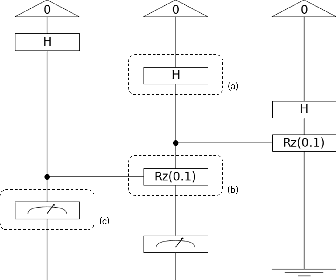

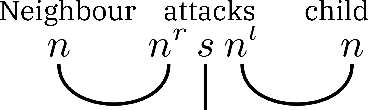
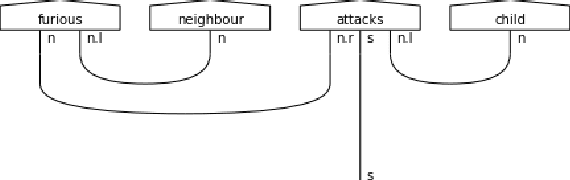
Sentiment analysis is a branch of Natural Language Processing (NLP) which goal is to assign sentiments or emotions to particular sentences or words. Performing this task is particularly useful for companies wishing to take into account customer feedback through chatbots or verbatim. This has been done extensively in the literature using various approaches, ranging from simple models to deep transformer neural networks. In this paper, we will tackle sentiment analysis in the Noisy Intermediate Scale Computing (NISQ) era, using the DisCoCat model of language. We will first present the basics of quantum computing and the DisCoCat model. This will enable us to define a general framework to perform NLP tasks on a quantum computer. We will then extend the two-class classification that was performed by Lorenz et al. (2021) to a four-class sentiment analysis experiment on a much larger dataset, showing the scalability of such a framework.