 Add to Chrome
 Add to Firefox
 Add to Edge
Bounded Difference Concentration for Infinitely Exchangeable Sequences with Applications to AI Benchmark Uncertainty
Jun 16, 2026
We consider the concentration properties of functions of infinitely exchangeable random variables. By conditioning on the de Finetti directing measure, we show that the deviation of any function with bounded-difference constants $c_1, \dots, c_n$ decomposes into a conditional sampling fluctuation and a latent mixture fluctuation. When this latent mixture is $σ_{\mathrm{mix}}^2$-subgaussian, we establish a concentration inequality with an effective variance proxy of $\frac{1}{4}\sum_i c_i^2 + σ_{\mathrm{mix}}^2$. Crucially, we demonstrate that for zero-sum linear contrasts, such as the difference between a subsample mean and a full population mean, the latent mixture term cancels exactly. This cancellation yields a tight, mixture-free Hoeffding-type bound that provides a direct de Finetti mechanism for the infinite-extendibility limit of recent finite-exchangeable concentration results. We apply this framework to quantify uncertainty in composite AI benchmarks, such as MMLU, where question items naturally exhibit exchangeable dependence across domains. Our results provide both a domain-stratified hierarchical model for bounding the uncertainty of accuracy scores, and a distribution-free, cost-saving statistical guarantee for accurately estimating full benchmark scores from random subsets.

Sharp Concentration Results for Heavy-Tailed Distributions
Mar 30, 2020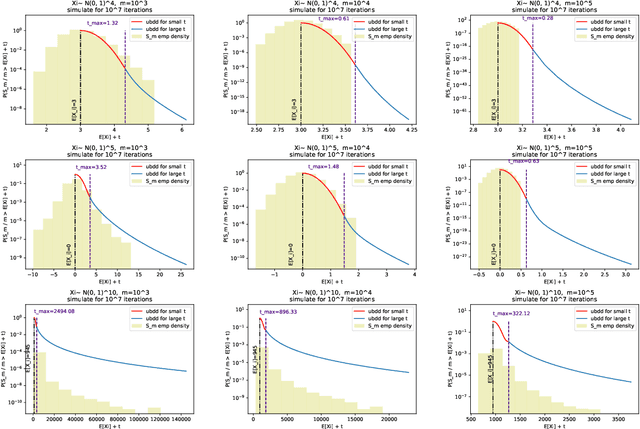
We obtain concentration and large deviation for the sums of independent and identically distributed random variables with heavy-tailed distributions. Our concentration results are concerned with random variables whose distributions satisfy $P(X>t) \leq {\rm e}^{- I(t)}$, where $I: \mathbb{R} \rightarrow \mathbb{R}$ is an increasing function and $I(t)/t \rightarrow \alpha \in [0, \infty)$ as $t \rightarrow \infty$. Our main theorem can not only recover some of the existing results, such as the concentration of the sum of subWeibull random variables, but it can also produce new results for the sum of random variables with heavier tails. We show that the concentration inequalities we obtain are sharp enough to offer large deviation results for the sums of independent random variables as well. Our analyses which are based on standard truncation arguments simplify, unify and generalize the existing results on the concentration and large deviation of heavy-tailed random variables.