 Add to Chrome
 Add to Firefox
 Add to Edge
Inferring High-Level Events from Timestamped Data: Complexity and Medical Applications
Apr 23, 2026
In this paper, we develop a novel logic-based approach to detecting high-level temporally extended events from timestamped data and background knowledge. Our framework employs logical rules to capture existence and termination conditions for simple temporal events and to combine these into meta-events. In the medical domain, for example, disease episodes and therapies are inferred from timestamped clinical observations, such as diagnoses and drug administrations stored in patient records, and can be further combined into higher-level disease events. As some incorrect events might be inferred, we use constraints to identify incompatible combinations of events and propose a repair mechanism to select preferred consistent sets of events. While reasoning in the full framework is intractable, we identify relevant restrictions that ensure polynomial-time data complexity. Our prototype system implements core components of the approach using answer set programming. An evaluation on a lung cancer use case supports the interest of the approach, both in terms of computational feasibility and positive alignment of our results with medical expert opinions. While strongly motivated by the needs of the healthcare domain, our framework is purposely generic, enabling its reuse in other areas.

Representation Learning to Advance Multi-institutional Studies with Electronic Health Record Data
Feb 12, 2025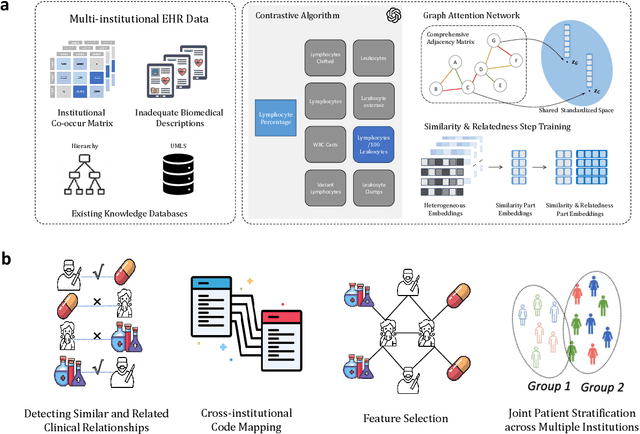
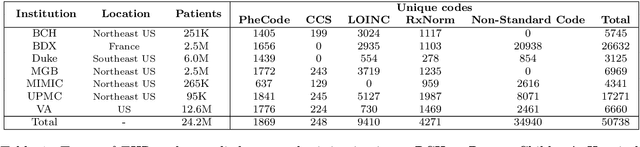
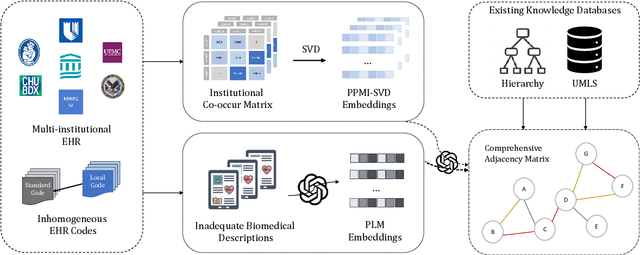

The adoption of EHRs has expanded opportunities to leverage data-driven algorithms in clinical care and research. A major bottleneck in effectively conducting multi-institutional EHR studies is the data heterogeneity across systems with numerous codes that either do not exist or represent different clinical concepts across institutions. The need for data privacy further limits the feasibility of including multi-institutional patient-level data required to study similarities and differences across patient subgroups. To address these challenges, we developed the GAME algorithm. Tested and validated across 7 institutions and 2 languages, GAME integrates data in several levels: (1) at the institutional level with knowledge graphs to establish relationships between codes and existing knowledge sources, providing the medical context for standard codes and their relationship to each other; (2) between institutions, leveraging language models to determine the relationships between institution-specific codes with established standard codes; and (3) quantifying the strength of the relationships between codes using a graph attention network. Jointly trained embeddings are created using transfer and federated learning to preserve data privacy. In this study, we demonstrate the applicability of GAME in selecting relevant features as inputs for AI-driven algorithms in a range of conditions, e.g., heart failure, rheumatoid arthritis. We then highlight the application of GAME harmonized multi-institutional EHR data in a study of Alzheimer's disease outcomes and suicide risk among patients with mental health disorders, without sharing patient-level data outside individual institutions.
Automatic detection of surgical site infections from a clinical data warehouse
Sep 16, 2019
Reducing the incidence of surgical site infections (SSIs) is one of the objectives of the French nosocomial infection control program. Manual monitoring of SSIs is carried out each year by the hospital hygiene team and surgeons at the University Hospital of Bordeaux. Our goal was to develop an automatic detection algorithm based on hospital information system data. Three years (2015, 2016 and 2017) of manual spine surgery monitoring have been used as a gold standard to extract features and train machine learning algorithms. The dataset contained 22 SSIs out of 2133 spine surgeries. Two different approaches were compared. The first used several data sources and achieved the best performance but is difficult to generalize to other institutions. The second was based on free text only with semiautomatic extraction of discriminant terms. The algorithms managed to identify all the SSIs with 20 and 26 false positives respectively on the dataset. Another evaluation is underway. These results are encouraging for the development of semi-automated surveillance methods.
* in French
IAM at CLEF eHealth 2018: Concept Annotation and Coding in French Death Certificates
Jul 10, 2018


In this paper, we describe the approach and results for our participation in the task 1 (multilingual information extraction) of the CLEF eHealth 2018 challenge. We addressed the task of automatically assigning ICD-10 codes to French death certificates. We used a dictionary-based approach using materials provided by the task organizers. The terms of the ICD-10 terminology were normalized, tokenized and stored in a tree data structure. The Levenshtein distance was used to detect typos. Frequent abbreviations were detected by manually creating a small set of them. Our system achieved an F-score of 0.786 (precision: 0.794, recall: 0.779). These scores were substantially higher than the average score of the systems that participated in the challenge.