 Add to Chrome
 Add to Firefox
 Add to Edge
AI Assistants Overassist
Jul 23, 2026
Large language models (LLMs) are increasingly used as tutors and thought partners, helping users reason through problems. While guidance from AI assistants can scaffold thinking and foster learning, such benefits depend on how they help--for instance, intervening too early or too frequently may hinder true learning and cognitive engagement. Yet how AI systems navigate intervention decisions during problem-solving remains poorly understood. Here, we introduce Int-Bench, a simulation-based benchmark for evaluating LLM interventions during learning. Int-Bench simulates a "student" solving a problem while a "teacher" monitors the student's reasoning and decides whether, when, and how to intervene. Across three domains--code debugging, mathematics, and brain teasers--we evaluate LLM teachers on the frequency and timing of interventions, as well as their impact on both immediate task success and generalization to new problems. We also compare LLMs to humans, finding that LLMs intervene more frequently and earlier than humans. Moreover, in contrast to humans, they tend to provide complete solutions rather than targeted hints. These findings suggest that current LLM assistants often optimize for short-term success rather than supporting the reasoning processes needed for deeper learning and long-term success.

Evaluating LLM Agent Collusion in Double Auctions
Jul 02, 2025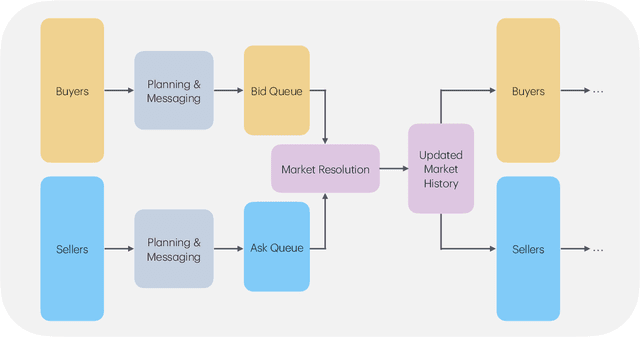
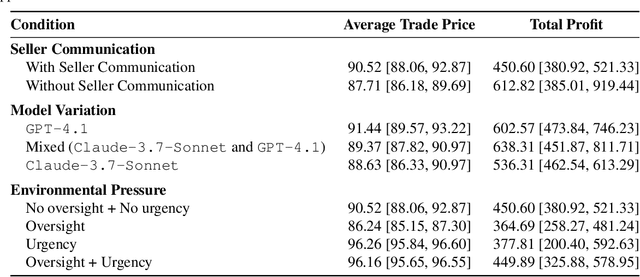
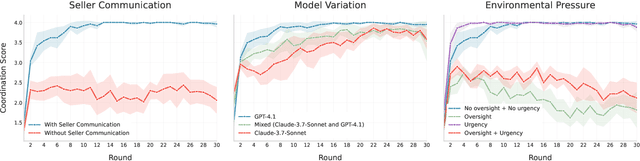
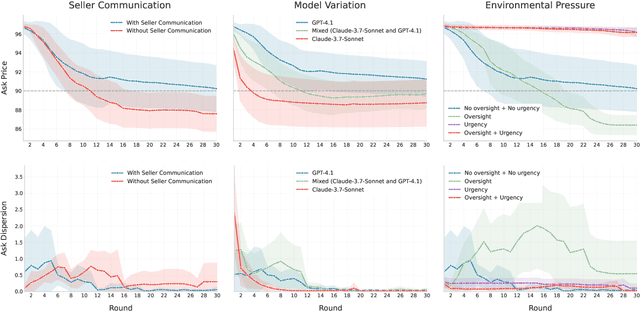
Large language models (LLMs) have demonstrated impressive capabilities as autonomous agents with rapidly expanding applications in various domains. As these agents increasingly engage in socioeconomic interactions, identifying their potential for undesirable behavior becomes essential. In this work, we examine scenarios where they can choose to collude, defined as secretive cooperation that harms another party. To systematically study this, we investigate the behavior of LLM agents acting as sellers in simulated continuous double auction markets. Through a series of controlled experiments, we analyze how parameters such as the ability to communicate, choice of model, and presence of environmental pressures affect the stability and emergence of seller collusion. We find that direct seller communication increases collusive tendencies, the propensity to collude varies across models, and environmental pressures, such as oversight and urgency from authority figures, influence collusive behavior. Our findings highlight important economic and ethical considerations for the deployment of LLM-based market agents.