 Add to Chrome
 Add to Firefox
 Add to Edge
DialogPII: A multilingual dataset of synthetic dialog transcripts to detect personal information
Jun 29, 2026
Conversational data collected in domains such as healthcare or social sciences is a valuable resource for research and automated analysis. However, responsible data sharing requires the detection and removal of personally identifiable and sensitive information to protect individual privacy. To support the development and evaluation of automatic de-identification systems, we present DialogPII, a multilingual dataset of synthetic dialogs and speech-derived transcripts for personal information detection. DialogPII covers eight interaction scenarios (emergency calls, medical anamnesis interviews, therapy sessions, insurance communication, customer support, clinical interviews regarding an AI-supported dashboard, police reports, and group therapy discussions), 19 entity types, and 11 languages (English, Arabic, Finnish, French, German, Hindi, Italian, Polish, Portuguese, Spanish, and Turkish). Dialogs were generated semi-automatically using large language models, manually curated for plausibility and diversity, and localized to country- and city-specific contexts. All dialogs were additionally converted to speech via text-to-speech synthesis, transcribed with Whisper, and annotated through automatic projection and manual correction, yielding aligned written and speech-derived resources across all languages. We further release baseline multilingual named entity recognition models and provide technical validation through inter-annotator agreement analysis, translation quality evaluation, annotation projection assessment, and benchmark experiments with transformer-based sequence labeling models.

MultiGraSCCo: A Multilingual Anonymization Benchmark with Annotations of Personal Identifiers
Mar 11, 2026Accessing sensitive patient data for machine learning is challenging due to privacy concerns. Datasets with annotations of personally identifiable information are crucial for developing and testing anonymization systems to enable safe data sharing that complies with privacy regulations. Since accessing real patient data is a bottleneck, synthetic data offers an efficient solution for data scarcity, bypassing privacy regulations that apply to real data. Moreover, neural machine translation can help to create high-quality data for low-resource languages by translating validated real or synthetic data from a high-resource language. In this work, we create a multilingual anonymization benchmark in ten languages, using a machine translation methodology that preserves the original annotations and renders names of cities and people in a culturally and contextually appropriate form in each target language. Our evaluation study with medical professionals confirms the quality of the translations, both in general and with respect to the translation and adaptation of personal information. Our benchmark with over 2,500 annotations of personal information can be used in many applications, including training annotators, validating annotations across institutions without legal complications, and helping improve the performance of automatic personal information detection. We make our benchmark and annotation guidelines available for further research.
Evaluation of a Sign Language Avatar on Comprehensibility, User Experience \& Acceptability
Aug 07, 2025This paper presents an investigation into the impact of adding adjustment features to an existing sign language (SL) avatar on a Microsoft Hololens 2 device. Through a detailed analysis of interactions of expert German Sign Language (DGS) users with both adjustable and non-adjustable avatars in a specific use case, this study identifies the key factors influencing the comprehensibility, the user experience (UX), and the acceptability of such a system. Despite user preference for adjustable settings, no significant improvements in UX or comprehensibility were observed, which remained at low levels, amid missing SL elements (mouthings and facial expressions) and implementation issues (indistinct hand shapes, lack of feedback and menu positioning). Hedonic quality was rated higher than pragmatic quality, indicating that users found the system more emotionally or aesthetically pleasing than functionally useful. Stress levels were higher for the adjustable avatar, reflecting lower performance, greater effort and more frustration. Additionally, concerns were raised about whether the Hololens adjustment gestures are intuitive and easy to familiarise oneself with. While acceptability of the concept of adjustability was generally positive, it was strongly dependent on usability and animation quality. This study highlights that personalisation alone is insufficient, and that SL avatars must be comprehensible by default. Key recommendations include enhancing mouthing and facial animation, improving interaction interfaces, and applying participatory design.
The TUB Sign Language Corpus Collection
Aug 07, 2025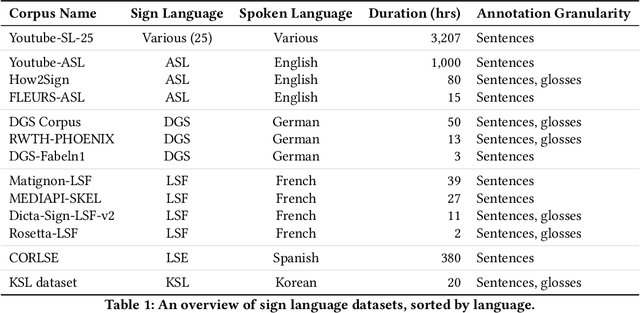
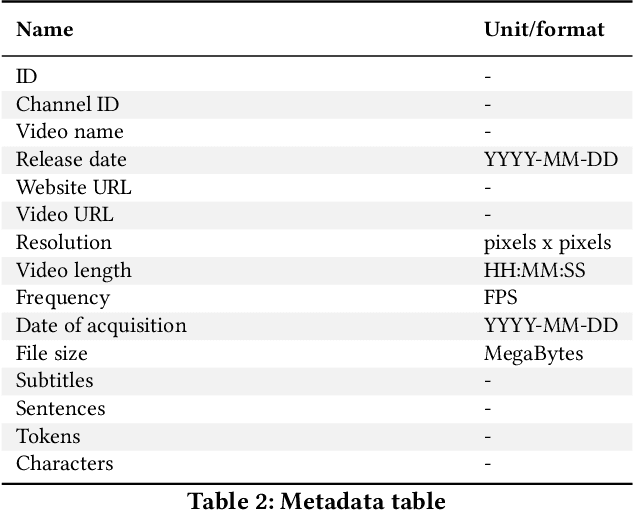
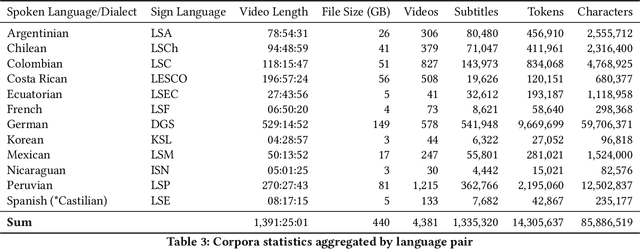
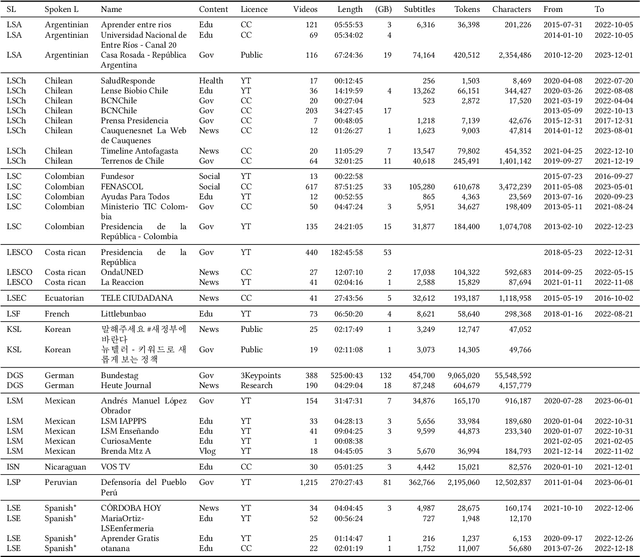
We present a collection of parallel corpora of 12 sign languages in video format, together with subtitles in the dominant spoken languages of the corresponding countries. The entire collection includes more than 1,300 hours in 4,381 video files, accompanied by 1,3~M subtitles containing 14~M tokens. Most notably, it includes the first consistent parallel corpora for 8 Latin American sign languages, whereas the size of the German Sign Language corpora is ten times the size of the previously available corpora. The collection was created by collecting and processing videos of multiple sign languages from various online sources, mainly broadcast material of news shows, governmental bodies and educational channels. The preparation involved several stages, including data collection, informing the content creators and seeking usage approvals, scraping, and cropping. The paper provides statistics on the collection and an overview of the methods used to collect the data.