 Add to Chrome
 Add to Firefox
 Add to Edge
DialogPII: A multilingual dataset of synthetic dialog transcripts to detect personal information
Jun 29, 2026
Conversational data collected in domains such as healthcare or social sciences is a valuable resource for research and automated analysis. However, responsible data sharing requires the detection and removal of personally identifiable and sensitive information to protect individual privacy. To support the development and evaluation of automatic de-identification systems, we present DialogPII, a multilingual dataset of synthetic dialogs and speech-derived transcripts for personal information detection. DialogPII covers eight interaction scenarios (emergency calls, medical anamnesis interviews, therapy sessions, insurance communication, customer support, clinical interviews regarding an AI-supported dashboard, police reports, and group therapy discussions), 19 entity types, and 11 languages (English, Arabic, Finnish, French, German, Hindi, Italian, Polish, Portuguese, Spanish, and Turkish). Dialogs were generated semi-automatically using large language models, manually curated for plausibility and diversity, and localized to country- and city-specific contexts. All dialogs were additionally converted to speech via text-to-speech synthesis, transcribed with Whisper, and annotated through automatic projection and manual correction, yielding aligned written and speech-derived resources across all languages. We further release baseline multilingual named entity recognition models and provide technical validation through inter-annotator agreement analysis, translation quality evaluation, annotation projection assessment, and benchmark experiments with transformer-based sequence labeling models.

MultiGraSCCo: A Multilingual Anonymization Benchmark with Annotations of Personal Identifiers
Mar 11, 2026Accessing sensitive patient data for machine learning is challenging due to privacy concerns. Datasets with annotations of personally identifiable information are crucial for developing and testing anonymization systems to enable safe data sharing that complies with privacy regulations. Since accessing real patient data is a bottleneck, synthetic data offers an efficient solution for data scarcity, bypassing privacy regulations that apply to real data. Moreover, neural machine translation can help to create high-quality data for low-resource languages by translating validated real or synthetic data from a high-resource language. In this work, we create a multilingual anonymization benchmark in ten languages, using a machine translation methodology that preserves the original annotations and renders names of cities and people in a culturally and contextually appropriate form in each target language. Our evaluation study with medical professionals confirms the quality of the translations, both in general and with respect to the translation and adaptation of personal information. Our benchmark with over 2,500 annotations of personal information can be used in many applications, including training annotators, validating annotations across institutions without legal complications, and helping improve the performance of automatic personal information detection. We make our benchmark and annotation guidelines available for further research.
Beyond De-Identification: A Structured Approach for Defining and Detecting Indirect Identifiers in Medical Texts
Feb 18, 2025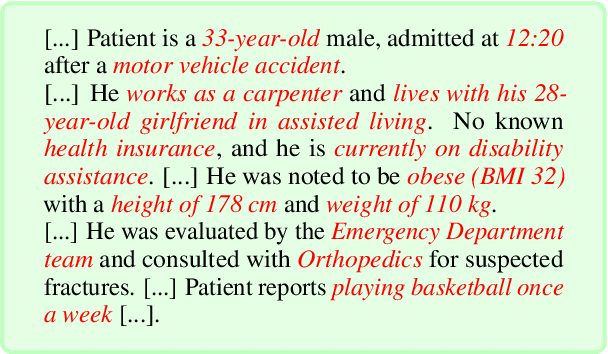
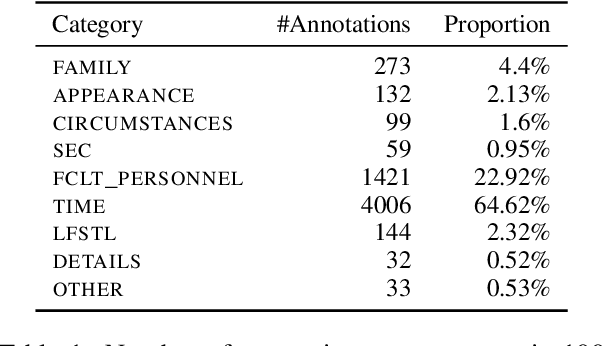
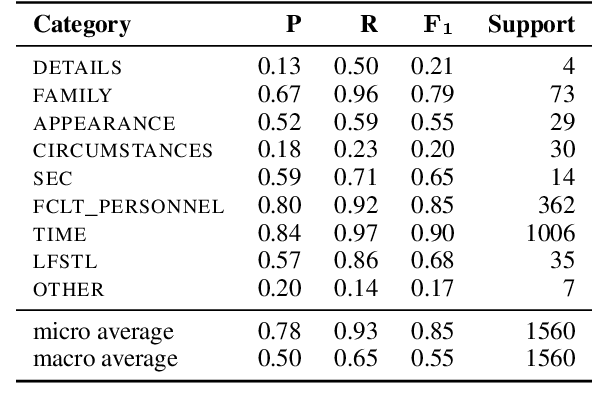
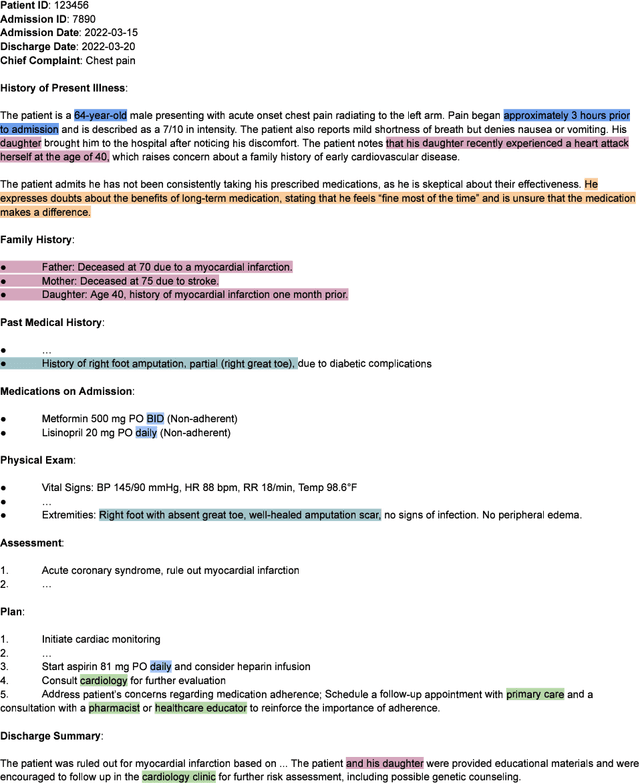
Sharing sensitive texts for scientific purposes requires appropriate techniques to protect the privacy of patients and healthcare personnel. Anonymizing textual data is particularly challenging due to the presence of diverse unstructured direct and indirect identifiers. To mitigate the risk of re-identification, this work introduces a schema of nine categories of indirect identifiers designed to account for different potential adversaries, including acquaintances, family members and medical staff. Using this schema, we annotate 100 MIMIC-III discharge summaries and propose baseline models for identifying indirect identifiers. We will release the annotation guidelines, annotation spans (6,199 annotations in total) and the corresponding MIMIC-III document IDs to support further research in this area.