 Add to Chrome
 Add to Firefox
 Add to Edge
ProDM: Synthetic Reality-driven Property-aware Progressive Diffusion Model for Coronary Calcium Motion Correction in Non-gated Chest CT
Dec 31, 2025
Coronary artery calcium (CAC) scoring from chest CT is a well-established tool to stratify and refine clinical cardiovascular disease risk estimation. CAC quantification relies on the accurate delineation of calcified lesions, but is oftentimes affected by artifacts introduced by cardiac and respiratory motion. ECG-gated cardiac CTs substantially reduce motion artifacts, but their use in population screening and routine imaging remains limited due to gating requirements and lack of insurance coverage. Although identification of incidental CAC from non-gated chest CT is increasingly considered for it offers an accessible and widely available alternative, this modality is limited by more severe motion artifacts. We present ProDM (Property-aware Progressive Correction Diffusion Model), a generative diffusion framework that restores motion-free calcified lesions from non-gated CTs. ProDM introduces three key components: (1) a CAC motion simulation data engine that synthesizes realistic non-gated acquisitions with diverse motion trajectories directly from cardiac-gated CTs, enabling supervised training without paired data; (2) a property-aware learning strategy incorporating calcium-specific priors through a differentiable calcium consistency loss to preserve lesion integrity; and (3) a progressive correction scheme that reduces artifacts gradually across diffusion steps to enhance stability and calcium fidelity. Experiments on real patient datasets show that ProDM significantly improves CAC scoring accuracy, spatial lesion fidelity, and risk stratification performance compared with several baselines. A reader study on real non-gated scans further confirms that ProDM suppresses motion artifacts and improves clinical usability. These findings highlight the potential of progressive, property-aware frameworks for reliable CAC quantification from routine chest CT imaging.

Uncertainty-Guided Cross Attention Ensemble Mean Teacher for Semi-supervised Medical Image Segmentation
Dec 19, 2024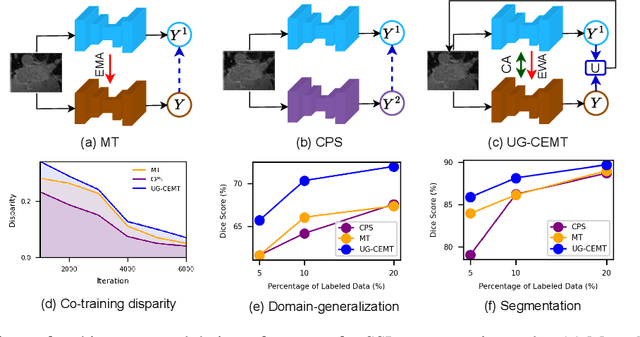
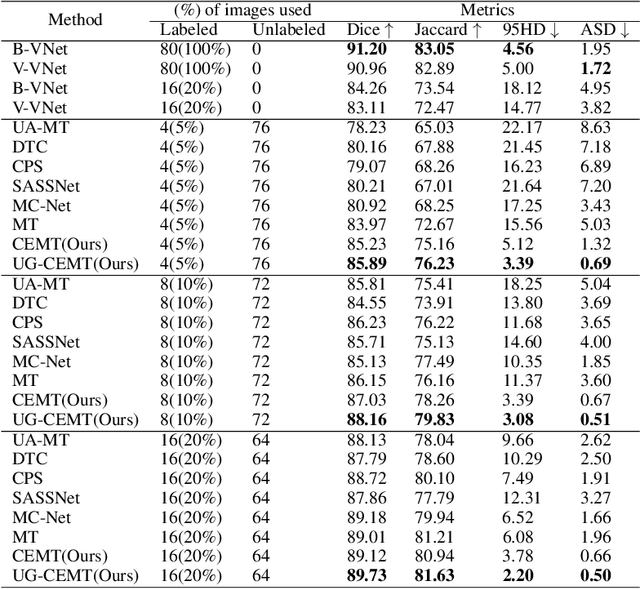
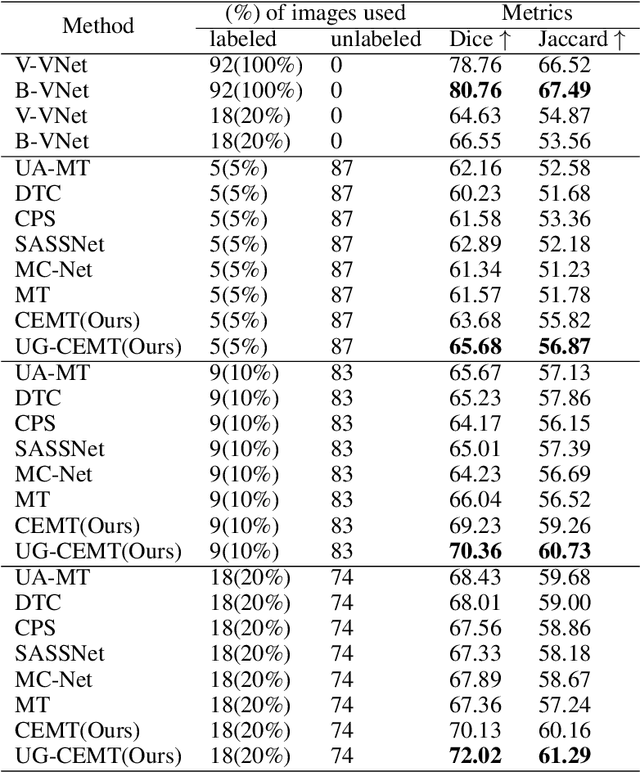
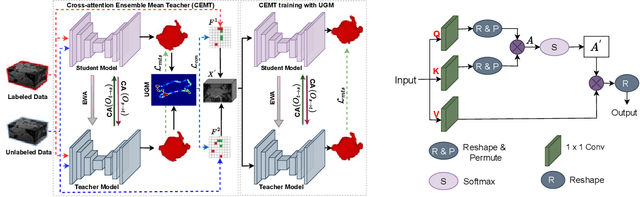
This work proposes a novel framework, Uncertainty-Guided Cross Attention Ensemble Mean Teacher (UG-CEMT), for achieving state-of-the-art performance in semi-supervised medical image segmentation. UG-CEMT leverages the strengths of co-training and knowledge distillation by combining a Cross-attention Ensemble Mean Teacher framework (CEMT) inspired by Vision Transformers (ViT) with uncertainty-guided consistency regularization and Sharpness-Aware Minimization emphasizing uncertainty. UG-CEMT improves semi-supervised performance while maintaining a consistent network architecture and task setting by fostering high disparity between sub-networks. Experiments demonstrate significant advantages over existing methods like Mean Teacher and Cross-pseudo Supervision in terms of disparity, domain generalization, and medical image segmentation performance. UG-CEMT achieves state-of-the-art results on multi-center prostate MRI and cardiac MRI datasets, where object segmentation is particularly challenging. Our results show that using only 10\% labeled data, UG-CEMT approaches the performance of fully supervised methods, demonstrating its effectiveness in exploiting unlabeled data for robust medical image segmentation. The code is publicly available at \url{https://github.com/Meghnak13/UG-CEMT}
Mortality Prediction of Pulmonary Embolism Patients with Deep Learning and XGBoost
Nov 27, 2024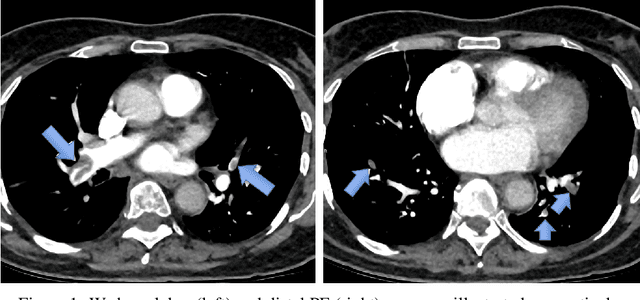
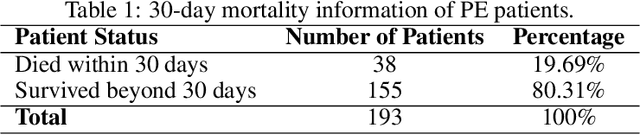
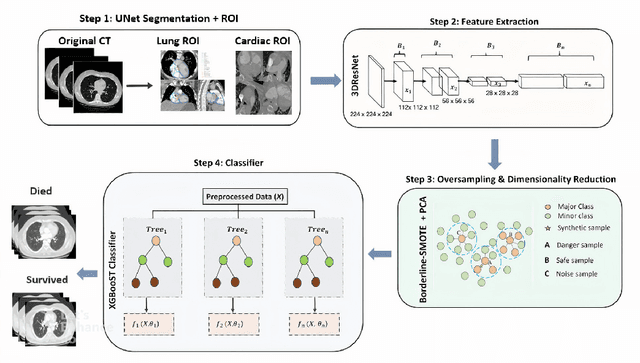

Pulmonary Embolism (PE) is a serious cardiovascular condition that remains a leading cause of mortality and critical illness, underscoring the need for enhanced diagnostic strategies. Conventional clinical methods have limited success in predicting 30-day in-hospital mortality of PE patients. In this study, we present a new algorithm, called PEP-Net, for 30-day mortality prediction of PE patients based on the initial imaging data (CT) that opportunistically integrates a 3D Residual Network (3DResNet) with Extreme Gradient Boosting (XGBoost) algorithm with patient level binary labels without annotations of the emboli and its extent. Our proposed system offers a comprehensive prediction strategy by handling class imbalance problems, reducing overfitting via regularization, and reducing the prediction variance for more stable predictions. PEP-Net was tested in a cohort of 193 volumetric CT scans diagnosed with Acute PE, and it demonstrated a superior performance by significantly outperforming baseline models (76-78\%) with an accuracy of 94.5\% (+/-0.3) and 94.0\% (+/-0.7) when the input image is either lung region (Lung-ROI) or heart region (Cardiac-ROI). Our results advance PE prognostics by using only initial imaging data, setting a new benchmark in the field. While purely deep learning models have become the go-to for many medical classification (diagnostic) tasks, combined ResNet and XGBoost models herein outperform sole deep learning models due to a potential reason for having lack of enough data.
Selecting the Best Optimizers for Deep Learning based Medical Image Segmentation
Feb 05, 2023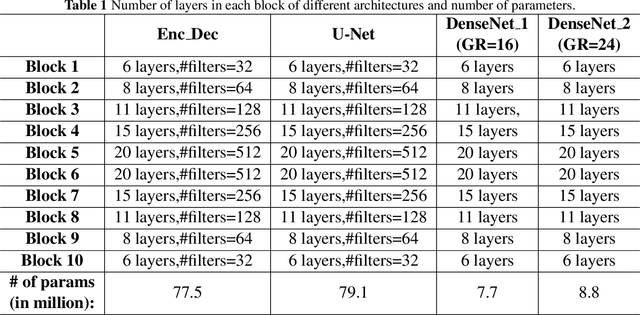
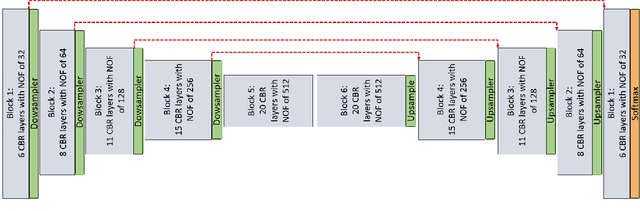
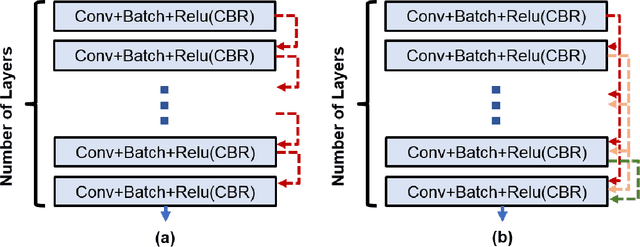
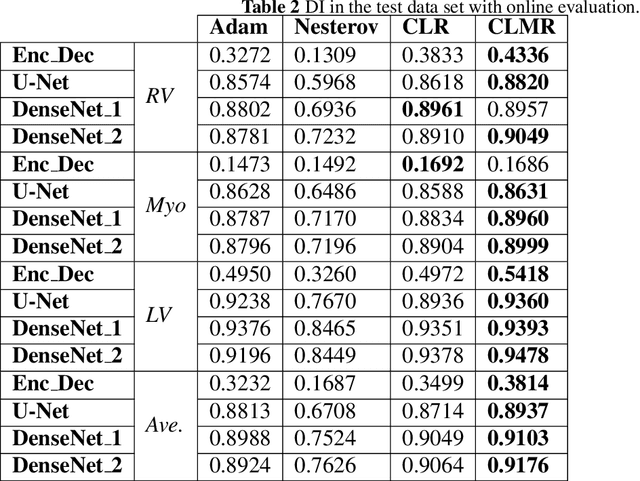
The goal of this work is to identify the best optimizers for deep learning in the context of cardiac image segmentation and to provide guidance on how to design segmentation networks with effective optimization strategies. Adaptive learning helps with fast convergence by starting with a larger learning rate (LR) and gradually decreasing it. Momentum optimizers are particularly effective at quickly optimizing neural networks within the accelerated schemes category. By revealing the potential interplay between these two types of algorithms (LR and momentum optimizers or momentum rate (MR) in short), in this article, we explore the two variants of SGD algorithms in a single setting. We suggest using cyclic learning as the base optimizer and integrating optimal values of learning rate and momentum rate. We investigated the relationship of LR and MR under an important problem of medical image segmentation of cardiac structures from MRI and CT scans. We conducted experiments using the cardiac imaging dataset from the ACDC challenge of MICCAI 2017, and four different architectures shown to be successful for cardiac image segmentation problems. Our comprehensive evaluations demonstrated that the proposed optimizer achieved better results (over a 2\% improvement in the dice metric) than other optimizers in deep learning literature with similar or lower computational cost in both single and multi-object segmentation settings. We hypothesized that combination of accelerated and adaptive optimization methods can have a drastic effect in medical image segmentation performances. To this end, we proposed a new cyclic optimization method (\textit{CLMR}) to address the efficiency and accuracy problems in deep learning based medical image segmentation. The proposed strategy yielded better generalization in comparison to adaptive optimizers.