 Add to Chrome
 Add to Firefox
 Add to Edge
ML Compass: Navigating Capability, Cost, and Compliance Trade-offs in AI Model Deployment
Dec 29, 2025
We study how organizations should select among competing AI models when user utility, deployment costs, and compliance requirements jointly matter. Widely used capability leaderboards do not translate directly into deployment decisions, creating a capability -- deployment gap; to bridge it, we take a systems-level view in which model choice is tied to application outcomes, operating constraints, and a capability-cost frontier. We develop ML Compass, a framework that treats model selection as constrained optimization over this frontier. On the theory side, we characterize optimal model configurations under a parametric frontier and show a three-regime structure in optimal internal measures: some dimensions are pinned at compliance minima, some saturate at maximum levels, and the remainder take interior values governed by frontier curvature. We derive comparative statics that quantify how budget changes, regulatory tightening, and technological progress propagate across capability dimensions and costs. On the implementation side, we propose a pipeline that (i) extracts low-dimensional internal measures from heterogeneous model descriptors, (ii) estimates an empirical frontier from capability and cost data, (iii) learns a user- or task-specific utility function from interaction outcome data, and (iv) uses these components to target capability-cost profiles and recommend models. We validate ML Compass with two case studies: a general-purpose conversational setting using the PRISM Alignment dataset and a healthcare setting using a custom dataset we build using HealthBench. In both environments, our framework produces recommendations -- and deployment-aware leaderboards based on predicted deployment value under constraints -- that can differ materially from capability-only rankings, and clarifies how trade-offs between capability, cost, and safety shape optimal model choice.

The Challenger: When Do New Data Sources Justify Switching Machine Learning Models?
Dec 20, 2025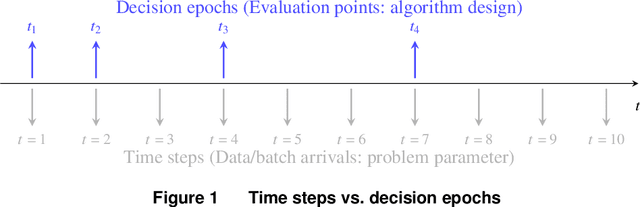
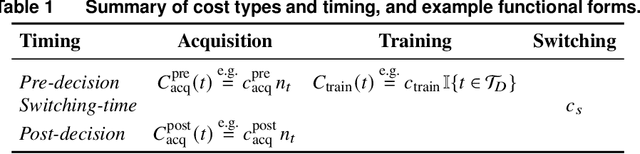

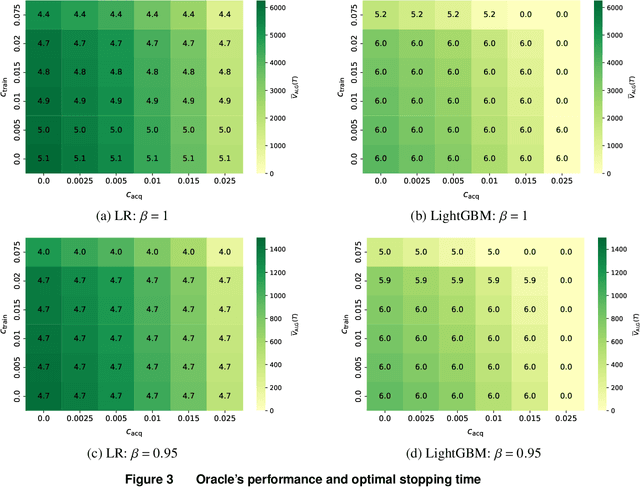
We study the problem of deciding whether, and when an organization should replace a trained incumbent model with a challenger relying on newly available features. We develop a unified economic and statistical framework that links learning-curve dynamics, data-acquisition and retraining costs, and discounting of future gains. First, we characterize the optimal switching time in stylized settings and derive closed-form expressions that quantify how horizon length, learning-curve curvature, and cost differentials shape the optimal decision. Second, we propose three practical algorithms: a one-shot baseline, a greedy sequential method, and a look-ahead sequential method. Using a real-world credit-scoring dataset with gradually arriving alternative data, we show that (i) optimal switching times vary systematically with cost parameters and learning-curve behavior, and (ii) the look-ahead sequential method outperforms other methods and is able to approach in value an oracle with full foresight. Finally, we establish finite-sample guarantees, including conditions under which the sequential look-ahead method achieve sublinear regret relative to that oracle. Our results provide an operational blueprint for economically sound model transitions as new data sources become available.