 Add to Chrome
 Add to Firefox
 Add to Edge
The Challenger: When Do New Data Sources Justify Switching Machine Learning Models?
Paper and Code
Dec 20, 2025
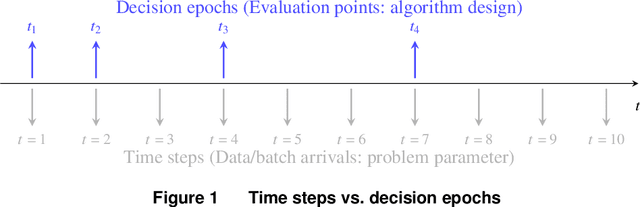
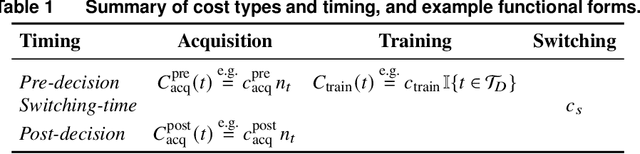

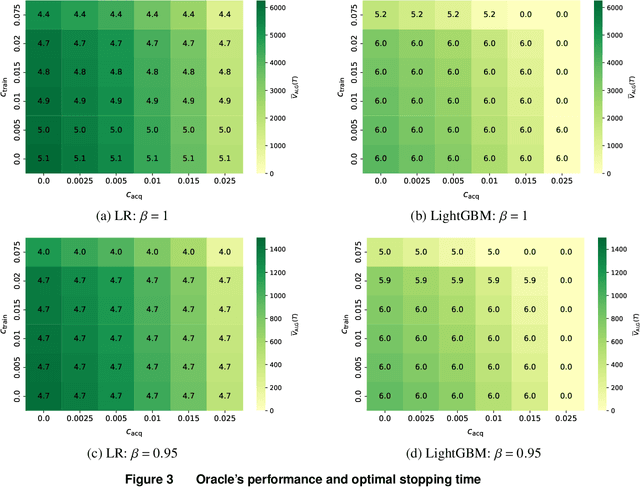
We study the problem of deciding whether, and when an organization should replace a trained incumbent model with a challenger relying on newly available features. We develop a unified economic and statistical framework that links learning-curve dynamics, data-acquisition and retraining costs, and discounting of future gains. First, we characterize the optimal switching time in stylized settings and derive closed-form expressions that quantify how horizon length, learning-curve curvature, and cost differentials shape the optimal decision. Second, we propose three practical algorithms: a one-shot baseline, a greedy sequential method, and a look-ahead sequential method. Using a real-world credit-scoring dataset with gradually arriving alternative data, we show that (i) optimal switching times vary systematically with cost parameters and learning-curve behavior, and (ii) the look-ahead sequential method outperforms other methods and is able to approach in value an oracle with full foresight. Finally, we establish finite-sample guarantees, including conditions under which the sequential look-ahead method achieve sublinear regret relative to that oracle. Our results provide an operational blueprint for economically sound model transitions as new data sources become available.
