 Add to Chrome
 Add to Firefox
 Add to Edge
Combining Masked Language Modeling and Cross-Modal Contrastive Learning for Prosody-Aware TTS
Mar 31, 2026
We investigate multi-stage pretraining for prosody modeling in diffusion-based TTS. A speaker-conditioned dual-stream encoder is trained with masked language modeling followed by SigLIP-style cross-modal contrastive learning using mixed-phoneme batches, with an additional same-phoneme refinement stage studied separately. We evaluate intrinsic text-audio retrieval and downstream synthesis in Grad-TTS and a latent diffusion TTS system. The two-stage curriculum (MLM + mixed-phoneme contrastive learning) achieves the best overall synthesis quality in terms of intelligibility, speaker similarity, and perceptual measures. Although same-phoneme refinement improves prosodic retrieval, it reduces phoneme discrimination and degrades synthesis. These findings indicate that improvements in embedding-space metrics do not necessarily translate to better generative performance and highlight the need to balance phoneme discrimination and prosodic sensitivity in TTS pretraining.

When Spoof Detectors Travel: Evaluation Across 66 Languages in the Low-Resource Language Spoofing Corpus
Mar 02, 2026We introduce LRLspoof, a large-scale multilingual synthetic-speech corpus for cross-lingual spoof detection, comprising 2,732 hours of audio generated with 24 open-source TTS systems across 66 languages, including 45 low-resource languages under our operational definition. To evaluate robustness without requiring target-domain bonafide speech, we benchmark 11 publicly available countermeasures using threshold transfer: for each model we calibrate an EER operating point on pooled external benchmarks and apply the resulting threshold, reporting spoof rejection rate (SRR). Results show model-dependent cross-lingual disparity, with spoof rejection varying markedly across languages even under controlled conditions, highlighting language as an independent source of domain shift in spoof detection. The dataset is publicly available at \href{https://huggingface.co/datasets/MTUCI/LRLspoof}{\textbf{\underline{\textit{HuggingFace}}}} and \href{https://modelscope.cn/datasets/lab260/LRLspoof}{\textbf{\underline{\textit{ModelScope}}}}
From Visual to Multimodal: Systematic Ablation of Encoders and Fusion Strategies in Animal Identification
Feb 28, 2026Automated animal identification is a practical task for reuniting lost pets with their owners, yet current systems often struggle due to limited dataset scale and reliance on unimodal visual cues. This study introduces a multimodal verification framework that enhances visual features with semantic identity priors derived from synthetic textual descriptions. We constructed a massive training corpus of 1.9 million photographs covering 695,091~unique animals to support this investigation. Through systematic ablation studies, we identified SigLIP2-Giant and E5-Small-v2 as the optimal vision and text backbones. We further evaluated fusion strategies ranging from simple concatenation to adaptive gating to determine the best method for integrating these modalities. Our proposed approach utilizes a gated fusion mechanism and achieved a Top-1 accuracy of 84.28\% and an Equal Error Rate of 0.0422 on a comprehensive test protocol. These results represent an 11\% improvement over leading unimodal baselines and demonstrate that integrating synthesized semantic descriptions significantly refines decision boundaries in large-scale pet re-identification.
* Published at MDPI Journal of Imaging (see at https://www.mdpi.com/2313-433X/12/1/30)
A Data-Centric Framework for Addressing Phonetic and Prosodic Challenges in Russian Speech Generative Models
Jul 17, 2025Russian speech synthesis presents distinctive challenges, including vowel reduction, consonant devoicing, variable stress patterns, homograph ambiguity, and unnatural intonation. This paper introduces Balalaika, a novel dataset comprising more than 2,000 hours of studio-quality Russian speech with comprehensive textual annotations, including punctuation and stress markings. Experimental results show that models trained on Balalaika significantly outperform those trained on existing datasets in both speech synthesis and enhancement tasks. We detail the dataset construction pipeline, annotation methodology, and results of comparative evaluations.
AASIST3: KAN-Enhanced AASIST Speech Deepfake Detection using SSL Features and Additional Regularization for the ASVspoof 2024 Challenge
Aug 30, 2024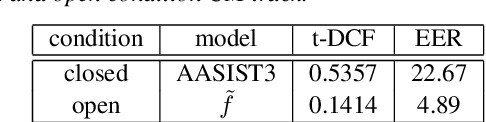

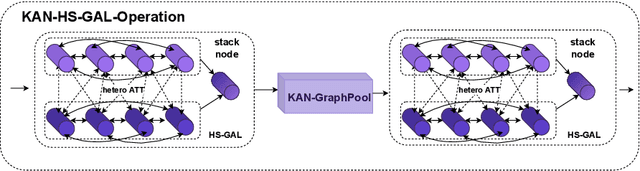
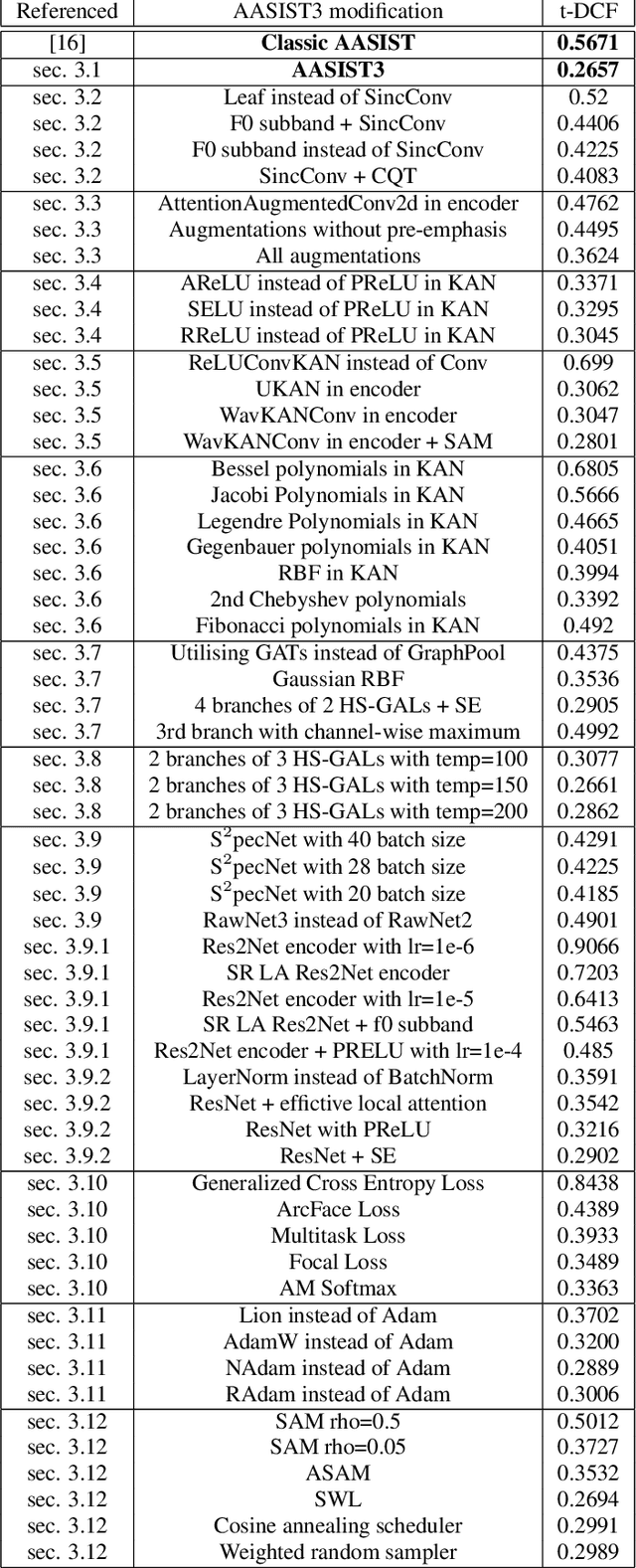
Automatic Speaker Verification (ASV) systems, which identify speakers based on their voice characteristics, have numerous applications, such as user authentication in financial transactions, exclusive access control in smart devices, and forensic fraud detection. However, the advancement of deep learning algorithms has enabled the generation of synthetic audio through Text-to-Speech (TTS) and Voice Conversion (VC) systems, exposing ASV systems to potential vulnerabilities. To counteract this, we propose a novel architecture named AASIST3. By enhancing the existing AASIST framework with Kolmogorov-Arnold networks, additional layers, encoders, and pre-emphasis techniques, AASIST3 achieves a more than twofold improvement in performance. It demonstrates minDCF results of 0.5357 in the closed condition and 0.1414 in the open condition, significantly enhancing the detection of synthetic voices and improving ASV security.