 Add to Chrome
 Add to Firefox
 Add to Edge
A Browser-based Open Source Assistant for Multimodal Content Verification
Mar 03, 2026
Disinformation and false content produced by generative AI pose a significant challenge for journalists and fact-checkers who must rapidly verify digital media information. While there is an abundance of NLP models for detecting credibility signals such as persuasion techniques, subjectivity, or machine-generated text, such methods often remain inaccessible to non-expert users and are not integrated into their daily workflows as a unified framework. This paper demonstrates the VERIFICATION ASSISTANT, a browser-based tool designed to bridge this gap. The VERIFICATION ASSISTANT, a core component of the widely adopted VERIFICATION PLUGIN (140,000+ users), allows users to submit URLs or media files to a unified interface. It automatically extracts content and routes it to a suite of backend NLP classifiers, delivering actionable credibility signals, estimating AI-generated content, and providing other verification guidance in a clear, easy-to-digest format. This paper showcases the tool architecture, its integration of multiple NLP services, and its real-world application to detecting disinformation.

A Survey on Automatic Credibility Assessment of Textual Credibility Signals in the Era of Large Language Models
Oct 28, 2024

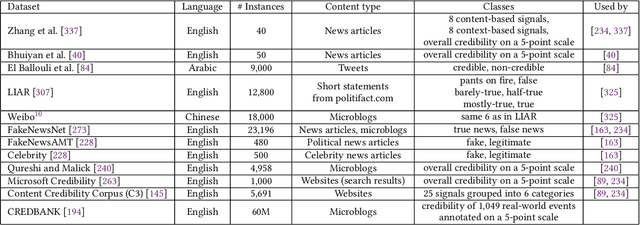
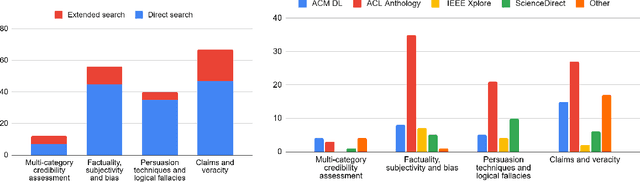
In the current era of social media and generative AI, an ability to automatically assess the credibility of online social media content is of tremendous importance. Credibility assessment is fundamentally based on aggregating credibility signals, which refer to small units of information, such as content factuality, bias, or a presence of persuasion techniques, into an overall credibility score. Credibility signals provide a more granular, more easily explainable and widely utilizable information in contrast to currently predominant fake news detection, which utilizes various (mostly latent) features. A growing body of research on automatic credibility assessment and detection of credibility signals can be characterized as highly fragmented and lacking mutual interconnections. This issue is even more prominent due to a lack of an up-to-date overview of research works on automatic credibility assessment. In this survey, we provide such systematic and comprehensive literature review of 175 research papers while focusing on textual credibility signals and Natural Language Processing (NLP), which undergoes a significant advancement due to Large Language Models (LLMs). While positioning the NLP research into the context of other multidisciplinary research works, we tackle with approaches for credibility assessment as well as with 9 categories of credibility signals (we provide a thorough analysis for 3 of them, namely: 1) factuality, subjectivity and bias, 2) persuasion techniques and logical fallacies, and 3) claims and veracity). Following the description of the existing methods, datasets and tools, we identify future challenges and opportunities, while paying a specific attention to recent rapid development of generative AI.
Evolution of Detection Performance throughout the Online Lifespan of Synthetic Images
Aug 21, 2024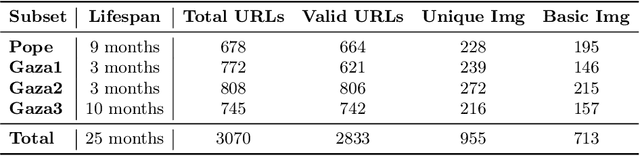

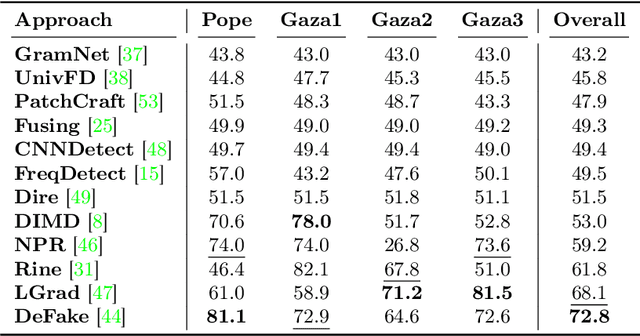

Synthetic images disseminated online significantly differ from those used during the training and evaluation of the state-of-the-art detectors. In this work, we analyze the performance of synthetic image detectors as deceptive synthetic images evolve throughout their online lifespan. Our study reveals that, despite advancements in the field, current state-of-the-art detectors struggle to distinguish between synthetic and real images in the wild. Moreover, we show that the time elapsed since the initial online appearance of a synthetic image negatively affects the performance of most detectors. Ultimately, by employing a retrieval-assisted detection approach, we demonstrate the feasibility to maintain initial detection performance throughout the whole online lifespan of an image and enhance the average detection efficacy across several state-of-the-art detectors by 6.7% and 7.8% for balanced accuracy and AUC metrics, respectively.