 Add to Chrome
 Add to Firefox
 Add to Edge
VOLTA: The Surprising Ineffectiveness of Auxiliary Losses for Calibrated Deep Learning
Apr 09, 2026
Uncertainty quantification (UQ) is essential for deploying deep learning models in safety critical applications, yet no consensus exists on which UQ method performs best across different data modalities and distribution shifts. This paper presents a comprehensive benchmark of ten widely used UQ baselines including MC Dropout, SWAG, ensemble methods, temperature scaling, energy based OOD, Mahalanobis, hyperbolic classifiers, ENN, Taylor Sensus, and split conformal prediction against a simplified yet highly effective variant of VOLTA that retains only a deep encoder, learnable prototypes, cross entropy loss, and post hoc temperature scaling. We evaluate all methods on CIFAR 10 (in distribution), CIFAR 100, SVHN, uniform noise (out of distribution), CIFAR 10 C (corruptions), and Tiny ImageNet features (tabular). VOLTA achieves competitive or superior accuracy (up to 0.864 on CIFAR 10), significantly lower expected calibration error (0.010 vs. 0.044 to 0.102 for baselines), and strong OOD detection (AUROC 0.802). Statistical testing over three random seeds shows that VOLTA matches or outperforms most baselines, with ablation studies confirming the importance of adaptive temperature and deep encoders. Our results establish VOLTA as a lightweight, deterministic, and well calibrated alternative to more complex UQ approaches.

Trans-defense: Transformer-based Denoiser for Adversarial Defense with Spatial-Frequency Domain Representation
Oct 31, 2025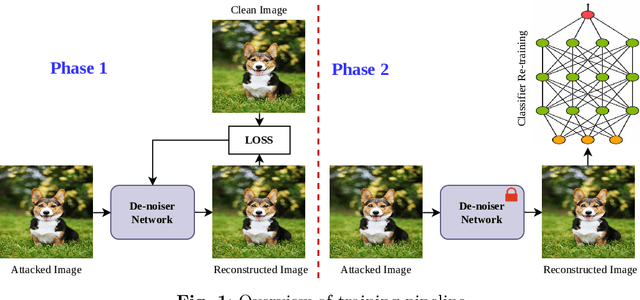
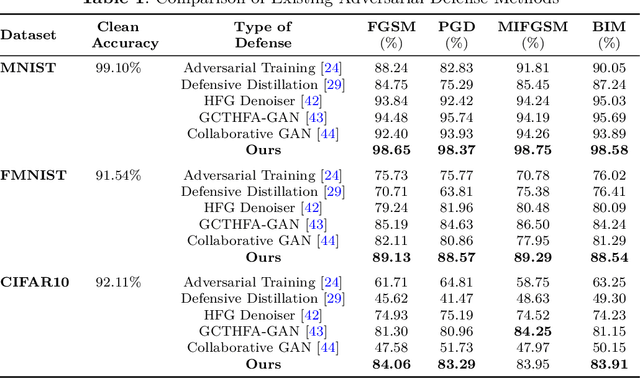
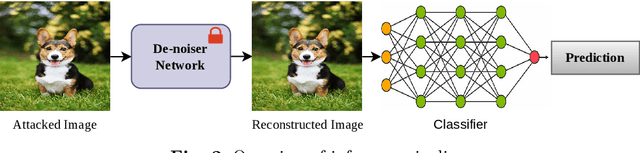
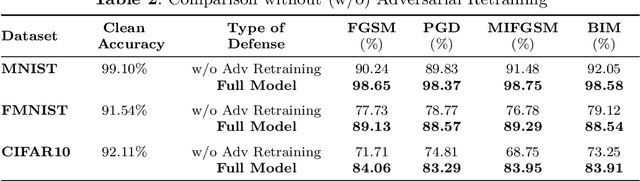
In recent times, deep neural networks (DNNs) have been successfully adopted for various applications. Despite their notable achievements, it has become evident that DNNs are vulnerable to sophisticated adversarial attacks, restricting their applications in security-critical systems. In this paper, we present two-phase training methods to tackle the attack: first, training the denoising network, and second, the deep classifier model. We propose a novel denoising strategy that integrates both spatial and frequency domain approaches to defend against adversarial attacks on images. Our analysis reveals that high-frequency components of attacked images are more severely corrupted compared to their lower-frequency counterparts. To address this, we leverage Discrete Wavelet Transform (DWT) for frequency analysis and develop a denoising network that combines spatial image features with wavelets through a transformer layer. Next, we retrain the classifier using the denoised images, which enhances the classifier's robustness against adversarial attacks. Experimental results across the MNIST, CIFAR-10, and Fashion-MNIST datasets reveal that the proposed method remarkably elevates classification accuracy, substantially exceeding the performance by utilizing a denoising network and adversarial training approaches. The code is available at https://github.com/Mayank94/Trans-Defense.