 Add to Chrome
 Add to Firefox
 Add to Edge
Hierarchy-Guided Topology Latent Flow for Molecular Graph Generation
Mar 28, 2026
Generating chemically valid 3D molecules is hindered by discrete bond topology: small local bond errors can cause global failures (valence violations, disconnections, implausible rings), especially for drug-like molecules with long-range constraints. Many unconditional 3D generators emphasize coordinates and then infer bonds or rely on post-processing, leaving topology feasibility weakly controlled. We propose Hierarchy-Guided Latent Topology Flow (HLTF), a planner-executor model that generates bond graphs with 3D coordinates, using a latent multi-scale plan for global context and a constraint-aware sampler to suppress topology-driven failures. On QM9, HLTF achieves 98.8% atom stability and 92.9% valid-and-unique, improving PoseBusters validity to 94.0% (+0.9 over the strongest reported baseline). On GEOM-DRUGS, HLTF attains 85.5%/85.0% validity/valid-unique-novel without post-processing and 92.2%/91.2% after standardized relaxation, within 0.9 points of the best post-processed baseline. Explicit topology generation also reduces "false-valid" samples that pass RDKit sanitization but fail stricter checks.

Property-Guided Molecular Generation and Optimization via Latent Flows
Mar 27, 2026Molecular discovery is increasingly framed as an inverse design problem: identifying molecular structures that satisfy desired property profiles under feasibility constraints. While recent generative models provide continuous latent representations of chemical space, targeted optimization within these representations often leads to degraded validity, loss of structural fidelity, or unstable behavior. We introduce MoltenFlow, a modular framework that combines property-organized latent representations with flow-matching generative priors and gradient-based guidance. This formulation supports both conditioned generation and local optimization within a single latent-space framework. We show that guided latent flows enable efficient multi-objective molecular optimization under fixed oracle budgets with controllable trade-offs, while a learned flow prior improves unconditional generation quality.
* 25 pages, 18 figures. Accepted to ICLR 2026 AI4Mat Workshop
AI-Guided Discovery of Novel Ionic Liquid Solvents for Industrial CO2 Capture
Jan 02, 2026We present an AI-driven approach to discover compounds with optimal properties for CO2 capture from flue gas-refinery emissions' primary source. Focusing on ionic liquids (ILs) as alternatives to traditional amine-based solvents, we successfully identify new IL candidates with high working capacity, manageable viscosity, favorable regeneration energy, and viable synthetic routes. Our approach follows a five-stage pipeline. First, we generate IL candidates by pairing available cation and anion molecules, then predict temperature- and pressure-dependent CO2 solubility and viscosity using a GNN-based molecular property prediction model. Next, we convert solubility to working capacity and regeneration energy via Van't Hoff modeling, and then find the best set of candidates using Pareto optimization, before finally filtering those based on feasible synthesis routes. We identify 36 feasible candidates that could enable 5-10% OPEX savings and up to 10% CAPEX reductions through lower regeneration energy requirements and reduced corrosivity-offering a novel carbon-capture strategy for refineries moving forward.
TEDDY: A Family Of Foundation Models For Understanding Single Cell Biology
Mar 05, 2025Understanding the biological mechanism of disease is critical for medicine, and in particular drug discovery. AI-powered analysis of genome-scale biological data hold great potential in this regard. The increasing availability of single-cell RNA sequencing data has enabled the development of large foundation models for disease biology. However, existing foundation models either do not improve or only modestly improve over task-specific models in downstream applications. Here, we explored two avenues for improving the state-of-the-art. First, we scaled the pre-training dataset to 116 million cells, which is larger than those used by previous models. Second, we leveraged the availability of large-scale biological annotations as a form of supervision during pre-training. We trained the TEDDY family of models comprising six transformer-based state-of-the-art single-cell foundation models with 70 million, 160 million, and 400 million parameters. We vetted our models on two downstream evaluation tasks -- identifying the underlying disease state of held-out donors not seen during training and distinguishing healthy cells from diseased ones for disease conditions and donors not seen during training. Scaling experiments showed that performance improved predictably with both data volume and parameter count. Our models showed substantial improvement over existing work on the first task and more muted improvements on the second.
Controllable Mixed-Initiative Dialogue Generation through Prompting
May 06, 2023
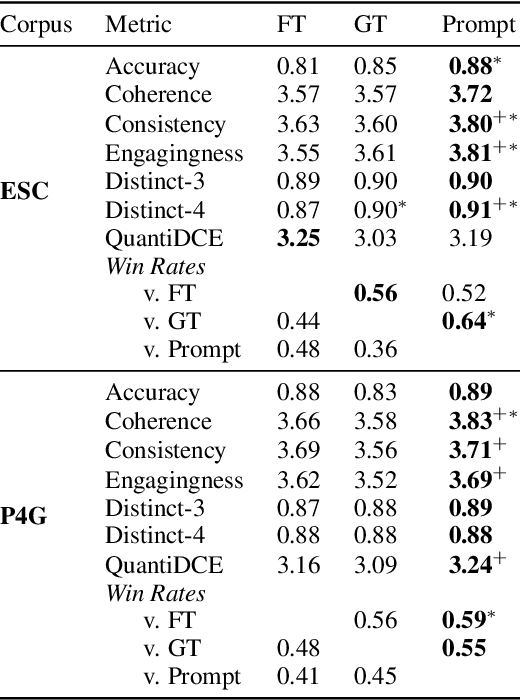
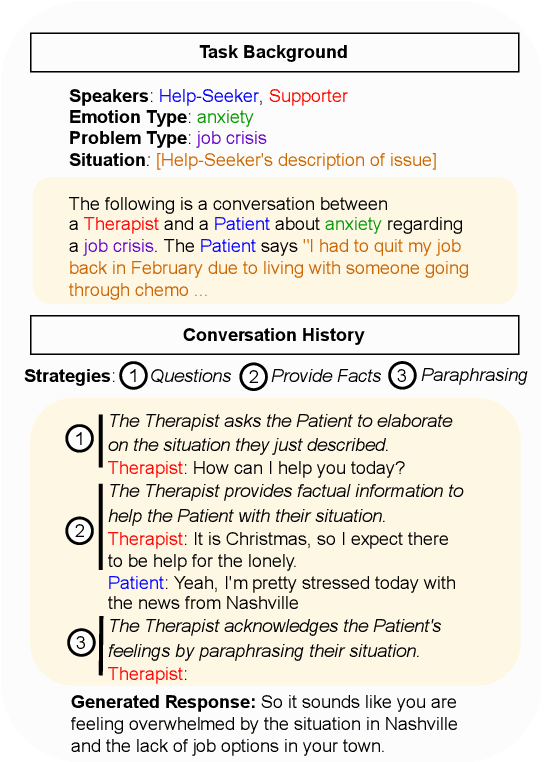
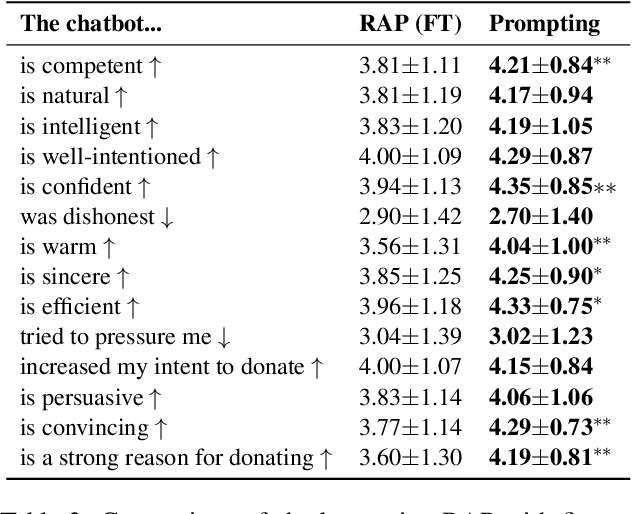
Mixed-initiative dialogue tasks involve repeated exchanges of information and conversational control. Conversational agents gain control by generating responses that follow particular dialogue intents or strategies, prescribed by a policy planner. The standard approach has been fine-tuning pre-trained language models to perform generation conditioned on these intents. However, these supervised generation models are limited by the cost and quality of data annotation. We instead prompt large language models as a drop-in replacement to fine-tuning on conditional generation. We formalize prompt construction for controllable mixed-initiative dialogue. Our findings show improvements over fine-tuning and ground truth responses according to human evaluation and automatic metrics for two tasks: PersuasionForGood and Emotional Support Conversations.