 Add to Chrome
 Add to Firefox
 Add to Edge
Score-Based Stabilization for Time-Dependent Problems
Jul 27, 2026
We propose a score-based stabilization framework for numerical simulation of partial differential equations, in which a learned score model defines a stabilization operator applied to provisional numerical updates. This operator augments standard time-stepping schemes by enforcing structure and physical consistency through a correction that drives iterates toward the manifold of admissible states. We show that the stabilization operator acts as a contraction toward this manifold, yielding a correction mechanism with basin-conditional stability. Numerical experiments on Advection, Korteweg-de Vries (KdV), Nonlinear Schrodinger (NLS), and Burgers' equations demonstrate improved robustness, suppression of nonphysical instabilities, and preservation of qualitative dynamics.

Faster gradient descent and the efficient recovery of images
Aug 12, 2013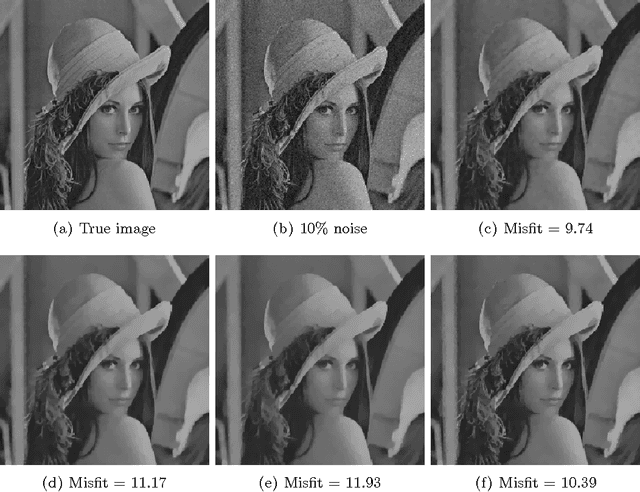
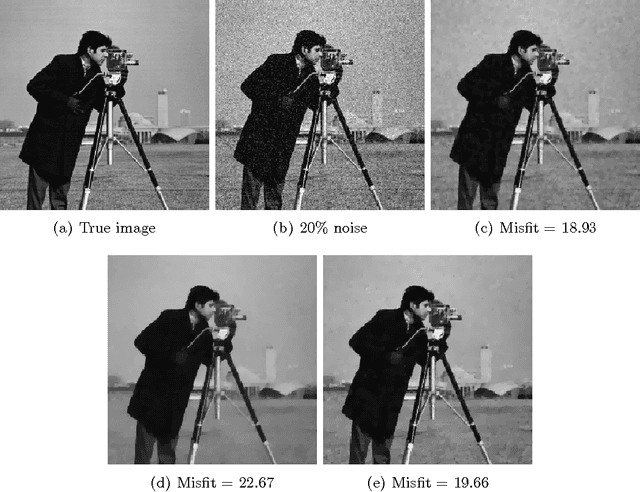
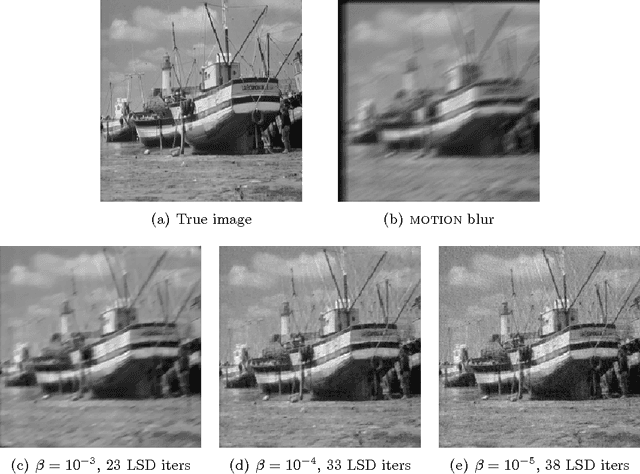
Much recent attention has been devoted to gradient descent algorithms where the steepest descent step size is replaced by a similar one from a previous iteration or gets updated only once every second step, thus forming a {\em faster gradient descent method}. For unconstrained convex quadratic optimization these methods can converge much faster than steepest descent. But the context of interest here is application to certain ill-posed inverse problems, where the steepest descent method is known to have a smoothing, regularizing effect, and where a strict optimization solution is not necessary. Specifically, in this paper we examine the effect of replacing steepest descent by a faster gradient descent algorithm in the practical context of image deblurring and denoising tasks. We also propose several highly efficient schemes for carrying out these tasks independently of the step size selection, as well as a scheme for the case where both blur and significant noise are present. In the above context there are situations where many steepest descent steps are required, thus building slowness into the solution procedure. Our general conclusion regarding gradient descent methods is that in such cases the faster gradient descent methods offer substantial advantages. In other situations where no such slowness buildup arises the steepest descent method can still be very effective.