 Add to Chrome
 Add to Firefox
 Add to Edge
Inference-Time Policy Alignment for Fair Reinforcement Learning
Jul 31, 2026
Deep reinforcement learning (RL) agents achieve strong performance by optimizing scalar reward functions. However, once deployed, the policies of these RL agents are often rigid and costly to adapt to new performance criteria. For instance, an agent trained to maximize expected cumulative reward may not accommodate previously unknown stakeholder preferences. Existing approaches to achieve fairness, a type of preference, in RL typically assume that such preferences are known a priori and require complete retraining of the policy under a fairness-oriented metric. Inspired by inference-time alignment in large language models, we investigate the problem of steering a pretrained RL policy toward welfare-based fairness objectives at inference time without updating the base policy's parameters. We formalize inference-time fairness alignment as a policy shaping problem and propose a multiplicative policy shaping framework that adjusts action probabilities using action-dependent welfare scores, thus requiring no modification to the base policy. Our framework is general and compatible with any deep RL agent. Through extensive experiments across multiple domains, we demonstrate that inference-time policy shaping substantially improves welfare-based fairness objectives while preserving core task performance.

Learning Fair Pareto-Optimal Policies in Multi-Objective Reinforcement Learning
Jun 16, 2026Fairness is an important aspect of decision-making in multi-objective reinforcement learning (MORL), where policies must ensure both optimality and equity across multiple, potentially conflicting objectives. While single-policy MORL methods can learn fair policies for fixed user preferences using welfare functions such as the generalized Gini welfare function (GGF), they fail to provide the diverse set of policies necessary for dynamic or unknown user preferences. To address this limitation, we formalize the fair optimization problem in multi-policy MORL, where the goal is to learn a set of Pareto-optimal policies that ensure fairness across all possible user preferences. Our key technical contributions are threefold: (1) We show that for concave, piecewise-linear welfare functions (e.g., GGF), fair policies remain in the convex coverage set (CCS), which is an approximated Pareto front for linear scalarization. (2) We demonstrate that non-stationary policies, augmented with accrued reward histories, and stochastic policies improve fairness by dynamically adapting to historical inequities. (3) We propose three novel algorithms, which include integrating GGF with multi-policy multi-objective Q-Learning (MOQL), state-augmented multi-policy MOQL for learning non-statoinary policies, and its novel extension for learning stochastic policies. We evaluate our algorithms across various domains and compare our methods against the state-of-the-art MORL baselines. The empirical results show that our methods learn a set of fair policies that accommodate different user preferences.
Adaptive Event-triggered Reinforcement Learning Control for Complex Nonlinear Systems
Sep 29, 2024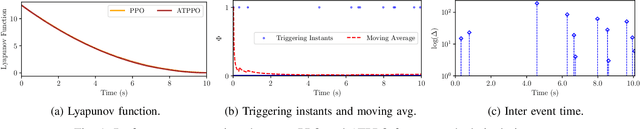
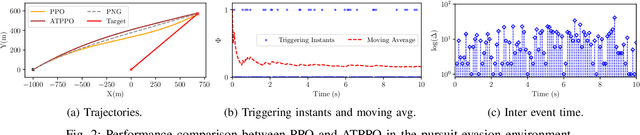
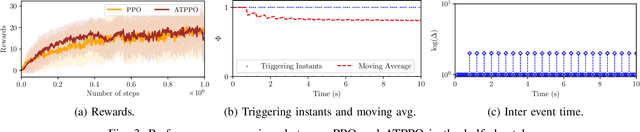
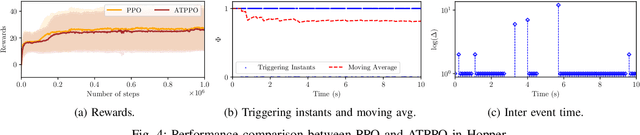
In this paper, we propose an adaptive event-triggered reinforcement learning control for continuous-time nonlinear systems, subject to bounded uncertainties, characterized by complex interactions. Specifically, the proposed method is capable of jointly learning both the control policy and the communication policy, thereby reducing the number of parameters and computational overhead when learning them separately or only one of them. By augmenting the state space with accrued rewards that represent the performance over the entire trajectory, we show that accurate and efficient determination of triggering conditions is possible without the need for explicit learning triggering conditions, thereby leading to an adaptive non-stationary policy. Finally, we provide several numerical examples to demonstrate the effectiveness of the proposed approach.
Fairness in Preference-based Reinforcement Learning
Jun 16, 2023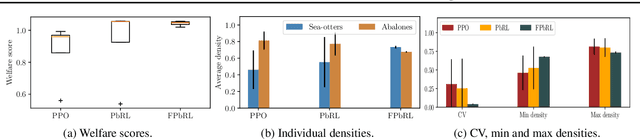
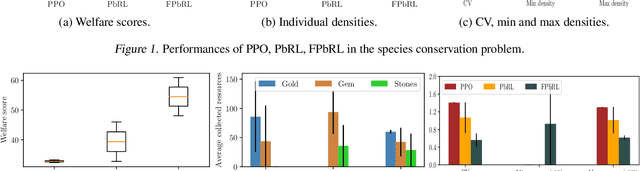
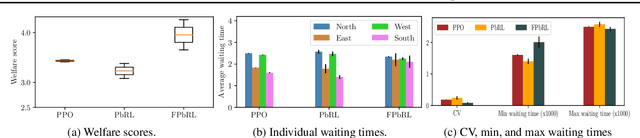
In this paper, we address the issue of fairness in preference-based reinforcement learning (PbRL) in the presence of multiple objectives. The main objective is to design control policies that can optimize multiple objectives while treating each objective fairly. Toward this objective, we design a new fairness-induced preference-based reinforcement learning or FPbRL. The main idea of FPbRL is to learn vector reward functions associated with multiple objectives via new welfare-based preferences rather than reward-based preference in PbRL, coupled with policy learning via maximizing a generalized Gini welfare function. Finally, we provide experiment studies on three different environments to show that the proposed FPbRL approach can achieve both efficiency and equity for learning effective and fair policies.
Learning Fair Policies in Decentralized Cooperative Multi-Agent Reinforcement Learning
Dec 17, 2020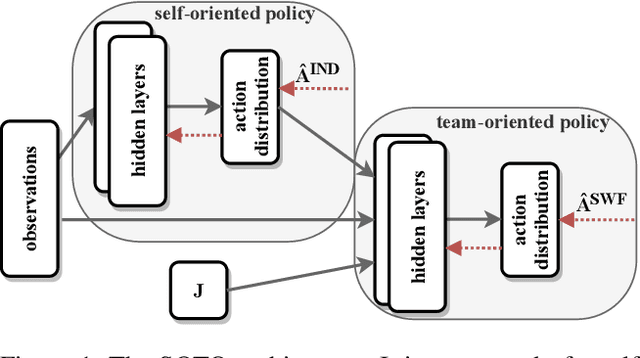
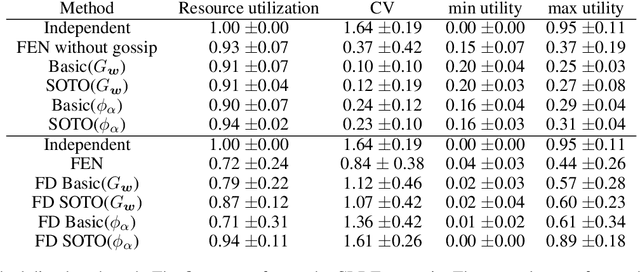
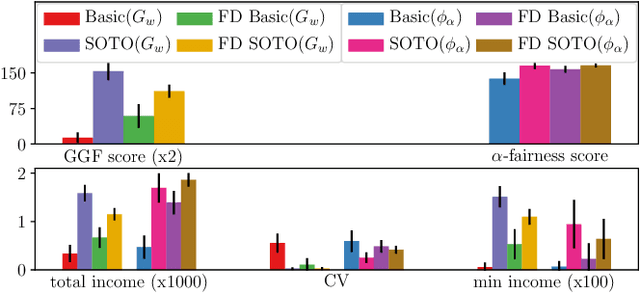
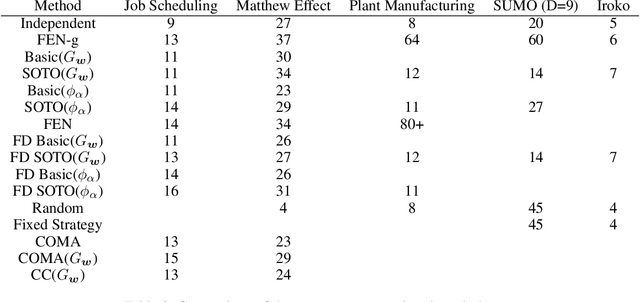
We consider the problem of learning fair policies in (deep) cooperative multi-agent reinforcement learning (MARL). We formalize it in a principled way as the problem of optimizing a welfare function that explicitly encodes two important aspects of fairness: efficiency and equity. As a solution method, we propose a novel neural network architecture, which is composed of two sub-networks specifically designed for taking into account the two aspects of fairness. In experiments, we demonstrate the importance of the two sub-networks for fair optimization. Our overall approach is general as it can accommodate any (sub)differentiable welfare function. Therefore, it is compatible with various notions of fairness that have been proposed in the literature (e.g., lexicographic maximin, generalized Gini social welfare function, proportional fairness). Our solution method is generic and can be implemented in various MARL settings: centralized training and decentralized execution, or fully decentralized. Finally, we experimentally validate our approach in various domains and show that it can perform much better than previous methods.
Learning Fair Policies in Multiobjective (Deep) Reinforcement Learning with Average and Discounted Rewards
Aug 18, 2020


As the operations of autonomous systems generally affect simultaneously several users, it is crucial that their designs account for fairness considerations. In contrast to standard (deep) reinforcement learning (RL), we investigate the problem of learning a policy that treats its users equitably. In this paper, we formulate this novel RL problem, in which an objective function, which encodes a notion of fairness that we formally define, is optimized. For this problem, we provide a theoretical discussion where we examine the case of discounted rewards and that of average rewards. During this analysis, we notably derive a new result in the standard RL setting, which is of independent interest: it states a novel bound on the approximation error with respect to the optimal average reward of that of a policy optimal for the discounted reward. Since learning with discounted rewards is generally easier, this discussion further justifies finding a fair policy for the average reward by learning a fair policy for the discounted reward. Thus, we describe how several classic deep RL algorithms can be adapted to our fair optimization problem, and we validate our approach with extensive experiments in three different domains.