 Add to Chrome
 Add to Firefox
 Add to Edge
Computing Thiele Rules on Interval Elections and their Generalizations
May 04, 2026
Approval-based committee voting has received significant attention in the social choice community. Among the studied rules, Thiele rules, and especially Proportional Approval Voting (PAV), stand out for desirable properties such as proportional representation, Pareto optimality, and support monotonicity. Their main drawback is that computing a Thiele outcome is NP-hard in general. A glimpse of hope comes from the fact that Thiele rules are better behaved under structured preferences. On the candidate interval (CI) domain, they are computable in polynomial time via a linear program (LP) that has a totally unimodular constraint matrix. Surprisingly, this approach fails for the related voter interval (VI) domain, and the complexity of the problem has repeatedly been posed as an open question. Our main result resolves this question: although the relevant matrix is not totally unimodular, the ``standard'' LP still admits at least one optimal integral solution, and we provide a fast algorithm for finding it. Our technique naturally extends to the voter-candidate interval (VCI) domain, also known as the 1-dimensional voter-candidate range (1D-VCR) domain, and to the linearly consistent (LC) domain, both of which generalize the candidate and voter interval domains. Although both the VCI and LC domains have been studied in social choice, their relationship was unknown. We show, through connections to graph theory, that LC strictly contains VCI. We also provide an alternative definition of LC that is closer in spirit to VCI and has a natural interpretation in approval elections; this equivalence may be of independent interest. Finally, we study an alternative tree-based generalization of VCI and show that Thiele rules become NP-hard to compute on this domain.

Dueling Bandits with Team Comparisons
Jul 06, 2021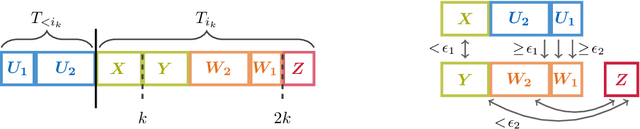
We introduce the dueling teams problem, a new online-learning setting in which the learner observes noisy comparisons of disjoint pairs of $k$-sized teams from a universe of $n$ players. The goal of the learner is to minimize the number of duels required to identify, with high probability, a Condorcet winning team, i.e., a team which wins against any other disjoint team (with probability at least $1/2$). Noisy comparisons are linked to a total order on the teams. We formalize our model by building upon the dueling bandits setting (Yue et al.2012) and provide several algorithms, both for stochastic and deterministic settings. For the stochastic setting, we provide a reduction to the classical dueling bandits setting, yielding an algorithm that identifies a Condorcet winning team within $\mathcal{O}((n + k \log (k)) \frac{\max(\log\log n, \log k)}{\Delta^2})$ duels, where $\Delta$ is a gap parameter. For deterministic feedback, we additionally present a gap-independent algorithm that identifies a Condorcet winning team within $\mathcal{O}(nk\log(k)+k^5)$ duels.