 Add to Chrome
 Add to Firefox
 Add to Edge
Empirical Evaluation of PDF Parsing and Chunking for Financial Question Answering with RAG
Apr 13, 2026
PDF files are primarily intended for human reading rather than automated processing. In addition, the heterogeneous content of PDFs, such as text, tables, and images, poses significant challenges for parsing and information extraction. To address these difficulties, both practitioners and researchers are increasingly developing new methods, including the promising Retrieval-Augmented Generation (RAG) systems to automated PDF processing. However, there is no comprehensive study investigating how different components and design choices affect the performance of a RAG system for understanding PDFs. In this paper, we propose such a study (1) by focusing on Question Answering, a specific language understanding task, and (2) by leveraging two benchmarks from the financial domain, including TableQuest, our newly generated, publicly available benchmark. We systematically examine multiple PDF parsers and chunking strategies (with varied overlap), along with their potential synergies in preserving document structure and ensuring answer correctness. Overall, our results offer practical guidelines for building robust RAG pipelines for PDF understanding.

CallNavi: A Study and Challenge on Function Calling Routing and Invocation in Large Language Models
Jan 09, 2025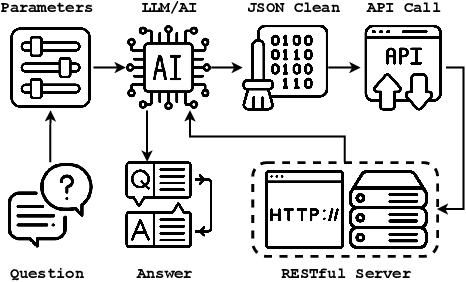
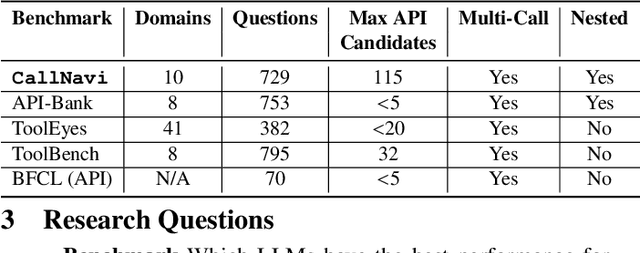
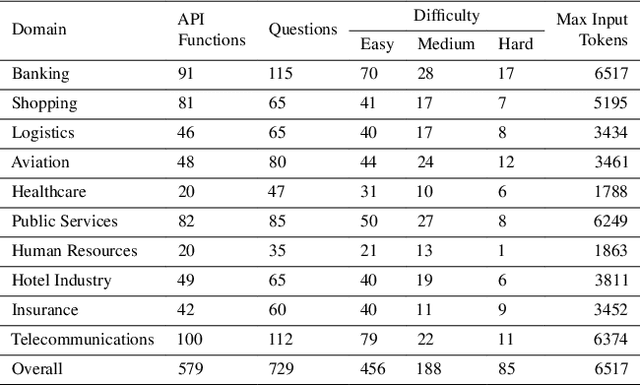
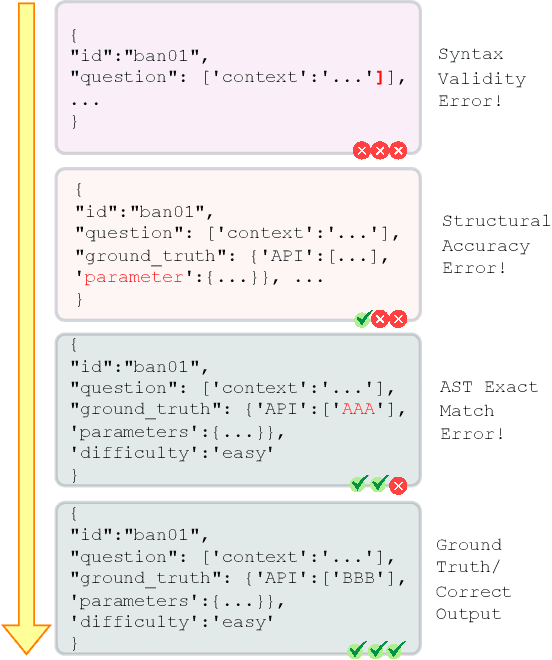
Interacting with a software system via a chatbot can be challenging, especially when the chatbot needs to generate API calls, in the right order and with the right parameters, to communicate with the system. API calling in chatbot systems poses significant challenges, particularly in complex, multi-step tasks requiring accurate API selection and execution. We contribute to this domain in three ways: first, by introducing a novel dataset designed to assess models on API function selection, parameter generation, and nested API calls; second, by benchmarking state-of-the-art language models across varying levels of complexity to evaluate their performance in API function generation and parameter accuracy; and third, by proposing an enhanced API routing method that combines general-purpose large language models for API selection with fine-tuned models for parameter generation and some prompt engineering approach. These approaches lead to substantial improvements in handling complex API tasks, offering practical advancements for real-world API-driven chatbot systems.