 Add to Chrome
 Add to Firefox
 Add to Edge
A Multi-Agent LLM Framework for Rating the Quality of Surgical Feedback
May 25, 2026
Verbal feedback delivered by attending surgeons in the operating room plays a critical formative role in resident trainee skill acquisition. Yet, assessing the quality of trainer feedback and its effectiveness in influencing trainee behavior during live surgery remains a challenge. Prior studies assessed feedback content relying on extensive manual annotation by expert human raters and focused on developing broad taxonomies that overlook the qualitative aspects of feedback delivery such as clarity or urgency. Limited existing automated methods, including keyword analysis and topic modeling, also fail to capture these nuanced aspects. We introduce a two-stage LLM-based framework that discovers interpretable feedback quality criteria grounded in the context of surgical training. Our method uses multi-agent prompting and surgical domain knowledge injection to discover a small set of human interpretable scoring criteria (e.g., Encouraging, Urgent, Clear). These criteria are then used to automatically score live surgical feedback via an LLM-as-a-judge approach. Evaluation on 4.2k trainer feedback instances demonstrates that our AI-discovered criteria outperform prior content-based frameworks in predicting feedback effectiveness, including observed trainee behavioral adjustments and trainer approval. This work advances scalable, human-aligned assessment of communication quality in the operating room and provides a foundation for improving surgical teaching practices.

End to End AI System for Surgical Gesture Sequence Recognition and Clinical Outcome Prediction
Nov 14, 2025Fine-grained analysis of intraoperative behavior and its impact on patient outcomes remain a longstanding challenge. We present Frame-to-Outcome (F2O), an end-to-end system that translates tissue dissection videos into gesture sequences and uncovers patterns associated with postoperative outcomes. Leveraging transformer-based spatial and temporal modeling and frame-wise classification, F2O robustly detects consecutive short (~2 seconds) gestures in the nerve-sparing step of robot-assisted radical prostatectomy (AUC: 0.80 frame-level; 0.81 video-level). F2O-derived features (gesture frequency, duration, and transitions) predicted postoperative outcomes with accuracy comparable to human annotations (0.79 vs. 0.75; overlapping 95% CI). Across 25 shared features, effect size directions were concordant with small differences (~ 0.07), and strong correlation (r = 0.96, p < 1e-14). F2O also captured key patterns linked to erectile function recovery, including prolonged tissue peeling and reduced energy use. By enabling automatic interpretable assessment, F2O establishes a foundation for data-driven surgical feedback and prospective clinical decision support.
Privacy Aware Question-Answering System for Online Mental Health Risk Assessment
Jun 09, 2023
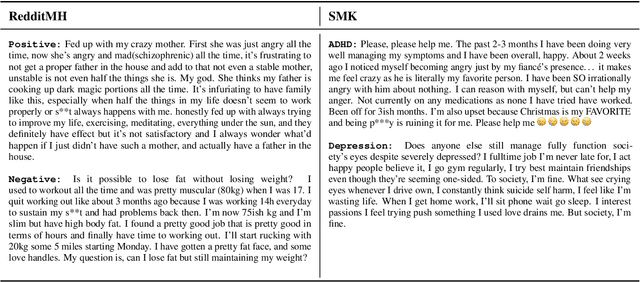
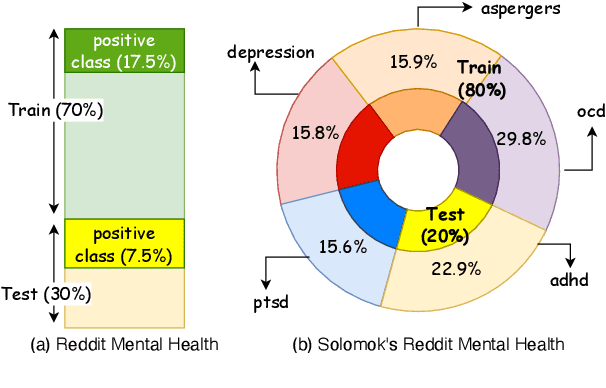
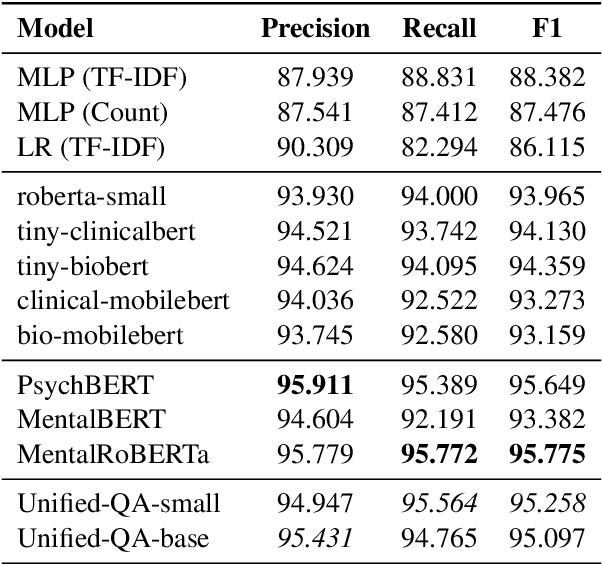
Social media platforms have enabled individuals suffering from mental illnesses to share their lived experiences and find the online support necessary to cope. However, many users fail to receive genuine clinical support, thus exacerbating their symptoms. Screening users based on what they post online can aid providers in administering targeted healthcare and minimize false positives. Pre-trained Language Models (LMs) can assess users' social media data and classify them in terms of their mental health risk. We propose a Question-Answering (QA) approach to assess mental health risk using the Unified-QA model on two large mental health datasets. To protect user data, we extend Unified-QA by anonymizing the model training process using differential privacy. Our results demonstrate the effectiveness of modeling risk assessment as a QA task, specifically for mental health use cases. Furthermore, the model's performance decreases by less than 1% with the inclusion of differential privacy. The proposed system's performance is indicative of a promising research direction that will lead to the development of privacy-aware diagnostic systems.