 Add to Chrome
 Add to Firefox
 Add to Edge
Exploiting Separability in Multi-Scale Grey-Box Bayesian Optimization
Aug 04, 2026
We consider grey-box optimization problems where the decision variables naturally partition into black-box variables (as arguments to an expensive black-box function) and white-box variables, governed by a set of explicit, closed-form equations that also depend on the output of the black-box function. We exploit this separability through a bilevel reformulation: an outer Bayesian optimization (BO) to optimize the scalar objective as a function of black-box variables alone, while an inner problem solves the white-box subproblem via global optimization. The Gaussian process surrogate used in BO is therefore defined rather than and white-box constraints are satisfied exactly whenever the inner optimizer converges to a feasible point---without penalty functions, chance constraints, or moment approximations. On a suite of 13 benchmark problems, bilevel BO achieves lower regret, with fewer iterations and wall clock time. This advantage is robust to initialization set size, exploration parameters, and inner-solver choice.

Topological Data Analysis for High-Dimensional Dynamic Process Monitoring
Jun 18, 2026Real-time process monitoring requires methods that extract actionable information from high-dimensional time-series data. In this work, we present a new approach for process monitoring that combines tools of topological data analysis (TDA) and machine learning. In the proposed approach, we represent multivariate time-series data as manifolds and use topological descriptors to summarize the structure of such data; we then use a neural ordinary differential equation to learn the dynamic evolution of the topological structure of the system. Using real data from an industrial process, we show that this trajectory-based event detection approach is effective at detecting diverse types of events. We contrast this approach against reconstruction-based approaches such as principal component analysis and autoencoders and against a trajectory-based approach that uses Koopman autoencoders.
Using the SEKF to Transfer NN Models of Dynamical Systems with Limited Data
Mar 02, 2026Data-driven models of dynamical systems require extensive amounts of training data. For many practical applications, gathering sufficient data is not feasible due to cost or safety concerns. This work uses the Subset Extended Kalman Filter (SEKF) to adapt pre-trained neural network models to new, similar systems with limited data available. Experimental validation across damped spring and continuous stirred-tank reactor systems demonstrates that small parameter perturbations to the initial model capture target system dynamics while requiring as little as 1% of original training data. In addition, finetuning requires less computational cost and reduces generalization error.
SAFE-OCC: A Novelty Detection Framework for Convolutional Neural Network Sensors and its Application in Process Control
Feb 03, 2022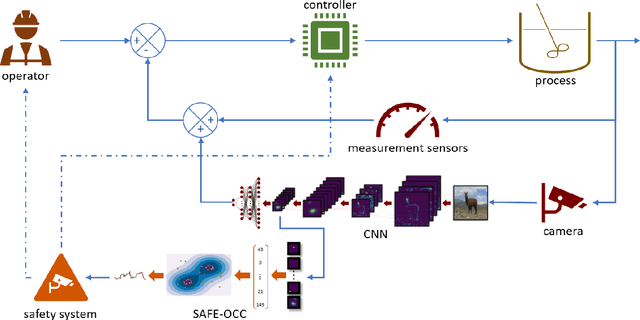
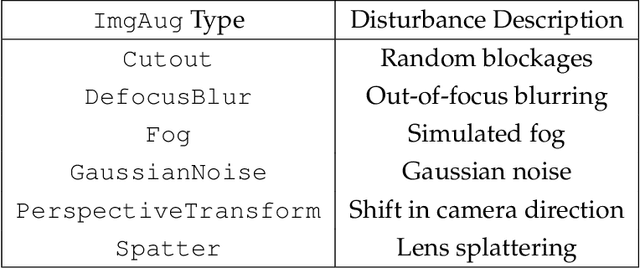
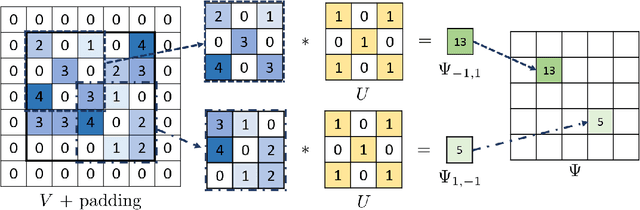
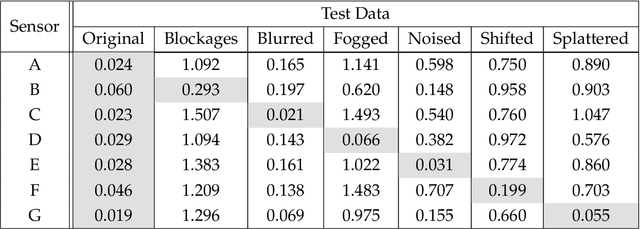
We present a novelty detection framework for Convolutional Neural Network (CNN) sensors that we call Sensor-Activated Feature Extraction One-Class Classification (SAFE-OCC). We show that this framework enables the safe use of computer vision sensors in process control architectures. Emergent control applications use CNN models to map visual data to a state signal that can be interpreted by the controller. Incorporating such sensors introduces a significant system operation vulnerability because CNN sensors can exhibit high prediction errors when exposed to novel (abnormal) visual data. Unfortunately, identifying such novelties in real-time is nontrivial. To address this issue, the SAFE-OCC framework leverages the convolutional blocks of the CNN to create an effective feature space to conduct novelty detection using a desired one-class classification technique. This approach engenders a feature space that directly corresponds to that used by the CNN sensor and avoids the need to derive an independent latent space. We demonstrate the effectiveness of SAFE-OCC via simulated control environments.