 Add to Chrome
 Add to Firefox
 Add to Edge
Using the SEKF to Transfer NN Models of Dynamical Systems with Limited Data
Mar 02, 2026
Data-driven models of dynamical systems require extensive amounts of training data. For many practical applications, gathering sufficient data is not feasible due to cost or safety concerns. This work uses the Subset Extended Kalman Filter (SEKF) to adapt pre-trained neural network models to new, similar systems with limited data available. Experimental validation across damped spring and continuous stirred-tank reactor systems demonstrates that small parameter perturbations to the initial model capture target system dynamics while requiring as little as 1% of original training data. In addition, finetuning requires less computational cost and reduces generalization error.

Short-Term Solar Irradiance Forecasting Under Data Transmission Constraints
Mar 19, 2024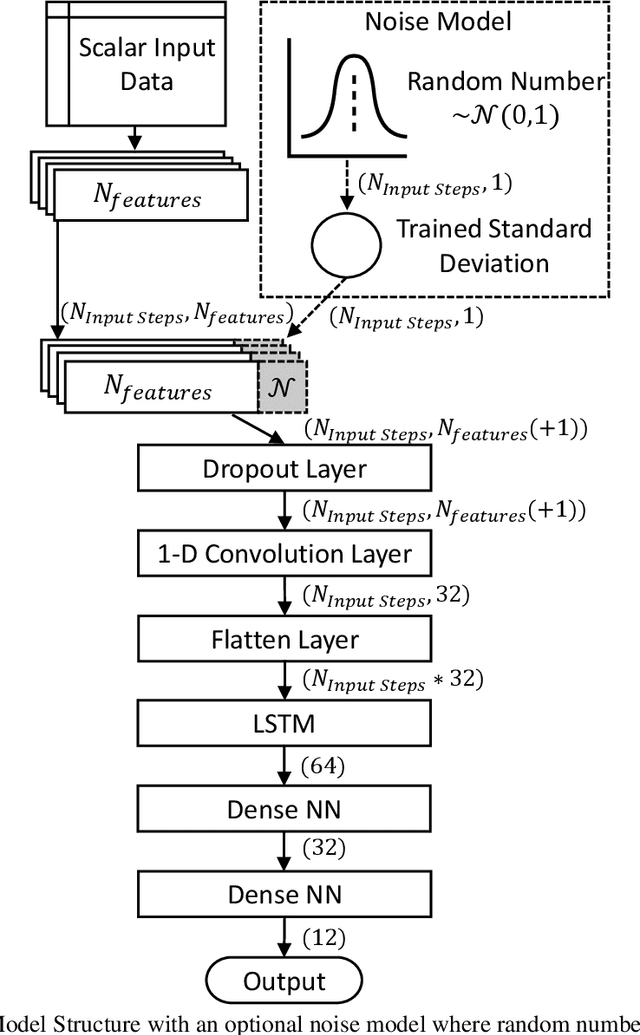


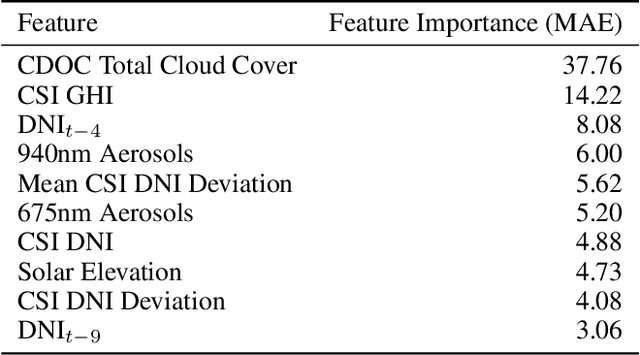
We report a data-parsimonious machine learning model for short-term forecasting of solar irradiance. The model inputs include sky camera images that are reduced to scalar features to meet data transmission constraints. The output irradiance values are transformed to focus on unknown short-term dynamics. Inspired by control theory, a noise input is used to reflect unmeasured variables and is shown to improve model predictions, often considerably. Five years of data from the NREL Solar Radiation Research Laboratory were used to create three rolling train-validate sets and determine the best representations for time, the optimal span of input measurements, and the most impactful model input data (features). For the chosen test data, the model achieves a mean absolute error of 74.34 $W/m^2$ compared to a baseline 134.35 $W/m^2$ using the persistence of cloudiness model.