 Add to Chrome
 Add to Firefox
 Add to Edge
Cross Modality Image Translation In Medical Imaging Using Generative Frameworks
May 13, 2026
Medical image-to-image (I2I) translation enables virtual scanning, i.e. the synthesis of a target imaging modality from a source one without additional acquisitions. Despite growing interest, most proposed methods operate on 2D slices, are evaluated on isolated tasks with different experimental set-ups and lack clinical validation. The primary contribution of this work is a reproducible, standardized comparative evaluation of 3D I2I translation methods in oncological imaging, designed to standardize preprocessing, splitting, inference, and multi-level evaluation across heterogeneous clinical tasks. Within this framework, we compare seven generative models, three Generative Adversarial Networks (GANs: Pix2Pix, CycleGAN, SRGAN) and four latent generative models (Latent Diffusion Model, Latent Diffusion Model+ControlNet, Brownian Bridge, Flow Matching), across eleven datasets spanning three anatomical regions (head/neck, lung, pelvis) and four translation directions (cone-beam CT to CT, MRI to CT, CT to PET, MRI T2-weighted to T2-FLAIR), for a total of 77 experiments under uniform training, inference, and evaluation conditions. The results show that GANs outperform latent generative models across all tasks, with SRGAN achieving statistically significant superiority. Our lesion-level analysis reveals that all models struggle with small lesions and that, in CT to PET synthesis, models reproduce lesion shape more reliably than absolute uptake-related intensity. We also performed a Visual Turing test administered to 17 physicians, including 15 radiologists, which shows near-chance classification accuracy (56.7%), confirming that synthetic volumes are largely indistinguishable from real acquisitions, while exposing a dissociation between quantitative metrics and clinical preference.

TotalSegmentator MRI: Sequence-Independent Segmentation of 59 Anatomical Structures in MR images
May 29, 2024


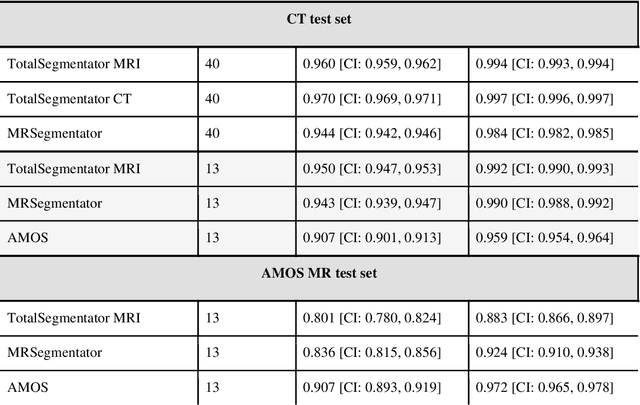
Purpose: To develop an open-source and easy-to-use segmentation model that can automatically and robustly segment most major anatomical structures in MR images independently of the MR sequence. Materials and Methods: In this study we extended the capabilities of TotalSegmentator to MR images. 298 MR scans and 227 CT scans were used to segment 59 anatomical structures (20 organs, 18 bones, 11 muscles, 7 vessels, 3 tissue types) relevant for use cases such as organ volumetry, disease characterization, and surgical planning. The MR and CT images were randomly sampled from routine clinical studies and thus represent a real-world dataset (different ages, pathologies, scanners, body parts, sequences, contrasts, echo times, repetition times, field strengths, slice thicknesses and sites). We trained an nnU-Net segmentation algorithm on this dataset and calculated Dice similarity coefficients (Dice) to evaluate the model's performance. Results: The model showed a Dice score of 0.824 (CI: 0.801, 0.842) on the test set, which included a wide range of clinical data with major pathologies. The model significantly outperformed two other publicly available segmentation models (Dice score, 0.824 versus 0.762; p<0.001 and 0.762 versus 0.542; p<0.001). On the CT image test set of the original TotalSegmentator paper it almost matches the performance of the original TotalSegmentator (Dice score, 0.960 versus 0.970; p<0.001). Conclusion: Our proposed model extends the capabilities of TotalSegmentator to MR images. The annotated dataset (https://zenodo.org/doi/10.5281/zenodo.11367004) and open-source toolkit (https://www.github.com/wasserth/TotalSegmentator) are publicly available.