 Add to Chrome
 Add to Firefox
 Add to Edge
Synthetic Clinical Notes for Rare ICD Codes: A Data-Centric Framework for Long-Tail Medical Coding
Nov 18, 2025
Automatic ICD coding from clinical text is a critical task in medical NLP but remains hindered by the extreme long-tail distribution of diagnostic codes. Thousands of rare and zero-shot ICD codes are severely underrepresented in datasets like MIMIC-III, leading to low macro-F1 scores. In this work, we propose a data-centric framework that generates high-quality synthetic discharge summaries to mitigate this imbalance. Our method constructs realistic multi-label code sets anchored on rare codes by leveraging real-world co-occurrence patterns, ICD descriptions, synonyms, taxonomy, and similar clinical notes. Using these structured prompts, we generate 90,000 synthetic notes covering 7,902 ICD codes, significantly expanding the training distribution. We fine-tune two state-of-the-art transformer-based models, PLM-ICD and GKI-ICD, on both the original and extended datasets. Experiments show that our approach modestly improves macro-F1 while maintaining strong micro-F1, outperforming prior SOTA. While the gain may seem marginal relative to the computational cost, our results demonstrate that carefully crafted synthetic data can enhance equity in long-tail ICD code prediction.

CURE: Cultural Understanding and Reasoning Evaluation - A Framework for "Thick" Culture Alignment Evaluation in LLMs
Nov 15, 2025Large language models (LLMs) are increasingly deployed in culturally diverse environments, yet existing evaluations of cultural competence remain limited. Existing methods focus on de-contextualized correctness or forced-choice judgments, overlooking the need for cultural understanding and reasoning required for appropriate responses. To address this gap, we introduce a set of benchmarks that, instead of directly probing abstract norms or isolated statements, present models with realistic situational contexts that require culturally grounded reasoning. In addition to the standard Exact Match metric, we introduce four complementary metrics (Coverage, Specificity, Connotation, and Coherence) to capture different dimensions of model's response quality. Empirical analysis across frontier models reveals that thin evaluation systematically overestimates cultural competence and produces unstable assessments with high variance. In contrast, thick evaluation exposes differences in reasoning depth, reduces variance, and provides more stable, interpretable signals of cultural understanding.
Subgrid BoostCNN: Efficient Boosting of Convolutional Networks via Gradient-Guided Feature Selection
Jul 30, 2025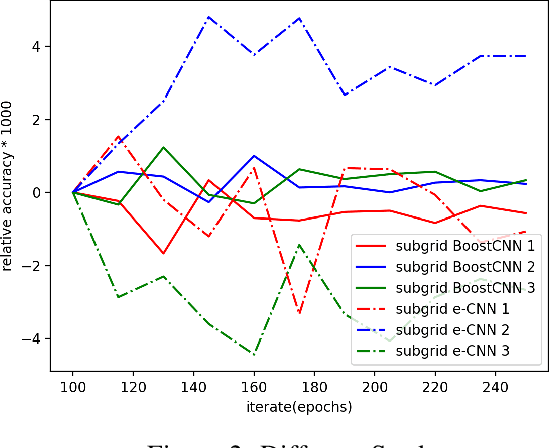
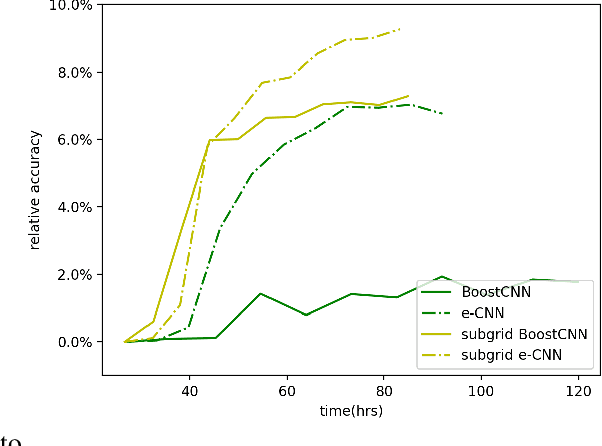
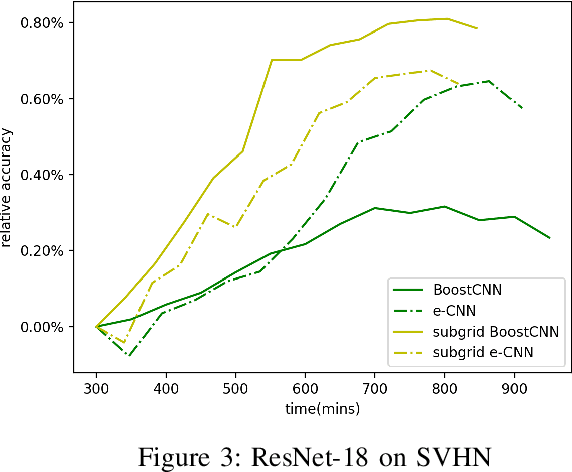
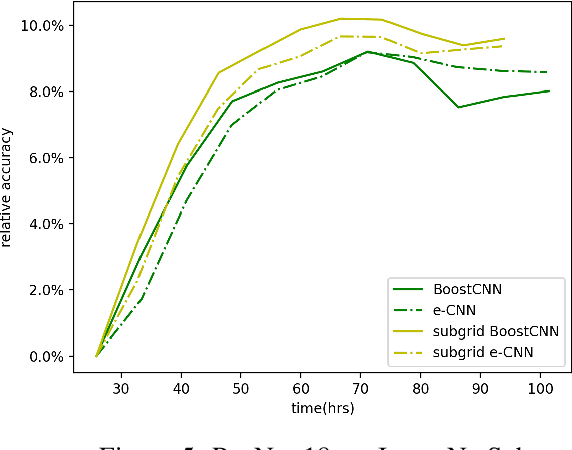
Convolutional Neural Networks (CNNs) have achieved remarkable success across a wide range of machine learning tasks by leveraging hierarchical feature learning through deep architectures. However, the large number of layers and millions of parameters often make CNNs computationally expensive to train, requiring extensive time and manual tuning to discover optimal architectures. In this paper, we introduce a novel framework for boosting CNN performance that integrates dynamic feature selection with the principles of BoostCNN. Our approach incorporates two key strategies: subgrid selection and importance sampling, to guide training toward informative regions of the feature space. We further develop a family of algorithms that embed boosting weights directly into the network training process using a least squares loss formulation. This integration not only alleviates the burden of manual architecture design but also enhances accuracy and efficiency. Experimental results across several fine-grained classification benchmarks demonstrate that our boosted CNN variants consistently outperform conventional CNNs in both predictive performance and training speed.