 Add to Chrome
 Add to Firefox
 Add to Edge
Chunk-wise Attention Transducers for Fast and Accurate Streaming Speech-to-Text
Feb 27, 2026
We propose Chunk-wise Attention Transducer (CHAT), a novel extension to RNN-T models that processes audio in fixed-size chunks while employing cross-attention within each chunk. This hybrid approach maintains RNN-T's streaming capability while introducing controlled flexibility for local alignment modeling. CHAT significantly reduces the temporal dimension that RNN-T must handle, yielding substantial efficiency improvements: up to 46.2% reduction in peak training memory, up to 1.36X faster training, and up to 1.69X faster inference. Alongside these efficiency gains, CHAT achieves consistent accuracy improvements over RNN-T across multiple languages and tasks -- up to 6.3% relative WER reduction for speech recognition and up to 18.0% BLEU improvement for speech translation. The method proves particularly effective for speech translation, where RNN-T's strict monotonic alignment hurts performance. Our results demonstrate that the CHAT model offers a practical solution for deploying more capable streaming speech models without sacrificing real-time constraints.

Three-in-One: Fast and Accurate Transducer for Hybrid-Autoregressive ASR
Oct 03, 2024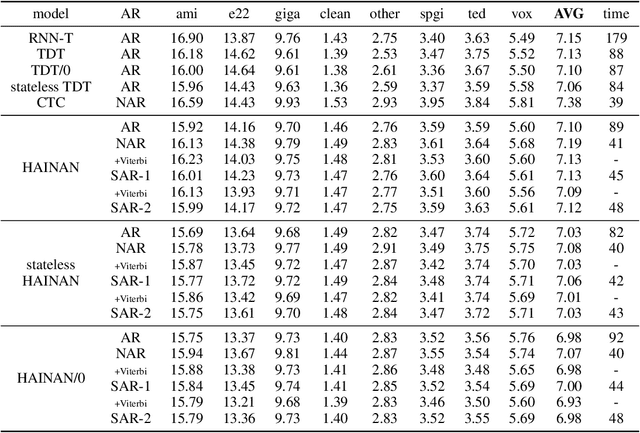
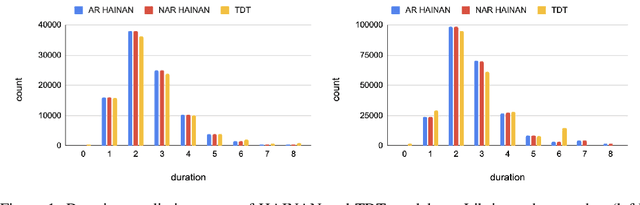
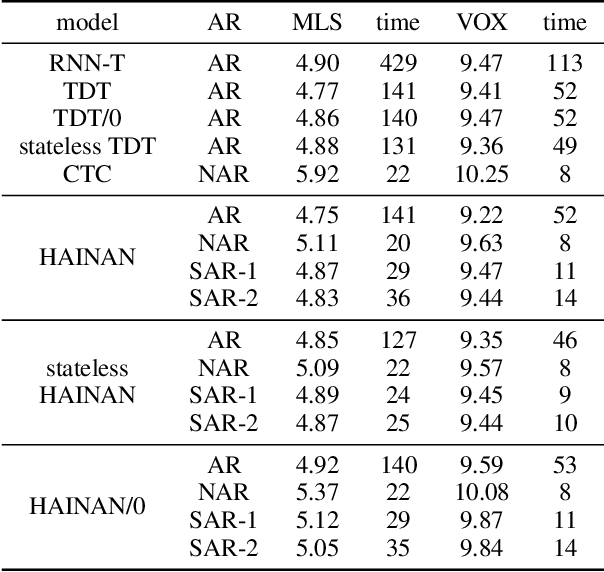
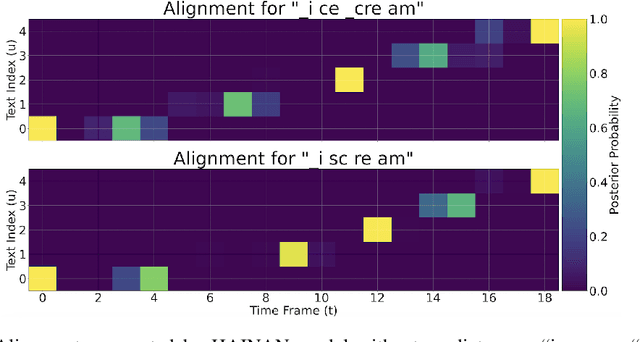
We present \textbf{H}ybrid-\textbf{A}utoregressive \textbf{IN}ference Tr\textbf{AN}sducers (HAINAN), a novel architecture for speech recognition that extends the Token-and-Duration Transducer (TDT) model. Trained with randomly masked predictor network outputs, HAINAN supports both autoregressive inference with all network components and non-autoregressive inference without the predictor. Additionally, we propose a novel semi-autoregressive inference paradigm that first generates an initial hypothesis using non-autoregressive inference, followed by refinement steps where each token prediction is regenerated using parallelized autoregression on the initial hypothesis. Experiments on multiple datasets across different languages demonstrate that HAINAN achieves efficiency parity with CTC in non-autoregressive mode and with TDT in autoregressive mode. In terms of accuracy, autoregressive HAINAN outperforms TDT and RNN-T, while non-autoregressive HAINAN significantly outperforms CTC. Semi-autoregressive inference further enhances the model's accuracy with minimal computational overhead, and even outperforms TDT results in some cases. These results highlight HAINAN's flexibility in balancing accuracy and speed, positioning it as a strong candidate for real-world speech recognition applications.
A Chat About Boring Problems: Studying GPT-based text normalization
Sep 23, 2023Text normalization - the conversion of text from written to spoken form - is traditionally assumed to be an ill-formed task for language models. In this work, we argue otherwise. We empirically show the capacity of Large-Language Models (LLM) for text normalization in few-shot scenarios. Combining self-consistency reasoning with linguistic-informed prompt engineering, we find LLM based text normalization to achieve error rates around 40\% lower than top normalization systems. Further, upon error analysis, we note key limitations in the conventional design of text normalization tasks. We create a new taxonomy of text normalization errors and apply it to results from GPT-3.5-Turbo and GPT-4.0. Through this new framework, we can identify strengths and weaknesses of GPT-based TN, opening opportunities for future work.
Accidental Learners: Spoken Language Identification in Multilingual Self-Supervised Models
Nov 09, 2022In this paper, we extend previous self-supervised approaches for language identification by experimenting with Conformer based architecture in a multilingual pre-training paradigm. We find that pre-trained speech models optimally encode language discriminatory information in lower layers. Further, we demonstrate that the embeddings obtained from these layers are significantly robust to classify unseen languages and different acoustic environments without additional training. After fine-tuning a pre-trained Conformer model on the VoxLingua107 dataset, we achieve results similar to current state-of-the-art systems for language identification. More, our model accomplishes this with 5x less parameters. We open-source the model through the NVIDIA NeMo toolkit.