 Add to Chrome
 Add to Firefox
 Add to Edge
Deep Adaptive Rate Allocation in Volatile Heterogeneous Wireless Networks
Mar 21, 2026
Modern multi-access 5G+ networks provide mobile terminals with additional capacity, improving network stability and performance. However, in highly mobile environments such as vehicular networks, supporting multi-access connectivity remains challenging. The rapid fluctuations of wireless link quality often outpace the responsiveness of existing multipath schedulers and transport-layer protocols. This paper addresses this challenge by integrating Transformer-based path state forecasting with a new multipath splitting scheduler called Deep Adaptive Rate Allocation (DARA). The proposed scheduler employs a deep reinforcement learning engine to dynamically compute optimal congestion window fractions on available paths, determining data allocation among them. A six-component normalised reward function with weight-mediated conflict resolution drives a DQN policy that eliminates the observation-reaction lag inherent in reactive schedulers. Performance evaluation uses a Mininet-based Multipath Datagram Congestion Control Protocol testbed with traces from mobile users in vehicular environments. Experimental results demonstrate that DARA achieves better file transfer time reductions compared to learning-based schedulers under moderate-volatility traces. For buffered video streaming, resolution improvements are maintained across all tested conditions. Under controlled burst scenarios with sub-second buffer constraints, DARA achieves substantial rebuffering improvements whilst state-of-the-art schedulers exhibit near-continuous stalling.

Semantic Communications in Networked Systems
Mar 09, 2021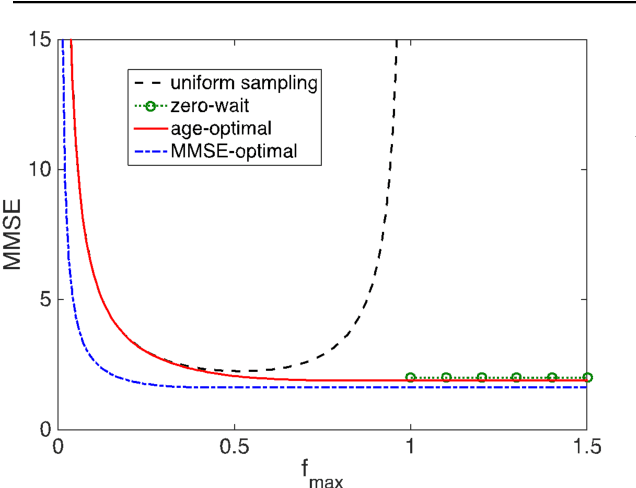
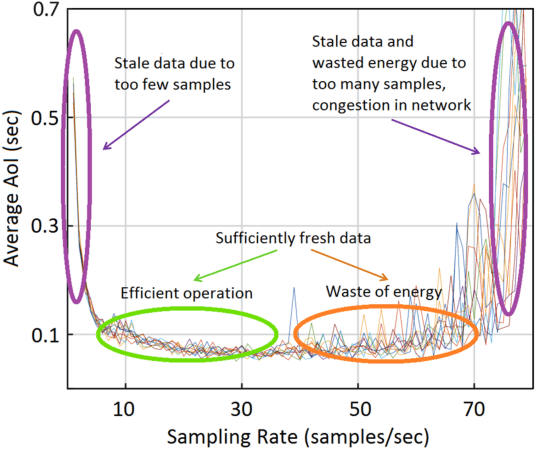
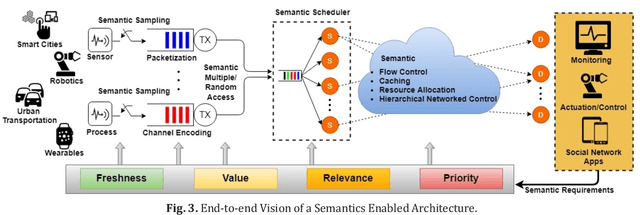
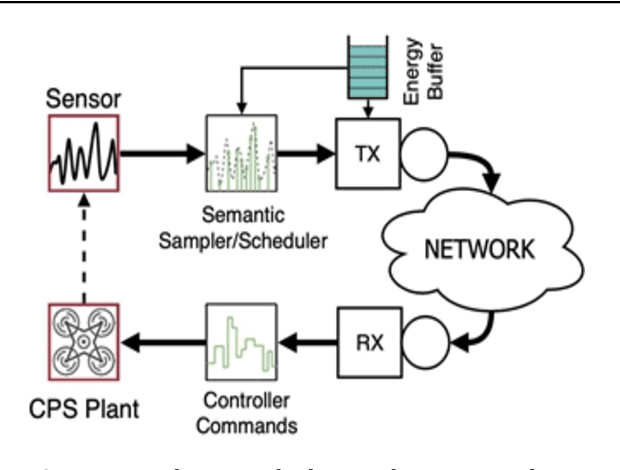
We present our vision for a departure from the established way of architecting and assessing communication networks, by incorporating the semantics of information for communications and control in networked systems. We define semantics of information, not as the meaning of the messages, but as their significance, possibly within a real time constraint, relative to the purpose of the data exchange. We argue that research efforts must focus on laying the theoretical foundations of a redesign of the entire process of information generation, transmission and usage in unison by developing: advanced semantic metrics for communications and control systems; an optimal sampling theory combining signal sparsity and semantics, for real-time prediction, reconstruction and control under communication constraints and delays; semantic compressed sensing techniques for decision making and inference directly in the compressed domain; semantic-aware data generation, channel coding, feedback, multiple and random access schemes that reduce the volume of data and the energy consumption, increasing the number of supportable devices.